






 Portuguese
  Spanish
  3 min of reading
  0 comments


Taiwan Announces The Development Of A Next-Generation Hypersonic Missile Capable Of Reaching 6 Times The Speed Of Sound, Strengthening Its National Defense.
Taiwan has taken a strategic step in its national defense by developing an advanced hypersonic missile named Qingtian. With the ability to reach speeds of Mach 6, equivalent to six times the speed of sound, this weapon places the country in an elite group of nations that possess this cutting-edge military technology.
The announcement comes amid rising tensions with China, which regards Taiwan as a renegade province and has intensified actions in the Indo-Pacific region.
Details Of The Qingtian Missile
According to information released by Liberty Time Net, the Qingtian is already being mass-produced and will be integrated into Taiwan’s military shortly.
-
Israel finds Hezbollah militarized tunnel over 200 meters long under village, with 4 missile launch shafts, 12 chambers, anti-tank missiles, drones, and weapons depots at a depth of 25 meters.

-
Ukraine launches largest drone attack on Moscow since 2022, Russia claims to have intercepted nearly 200 aircraft near the capital, Kapotnya refinery targeted again, and offensive reignites alert about war reaching the Russian energy heart just a few kilometers from the Kremlin.

-
Truck drivers, freight, and fines from 2022 take center stage in politics: Chamber approves MP with amnesty, mandatory tracking by CIOT, million-dollar penalties, and new minimum wage for those who spend more than 24 hours on the road.

-
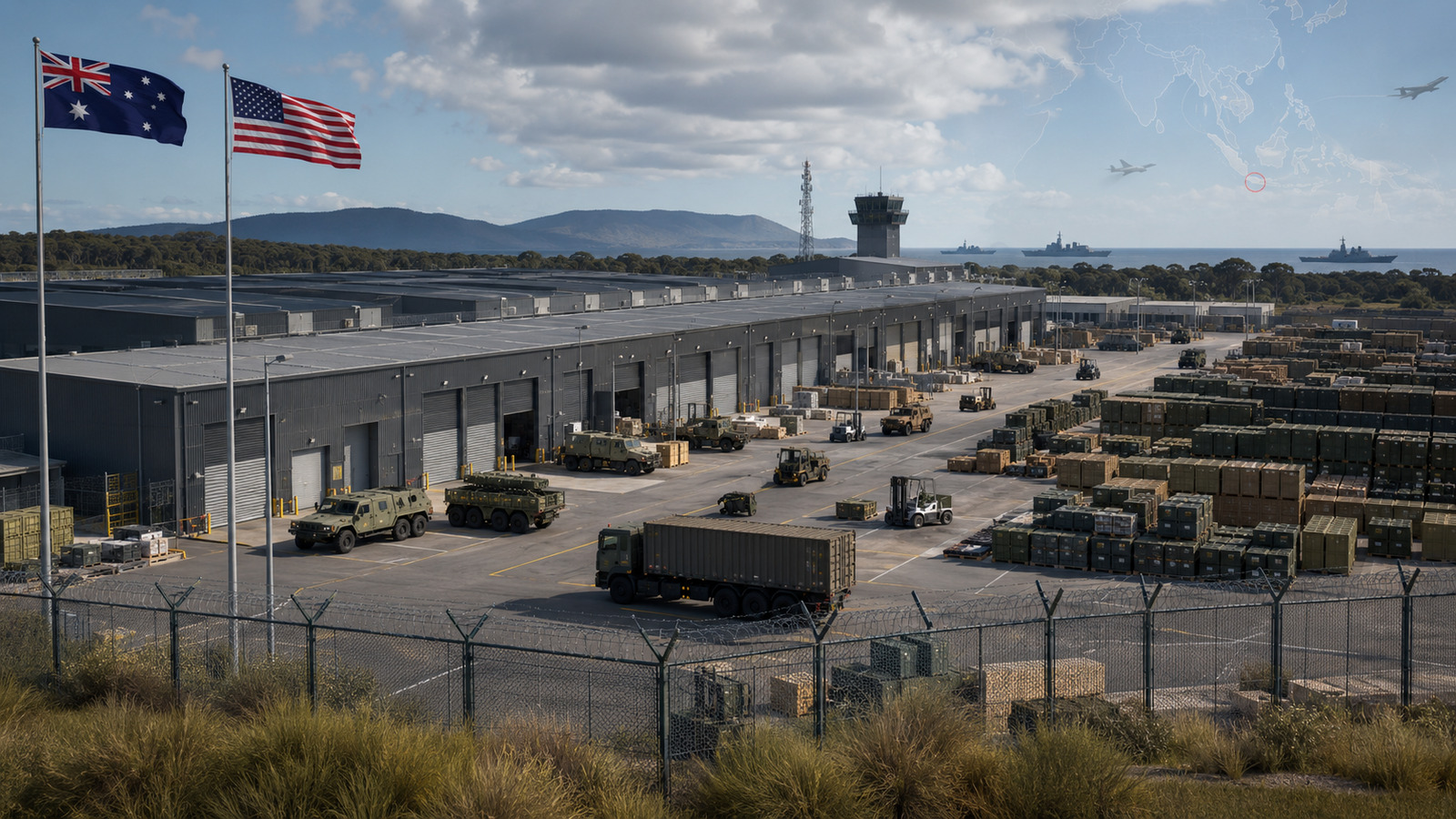
China off the radar: US plans mega $30 million weapons depot in Australia, out of reach of most Chinese missiles, with full capacity expected by 2028



The missile has an impressive range of over 2,000 kilometers, allowing it to strike strategic targets in distant regions.
The development of the Qingtian was led by the National Chung-Shan Institute of Science and Technology (NCSIST), supported by the “National Defense Advanced Technology Research Plan” of the Ministry of National Defense of Taiwan.

Sources confirm that some units have already been delivered to the country’s air force missile brigades, signaling that the project is advanced and operational.
Additionally, Taiwan is negotiating with Czech and American companies to create mobile launchers that will enhance the deployment flexibility of the weapon.
Among the models under evaluation are the Tatra Force 12×12 trucks, known for their adaptability to mountainous terrain, and the Oshkosh M983, an American model with high performance in adverse environments.
Technological Background
The Qingtian is not Taiwan’s first hypersonic missile project. The new technology is based on the Yunfeng and Yungeng II programs, which have already provided notable advancements in the past.
In 2014, the country launched the Yun Feng missile, a supersonic cruise model with a range of 1,200 km. An extended-range variant was later developed, exceeding 2,000 km, paving the way for the Qingtian.
The Yun Feng utilized a ramjet engine powered by solid fuel, a technology that also influenced the design of the new hypersonic missile.
The Mach 6 speed of the Qingtian represents a substantial advancement, making it extremely difficult to track or intercept by enemy air defense systems.
Regional Context And The China Threat
The escalation of tensions between Taiwan and China has been a major driver for the development of advanced weaponry.
China considers Taiwan part of its territory and frequently conducts military exercises near the island.
Additionally, Beijing’s diplomatic and economic pressure on the international community to isolate Taiwan has intensified the country’s pursuit of military autonomy.
Hypersonic technology is seen as a strategic response to these threats. Unlike traditional missiles, hypersonic weapons can reach altitudes beyond the range of most defense systems before descending rapidly toward their targets, making any response extremely challenging.
In 2024, Taiwan announced the development of scramjet engines, a supersonic combustion technology that promises to further enhance its military capabilities.
This type of engine is essential for hypersonic weapons due to its efficiency at high speeds and capability to operate at high altitudes.
The Global Hypersonic Weapons Scenario
The development of hypersonic weapons is not exclusive to Taiwan. The United States, Russia, China, and India also possess advanced programs in this area.
In December 2024, the U.S. Army and Navy successfully tested the Dark Eagle hypersonic missile, with a range of 1,725 miles (approximately 2,780 km).
The event marked a significant advancement in the Long-Range Hypersonic Weapon (LRHW) program, establishing the U.S. as one of the leading powers in hypersonic technology.
China, in turn, has demonstrated accelerated progress, integrating hypersonic missiles into its military arsenal in recent years. Russia also stands out with the Avangard missile, which has already been successfully tested and is operational.
India, more recently, conducted a successful test of a hypersonic weapon with a range of 930 miles (approximately 1,500 km), demonstrating that the global landscape is rapidly evolving.





-

1 person reacted to this.