





 Portuguese
  English
  Spanish
  3 min of reading
  0 comments


Villena Treasure Contains Meteoric Iron Objects, Highlighting Advanced Technology of the Bronze Age
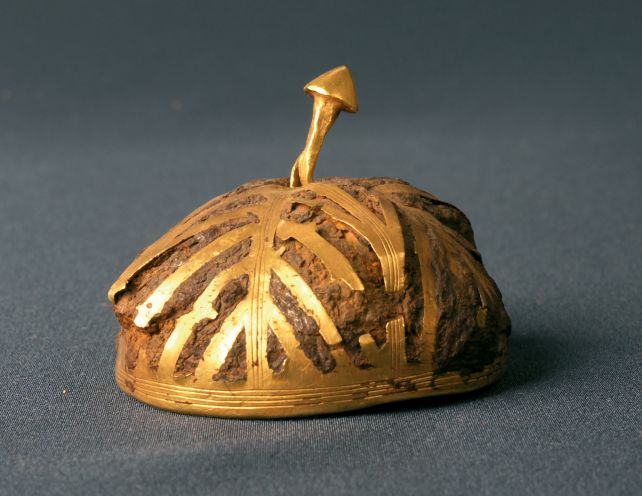
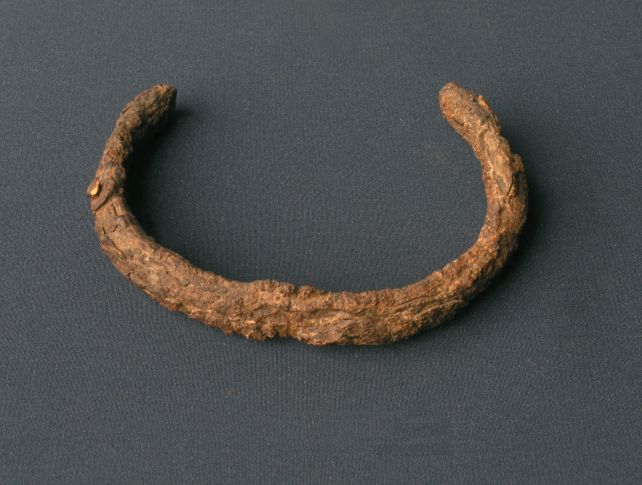
Among a stock of shimmering golden treasures from the Iberian Bronze Age, a pair of corroded objects may be the most valuable of all. Researchers have identified that an opaque bracelet and a hollow hemispherical object adorned with gold were shaped, not from metal sourced from the earth, but from meteorite iron that fell from the sky.
The Villena Treasure is one of the most important finds in Spain and all of Europe. Discovered in 1963 in the Alicante region, the treasure contains 66 objects, mostly in gold, and is an emblematic example of the craftsmanship of Bronze Age goldsmiths.
However, two objects in particular – a bracelet and a hollow hemisphere – have intrigued researchers due to their fascinating “ferrous” characteristics for the time.
-
The USA does not want to lose its title as a military power and is testing the hybrid drone Squire, which flies a few meters above the sea, reaches 80 knots, covers more than 185 km, and carries 22 kg with low radar detection.

-
The largest private island in Brazil has 299,500 m², a certified landing strip, a private beach, a dock for large vessels, nine suites, and a resort structure hidden in the Atlantic Forest that impresses and is for sale!

-
For 80 years, paleontologists dismissed the fossil as a teenage T. rex — until an analysis of the throat bone proved it was a distinct predator, ten times lighter and with larger claws than the largest carnivore in history.

-
Removed 119 years ago from a cave called Stinking Air in Australia, a fossil was forgotten in a museum until a researcher realized it was a relative of the platypus three times larger than the current ones.




Great Treasure of the Iron Age
In the Iberian Peninsula, the Iron Age, a period when cast iron became the dominant material, began around 850 BC. However, the objects from the Villena Treasure were dated between 1500 and 1200 BC, well before the onset of the Iron Age.
So, how can objects with a ferrous appearance be dated to a period prior to the arrival of terrestrial iron in the region? The answer, according to researchers, lies in a less conventional source of iron: meteorites.
Villena Museum )
Metalworking and Meteoric Iron
Historically, ancient cultures in various parts of the world used meteorite iron to create prestigious and high-value objects.
A famous example is the dagger of Tutankhamun, Pharaoh of Egypt, made of meteoric iron. This practice indicates that iron from meteorites was considered rare and valuable, given its luster and superior hardness.
To determine the origin of the objects, researchers collected samples from the artifacts and used mass spectrometry to analyze their composition.
They focused on the nickel content, an indicator of meteoric iron, as meteoric iron has a much higher level of nickel than terrestrial iron.
Villena Museum )
Surprising Results
Despite the advanced corrosion of the artifacts, the test results clearly indicated the presence of meteoric iron.
This positions the bracelet and hemisphere as two of the earliest objects made from meteoric iron in the Iberian Peninsula, reinforcing the idea that the use of this material was more common than we imagined during the Bronze Age.
Significance of the Discovery
The discovery not only challenges ideas about our techniques and skills in the Bronze Age but also highlights the value attributed to metallic objects derived from meteorites.
For ancient peoples, these objects carried a direct connection to the heavens, granting them a special and spiritual significance.
Moreover, the discovery sheds new light on cultural connectivity and knowledge exchange among societies of the time.
The use of meteoric iron suggests that Iberian artisans had an advanced understanding of metallurgy and were attentive to rare sources of raw material, even if they came from space.
The Continuation of Research
The research team confirms that while the results are promising, they are still inconclusive due to the significant corrosion of the objects.
However, more modern and non-invasive analysis techniques may be used in the future to provide additional data to confirm the exact composition of the artifacts.


Seja o primeiro a reagir!