





 Portuguese
  English
  Spanish
  3 min of reading
  0 comments


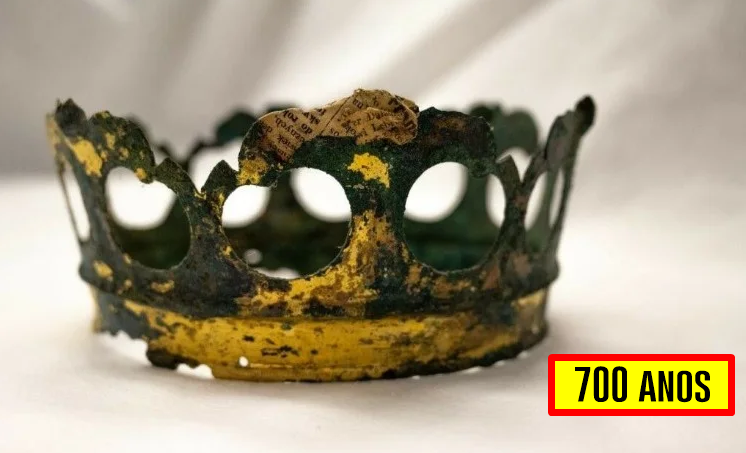
A Lost Royal Treasure From World War II Has Been Found In A Cathedral After More Than 80 Years. What It Contains And How It Was Discovered? The Story Behind This Find Is As Fascinating As The Jewels It Hides.
A treasure lost since the dark days of World War II has finally been unveiled. Hidden for over eight decades, the collection of insignias and funeral crowns, which belonged to Polish and Lithuanian monarchs, was discovered in the Cathedral of Vilnius in Lithuania.
The announcement, made by the Go Vilnius agency, revealed that the artifacts were originally hidden in 1939, when the war threatened to destroy or loot historical heritage.
Among the items is the crown of Alexander Jagiellon, King of Poland and Grand Duke of Lithuania, who lived from 1461 to 1506. The discovery reignites Lithuania’s historical connection with the ancient union between the two countries.
-
A study proposes transforming the Moon into a kind of quarantine center for samples brought from Mars and other worlds, creating a sterile and isolated barrier that would filter any unknown organisms before the material reaches Earth and its ecosystems.

-
Wax notebook falls into latrine 800 years ago, survives intact in Germany and reveals Latin notes that may expose the routine of a high-status medieval merchant.

-
After more than 11 years orbiting Mars, NASA declared the MAVEN probe lost, which disappeared after passing behind the Red Planet in December, began to spin abnormally, depleted its batteries, and never responded to controllers on Earth again.
-
China creates a capsule with artificial intelligence that scans the stomach in just 8 minutes and can reduce costs by up to R$ 1,400, paving the way for a new era of gastrointestinal diagnostics without tubes, sedation, and discomfort for patients.


Artifacts Reveal Medieval Mastery
The funeral insignias are a testament to the high skill level of medieval artisans. According to Gintaras Grušas, Archbishop of Vilnius, these items reinforce Lithuania’s cultural and political significance during the Middle Ages.
Among the artifacts are crowns, scepters, orbs, and coffin plates, created to symbolize the greatness of the rulers.
The collection also includes pieces connected to Elizabeth of Austria, wife of King Casimir IV, and Barbara Radziwiłł, who was married to Sigismund II Augustus.
However, the purpose of these jewels was not for everyday use. They were created exclusively to adorn royal tombs, a common practice in the burial rites of Europe at that time.
In addition to their historical relevance, the objects are unique works of sacred art. The crowns, made for the eternal rest of rulers, reveal meticulous details and rich symbolism.
The cathedral, which served as a necropolis for the nobility of the Grand Duchy of Lithuania, has become the center of attention for historians once again.

Mystery Resolved After 85 Years
The story behind these artifacts is as intriguing as the items themselves. In 1931, during a cleaning of the cathedral after floods, the crypt where the treasures were hidden was discovered.
They were exposed for a short period until the uncertainties brought by the war forced their concealment.
Efforts to locate the treasure began again in the mid-2000s. Modern equipment, such as ground-penetrating radar and metal detectors, was used in various searches.


Still, the results only came last September when researchers, with the approval of the archdiocese, resumed investigations at the site.
The reappearance of this treasure is a victory for the preservation of historical heritage. It connects the present with a past marked by the complex history of Eastern Europe, involving political alliances, disputes, and traditions that shaped the identity of the region.
With the discovery, the Cathedral of Vilnius reaffirms its role as a guardian of precious relics, and the mystery that lasted almost a century finally finds its resolution.







-

1 person reacted to this.