






 Portuguese
  Spanish


Thailand’s Southern Landbridge will connect two ports by 89 km of railway and highway, reduce routes by up to 1,000 km, and create an alternative to the Strait of Malacca.
According to the Geopolitical Monitor, Thailand decided in 2025 to cross the country by land instead of cutting it by water. The Southern Landbridge, also called the Southern Economic Corridor, is a project of 997 billion baht, about US$ 28 billion, which will connect two new deep-water ports by 89 kilometers of highway and railway through the Isthmus of Kra. The connection will unite Laem Riow, in Chumphon, in the Gulf of Thailand, to Laem Ao Ang, in Ranong, in the Andaman Sea.
According to the Geopolitical Monitor, the new route could shorten by approximately 1,000 kilometers the route of ships that currently need to bypass the entire Malay Peninsula via the Strait of Malacca to go from the Pacific to the Indian Ocean. The Thai government intends to open the bidding in 2026, start construction in the same year, open the first phase in 2030, and complete full operation in 2039.
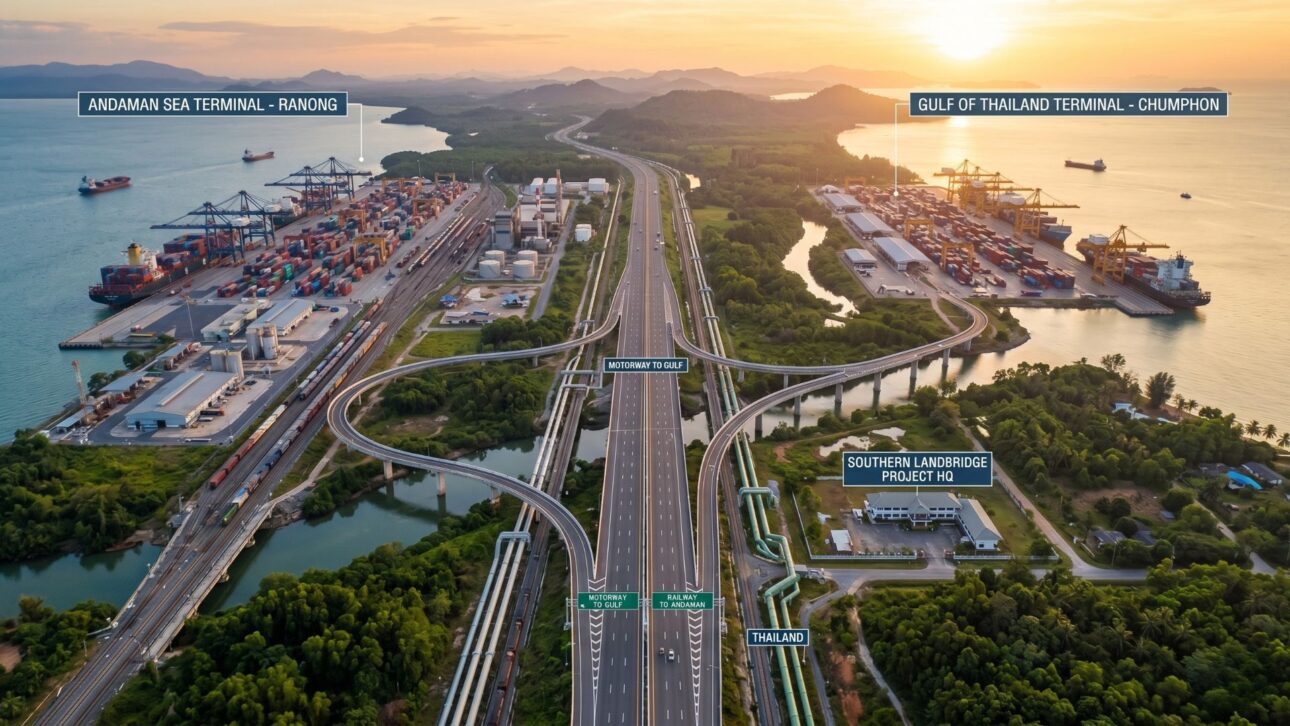
The two ports were planned with smart port technology and green port principles, with a projected capacity of 19.4 million TEUs in Ranong and 13.8 million TEUs in Chumphon.
-
U.S. City Builds Tiny Home Village on Water Company Land to House 136 Homeless People: Inside the Social Housing Units

-
Woman Turns Shipping Container into Home, Embraces Rural Life to Cut Monthly Expenses to Just Over $330
-
France Revamps 530 Social Housing Units with Large Balconies and Glass Facades Without Demolishing Existing Buildings

-
Facing high rent, couple transforms parents’ garage into a fully functional apartment, creating a complete home at a fraction of the market cost.




Southern Landbridge replaces the old Kra Canal project and preserves Thailand’s sovereignty
According to the Geopolitical Monitor, the idea of opening a Kra Canal across the isthmus has existed for more than 300 years. The first known project emerged in 1677, when the Thai king Narai asked the French engineer De Lamar to study the connection between the Gulf of Siam and the Andaman Sea. Since then, the proposal has reappeared several times as an alternative to the Strait of Malacca.
The most recent and sensitive interest came from China. In 2015, Chinese and Thai companies signed a memorandum to study the feasibility of the canal.
Beijing viewed the project as a response to the so-called Malacca Dilemma, the dependence on the strait through which a large portion of the oil imported by China passes. But Bangkok quickly backed down. A canal would physically divide Thailand, create sovereignty tensions, and increase the risk of external influence in an already sensitive region of the country’s south.


The Southern Landbridge emerged precisely as the Thai solution to capture economic gain without assuming the geopolitical cost of the canal. Instead of a waterway vulnerable to blockades and dependent on external operators, the country chose a land corridor sovereignly controlled by Thailand, with partners defined by Bangkok and without cutting the national territory into two parts.
89 km Corridor to Connect Ports, Railway, Highway, and Pipelines in the Kra Isthmus
According to the Geopolitical Monitor, the 89 kilometers between Chumphon and Ranong will be covered by three main transportation systems. The first is a six-lane highway, intended for container trucks, passenger vehicles, and general cargo.
The second is a railway with dual gauges, standard and metric, to ensure compatibility with both the Thai and Malaysian networks as well as broader logistical connections in Asia.
The third planned component is oil and gas pipelines. According to the publication, the route between Chumphon and Ranong is shorter for Middle Eastern oil destined for China and Japan than the passage through Malacca, which gives the corridor additional value beyond container transport. In times of regional instability, such as tensions in the Persian Gulf, this detour gains even more strategic importance.
This integration transforms the Southern Landbridge into much more than a port connection. The project was designed to operate as a multimodal logistics platform capable of moving containers, fuels, and general cargo with speed, predictability, and less dependence on maritime bottlenecks in Southeast Asia.
$28 Billion Project Aims to Create a Real Alternative to the Strait of Malacca
According to the Geopolitical Monitor, Thailand calculates an internal economic return of 17.38% for the project. The government estimates that the break-even point will be reached in 24 years, with the generation of 58 billion baht in the first year of operation, mainly from the sale of fuel to ships in transit.
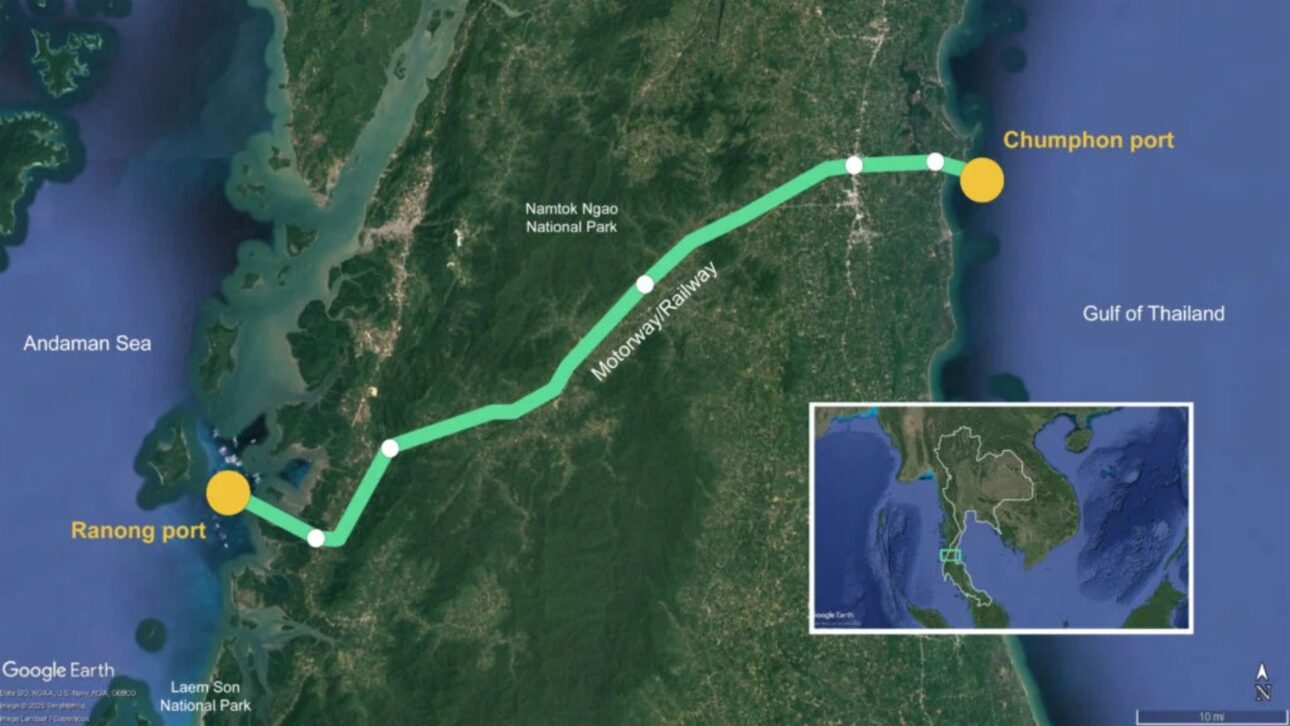
The capacity numbers reinforce the ambition. With 19.4 million TEUs in Ranong and 13.8 million TEUs in Chumphon, the corridor is designed to rival some of the largest port hubs in Asia. This includes competing for part of the flow that currently passes through Hong Kong, Singapore, and other major transshipment centers in the region.
In practice, Thailand is trying to capture a share of the Asia-Europe maritime trade by offering a hybrid route that reduces distance, shortens time, and creates a land alternative in one of the most strategic points on the planet. The project does not eliminate the Strait of Malacca, but seeks to reduce absolute dependence on it.
Fishermen, durian producers, and environmental activists have become the main obstacle to the schedule
According to the Geopolitical Monitor, the biggest threat to the Southern Landbridge schedule is not engineering or financing, but social resistance in the regions where the ports will be implemented. The communities of Ranong and Chumphon question the impacts on artisanal fishing, agricultural lands, and coastal ecosystems.
Among the most affected groups are more than 5,000 stateless individuals who depend on fishing in the bays of Ao Ang and Laem Riow, exactly where the new deep-water ports will be built. Ranong is also a central area for durian production in Thailand, which increases the tension over land use, the presence of foreign capital, and the economic transformation of the region.
The protests grew in 2024 and began to question the transparency of environmental impact assessments. According to the publication, activists accuse the process of being conducted in a fragmented manner, without an integrated analysis of the total impact of the corridor.
The creation of a special economic zone with exemptions and possible long-term concessions to foreign investors also raised concerns about sovereignty and territorial control.
Southern Landbridge may reduce Singapore’s strategic advantage in Asian trade
According to the Geopolitical Monitor, Singapore has direct reasons to follow the project closely. Its port is the second busiest in the world, with about 38 million TEUs per year, and its historical strength depends precisely on the privileged position in the Strait of Malacca.

The Southern Landbridge does not eliminate Singapore as a hub, because very large ships may still prefer Malacca, as the land transshipment in Thailand has its own cost. But the project reduces the mandatory passage condition and erodes part of the absolute geographical advantage that has sustained Singaporean centrality for decades.
At the same time, Malaysia is also expanding its own ports, making the regional competition even more intense.
The consequence is clear. Thailand is not just building an infrastructure project. It is attempting to redesign the logistical map of Southeast Asia and open a new competition for containers, fuels, transshipment, and regional influence among the world’s largest maritime corridors.
Thailand accelerates work to transform the Isthmus of Kra into a strategic corridor by 2039
According to the Geopolitical Monitor, the Thai Minister of Transport confirmed in April 2026 that the project will be accelerated. The bidding is scheduled for 2026, the first phase for 2030, and full completion by 2039, in a timeline that combines political speed with long-term ambition.
The central point is that Thailand chose to do with railway, highway, ports, and pipelines what for centuries was imagined as a great canal.
The project that China saw as a solution to the Malacca Dilemma will not be controlled by Beijing, but executed in sovereign Thai territory, with capital and technology chosen by Bangkok.
If it comes off the drawing board on the promised schedule, the Southern Landbridge could become one of the most important logistical works in Asia in the coming decades, connecting two oceans without opening a canal and placing Thailand at the center of a new route between the Pacific and the Indian Ocean.







