Portuguese
  Spanish


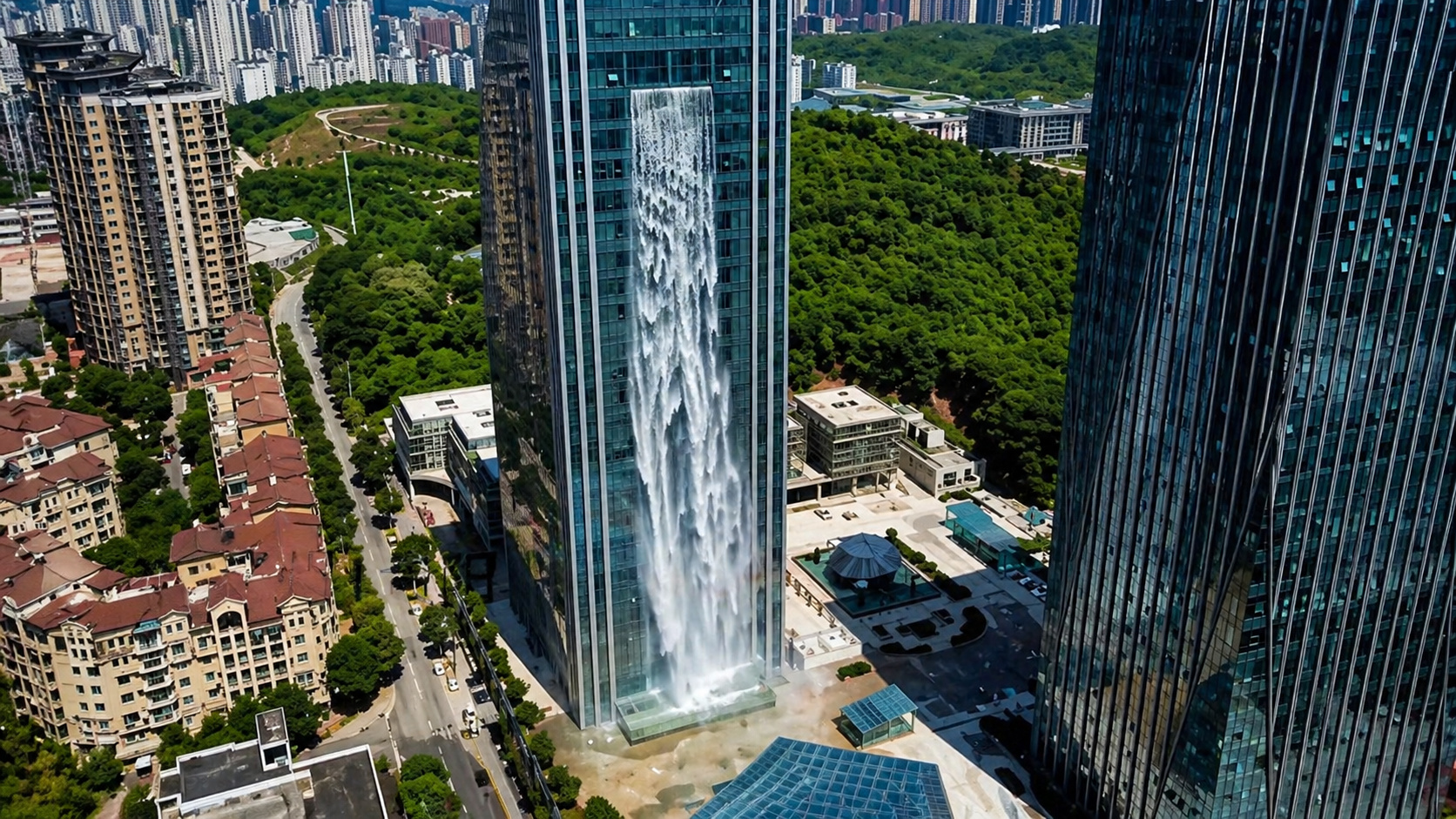

A giant structure with a 108-meter artificial waterfall draws attention for its impressive visual, but the high energy consumption limits frequent use and raises debate about urban sustainability
The 121-meter building in China with an artificial waterfall has become one of the most curious examples of modern architecture. The structure draws attention by transforming practically the entire facade into a continuous waterfall, creating a rare spectacle in the city.
Even with the visual impact, its operation depends on a complex and expensive system. The use of four giant industrial pumps and the cost of about US$ 118 per hour in energy mean that the waterfall is activated only on special occasions.
Bold engineering brought water to the top of the skyscraper
The project required out-of-the-box solutions to function. The water needs to be elevated to the top of the 121 meters high, which is only possible with high-power equipment.
-
Tourist Discovers Forgotten Joaquín Sorolla Painting Worth Up to 60,000 Euros While Strolling in Seville

-
Brazil’s Fernando de Noronha Boasts World’s Most Beautiful Beach, Accessible Only by Descending 208 Cliffside Steps and With No Food Vendors Allowed

-
Wave Rock: Australia’s Giant Granite Wave Stands 15 Meters Tall, Spans 110 Meters, and Showcases 2.7 Billion Years of Erosion in the Australian Desert
-
How to Unclog Showerhead Holes Blocked by Limescale and Hard Water Without Replacing or Hiring a Technician


The investigation was published by ArchDaily, an international portal specialized in architecture, which detailed the structure used. The system includes four industrial pumps capable of maintaining the continuous flow of water.


This type of operation requires a lot of energy, which explains why the waterfall is not kept on all the time.
108-meter waterfall occupies almost the entire facade of the building
The waterfall is 108 meters high, occupying almost the entire length of the building. This places the structure among the largest urban artificial waterfalls ever built.
Besides the impressive size, the project uses rainwater stored in underground reservoirs, which is filtered before being reused. This process helps reduce waste, even with the high energy consumption.
High energy consumption prevents continuous operation
The cost of operation is one of the main factors limiting the use of the waterfall. The expense of about US$ 118 per hour makes it unfeasible to keep the system running daily.
This amount is linked to the power needed to pump the water to the top of the building. Therefore, activation occurs only on specific occasions, usually related to events or special dates.
Even so, the visual impact remains one of the project’s biggest attractions.

System creates visible rainbow and became an urban attraction
The building was inaugurated in 2018 by Guizhou Ludiya Property Management. The system was designed to fill the base tank in about two hours, allowing the full operation of the waterfall.
When activated on sunny days, the falling water can generate a constant rainbow effect, visible to those in the square in front of the building.
ArchDaily, an international portal specialized in architecture, highlighted this effect as one of the visual differentials of the construction.
Project raises debate about waste and spectacle architecture
Despite the innovative proposal, the building has also become the target of discussions. The high energy consumption raises questions about sustainability and energy waste.
The project fits into the concept of spectacle architecture, which prioritizes visual impact and innovation. This type of construction tends to attract global attention but also provokes criticism about efficiency and resource use.
The case shows how impressive ideas can face limitations when applied in practice.
Structure impresses, but limited use draws attention
The 108-meter waterfall building in China remains a visual landmark, but also an example of how cost can limit large projects.
The combination of advanced engineering, high energy consumption, and restricted use transforms the building into a symbol of innovation with clear challenges.
Do you believe projects like this are worth the investment even with high cost and limited use, or should they be avoided? Leave your opinion in the comments and share this content with others curious about engineering and architecture.