Portuguese
  Spanish


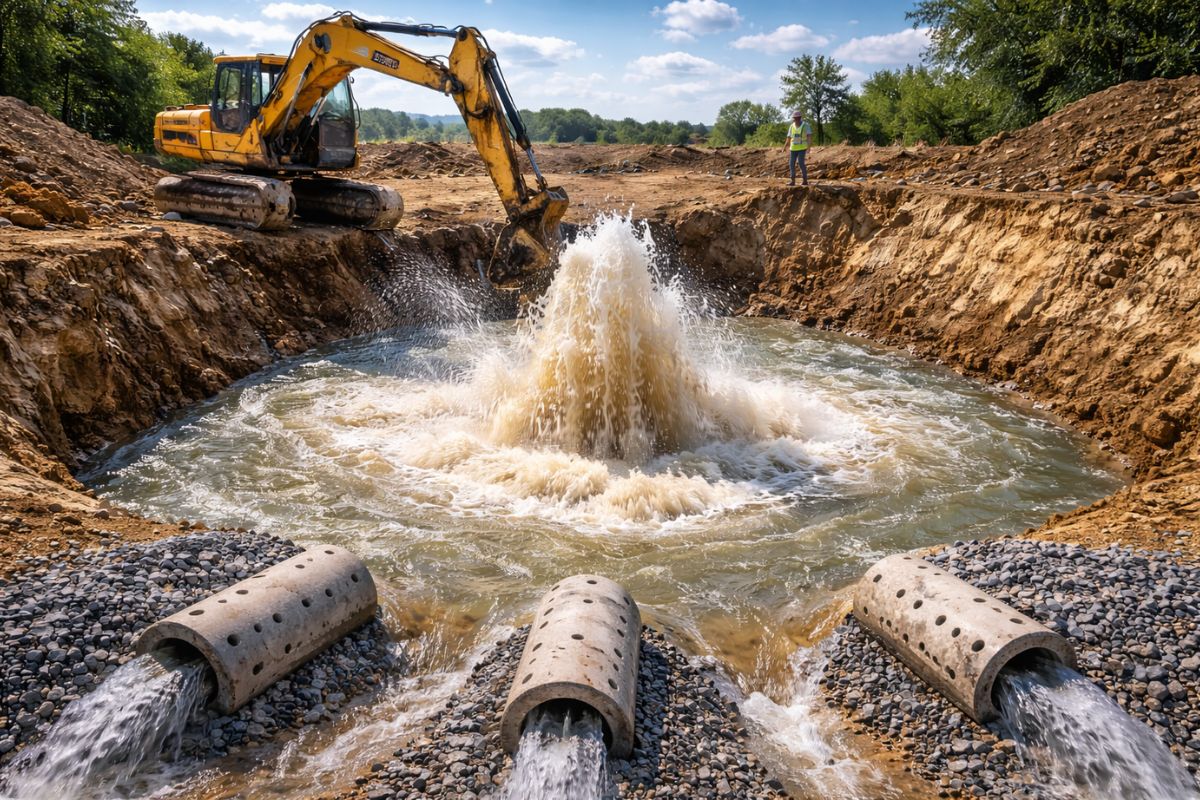

The water source appeared in the large pool when the backhoe hit the sand; drains with pipes and gravel help filter and the flow continues strong.
The water source appeared when the large pool reached about 6 meters deep and “gave water” at the bottom. Those who followed the end of the work say that the first instinct was to dig deeper, but the fine sand started to rise along with the water. Then everything changed: instead of insisting on the hole, the idea became to take advantage of what had already emerged and organize a drain with pipes and gravel to channel this water without turning it into a problem.
According to the report, the excavation was hitting gravel and a softer stone, until it suddenly switched to very fine, white sand, which began to rise from the bottom. From that point on, the focus became very clear: hold the situation, prevent the sand from clogging the system, and make drains around to capture water without “pulling” even more sand.
When the water source appeared in the large pool

The described scene is the kind that catches a person by surprise: while digging the large pool, in one corner, water started to appear at the bottom. The backhoe made a hole there, near 6 meters, and the water appeared.
-
28-meter, 156-ton titans traveled 20,000 km from China to the port of Santa Catarina: Portonave received 7 fully electric megacranes, part of a R$ 210 million package, to double container handling.

-
They exchanged the idea of a large house for a 35 m² warehouse, spent US$ 12,000 on the structure, and created a tiny house in Colorado with space to live and work.

-
A newly opened terminal in the middle of the Amazon has begun transporting soy and corn through Amapá, eyeing the queue of ships that is congesting the ports in the South.

-
Goodbye to old tiles: renovation technique without construction transforms bathrooms in a few hours, eliminates debris, and reduces costs with coverings using special paints, high-resistance adhesives, and modern finishes that completely renew the space.


And that’s when the caution came. When the sand “turned” and started to rise, the guidance was to stop. The logic is simple: if you keep digging down, the fine sand can create a “suction” effect, bringing more material from the bottom and complicating what was already working.
Pipes and gravel: how the drain was assembled

The solution was to place the pipes up to where the excavator could reach and start throwing gravel around, rising to the point where water had already appeared. Higher up, where there was no water, soil from the material that had been removed was added.
In practice, the idea is to create a better path for the water and reduce sand drag. When the water pushes sand along, a well-constructed drain makes the difference between having a useful water source and having a hole that clogs and collapses.
Fine sand became the limit and changed the plan

The report repeatedly mentions that the sand was very fine, white, and came “pure” from the bottom. At times, you can feel the water pushing the sand up when you place your foot or hand on the bottom.
Therefore, the decision was made to stop deepening and to create drains around, trying to capture the water from the side. If the water source has already appeared, the reasoning was to take advantage of what it delivers without disturbing the bottom further, as the bottom has become the most unstable point.
Six drains, one clogged, and water left even with pump on

On site, six drains were made. One of them, the one that caught the sand, would have clogged, but even so, a little water was still coming through.
It is also mentioned that a pump was left on continuously and there was still excess water. And that if two pumps were turned on, then the level would indeed drop. This reinforces the impression that the water source there is not “weak”; it is pushing a constant volume.
The flow measured in the gutter: from 60 thousand to 110 thousand liters per hour
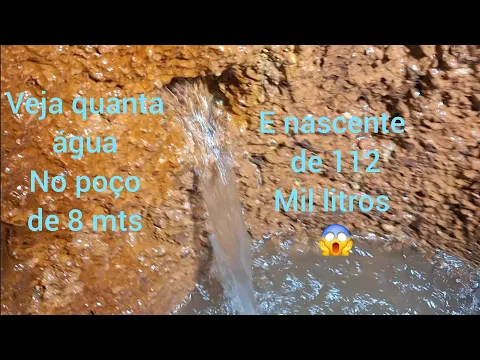
To measure flow, they used gutters. In a previous measurement, the flow was around 60 thousand liters per hour. Later, in the main gutter, something in the range of 110 thousand liters per hour appeared, with variation cited between 110 and 115 thousand.
The report itself explains that this changes according to the water level throughout the year. When the level is higher, the flow tends to appear greater.
When the water tends to drop

The base says that in March, April, and May the level starts to drop, and that the period when it is lowest would be October and November.
This is an important point for those considering a large pool as a reserve: the water source may be strong now and decrease later, so it’s worth observing how it behaves at other times.
Why the subsoil there stores water and also releases sand
The final explanation is quite simple: the region is very sandy and flat, a low area. When it rains, the water easily enters the soil and goes to the subsoil, which is why it would be a water-rich area. However, this same condition brings the annoying part: there is a lot of sand in between, so the water can come carrying sand along.
And now, speaking as someone who is closely observing the work: if you saw a water source throwing sand up like that, would you stop at that point and make drains around it or would you try to dig a little more to see “how far it goes”?