






 Portuguese
  Spanish
  5 min of reading
  0 comments


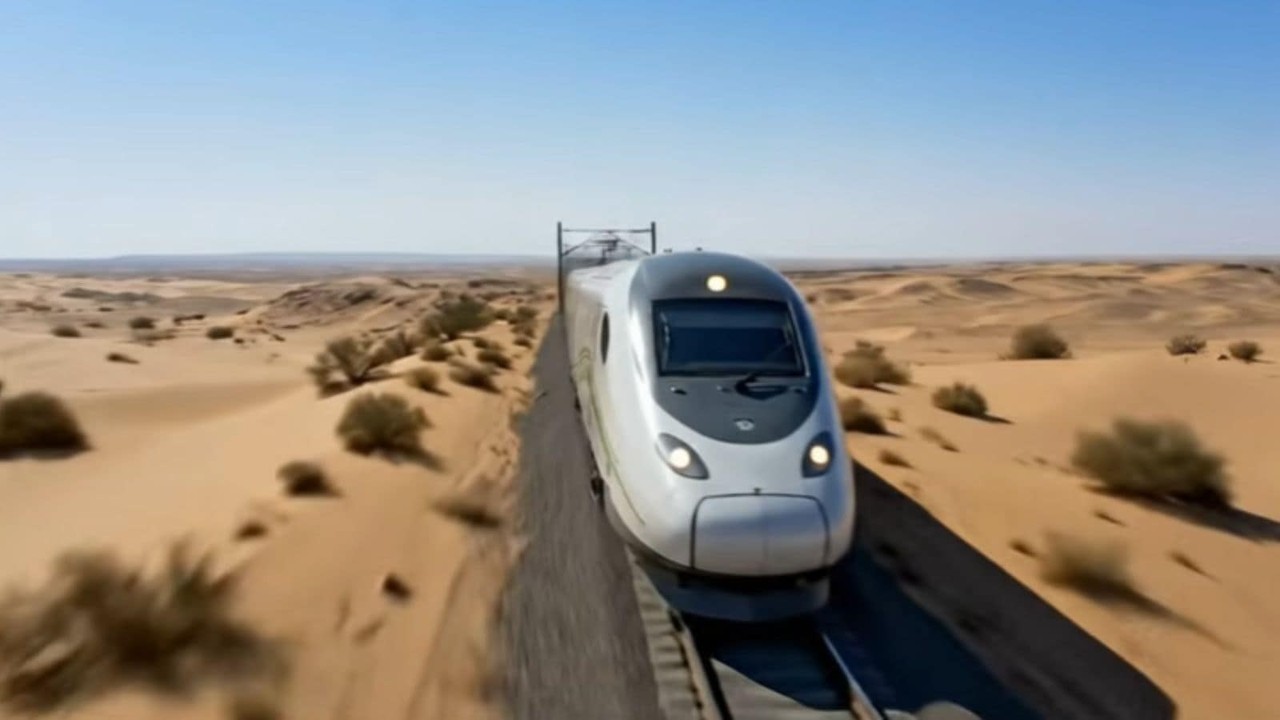
Starting in 2026, crossing the 785 kilometers of desert that separate Riyadh from Doha will no longer be a flight or an exhausting car journey but rather a little over two hours inside an electric train gliding at 300 kilometers per hour between two capitals that until recently barely spoke to each other.
The agreement was signed at the end of last year by Saudi Arabia and Qatar, and those who follow the region know that it carries a weight that goes far beyond the tracks. We are talking about two neighbors who, a few years ago, turned their backs on each other, with closed borders and suspended flights. Now they have decided to connect through the most concrete thing that exists in transport engineering, a high-speed line that will run straight through the desert, linking Riyadh, the Saudi capital, to Doha, the Qatari capital.
The number that opens this story is simple to visualize. It is 785 kilometers of new line, designed for a train that maintains 300 kilometers per hour in cruising mode. In practice, the journey between the two cities drops to around two hours, with the line directly connecting the airports at both ends, Riyadh and Hamad International in Doha. Those who make this journey today depend on a plane or face hours of road cutting through sand. The train changes the standard.
Why a train between Riyadh and Doha is more than just a train
I confess that what captivates me in this topic is not just the speed. It’s the gesture. Building a railway between two countries is the kind of project that no one undertakes if the relationship isn’t solid, because it involves years of construction, billions invested, and a mutual dependency that lasts decades after the inauguration. When two governments decide to lay tracks across the border, they are saying, in concrete terms, that they are betting on each other for the long term.
-
Without a mansion, without high investment, and without a traditional classroom, a teacher living in a 22 m² house taught students to build a 9 m² studio apartment with the equivalent of R$10,000.

-
Largest bridge in São Paulo reaches 75% completion and is expected to strengthen strategic connection in the interior of São Paulo.

-
Without her own home and pressured by rent, a 25-year-old bought a small 15-meter boat, gradually renovated the interior by herself, transformed the interior with paint, new flooring, a larger bathroom, and started living on the canals, paying much less per month.
-
Tired of seeing families sleeping on the street, São Paulo delivered 18 m² furnished microhouses and took 888 people off the streets: Vila Reencontro became the model social housing for the homeless population.


The route also has an economic logic that stands out. The Gulf is a region where capitals have grown isolated, each pulling its own financial hub, airports, and skyscrapers. Connecting Riyadh to Doha by land, in two hours, begins to weave these economies together in a way that airplanes never did, because a high-speed train changes the daily life of those who work, study, and do business between the two ends.

Saudi Arabia already knows how to run at 300 per hour
There is a detail that gives credibility to the project and that many people forget. Saudi Arabia is not starting from scratch in this matter. The country already operates the Haramain, the high-speed line that connects Mecca to Medina crossing the Saudi west, also at 300 kilometers per hour. In other words, it is not an empty promise from a country that has never seen a high-speed rail up close. It is a government that has already managed a state-of-the-art railway, learned to operate in the extreme heat of the desert, and now wants to extend this expertise beyond its own borders.
And the desert environment, it is worth mentioning, is one of the most hostile that exists for this type of technology. Temperatures easily exceed fifty degrees, sandstorms infiltrate everything, and track expansion under the sun. Keeping a train stable at 300 per hour in these conditions requires a level of track engineering and maintenance that few places in the world master. The experience of the Haramain is precisely the asset that makes the Riyadh-Doha project plausible and not just a trade show announcement.

What Brazil watches from afar
It’s impossible not to make the comparison with our reality. While the Gulf signs, designs, and sets in motion a 785-kilometer line at 300 per hour connecting two countries, Brazil, with its continental size and a pressing need for railways, is still discussing auctions and financing for the first freight corridors that promise to finally get off the ground. We’re not talking about passenger bullet trains here, but something more basic, and even so, it drags on.
It’s not a comparison to belittle anyone, it’s just to gauge the speed with which decisions turn into concrete in places that have chosen to heavily invest in infrastructure. The Gulf has oil, of course, and that helps finance it. But money alone doesn’t build railways. It takes continuous political will, a plan that doesn’t change with every government shift, and the willingness to support a project that only shows results years later.

A line that redraws the Gulf map
I imagine the accumulated effect of this in ten years. A two-hour trip between Riyadh and Doha, connecting airport to airport, transforms two distant cities into something akin to two neighborhoods of the same giant metropolitan area. Companies start operating at both ends without the friction of flying, families spread out, tourism from one capital irrigates the other. The railway is not just a means of transportation; it is an instrument of integration that erases distance.
With the operation expected to start as early as 2026, this is one of those projects that we will see become reality in a short time, not in a vague horizon of decades. The Gulf is showing, once again, that when it decides to build, it builds quickly and on a large scale. And the desert that has always separated these capitals is about to become the path that will unite them.
Will we see something similar connecting two Brazilian capitals in this generation, or will this train continue to pass far from here?


Be the first to react!