Portuguese
  Spanish


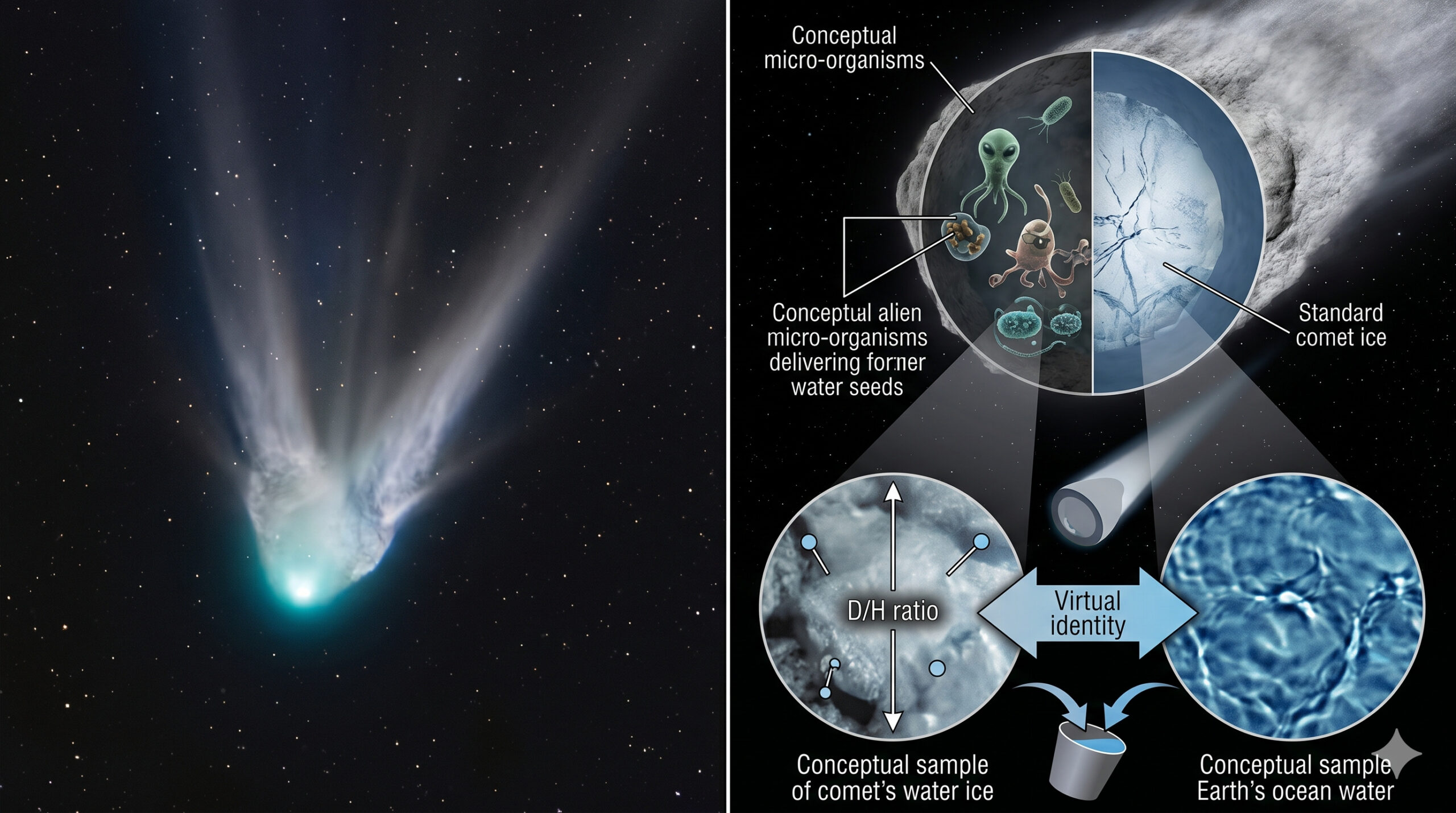

ALMA and NASA map water in comet 12P/Pons-Brooks and reveal a composition almost identical to that of Earth’s oceans, changing theories about its origin.
According to the ALMA Observatory, an international team led by Martin Cordiner from NASA’s Goddard Center has mapped for the first time in history the spatial distribution of ordinary water and heavy water in the coma of a comet — and the result has changed the way scientists understand the origin of Earth’s oceans. The comet in question is 12P/Pons-Brooks, a visitor that the Chinese have recorded since the 14th century, which Europeans called a celestial wonder in the 19th century, and which 21st-century astrophysicists decided to call “Devil Comet.”
The nickname, hastily given in the summer of 2023, describes its appearance: two horns of gas sprouting from the coma as if the object were alive and irritated. What no one expected was that, inside, it carried a chemical signature almost identical to that of the water that covers 71% of Earth’s surface.
A traveler of 4.5 billion years with comet 12P/Pons-Brook
12P/Pons-Brooks completes an orbit around the Sun every 71 years. This means that most people who saw it in 2024 will not have another chance; the next passage is expected in 2095.
-
Humanoid Robots Transition from Demonstrations to Real Work in Factories

-
Anti-poaching patrol in Thailand accidentally discovers hidden cave with 2,000-year-old petroglyphs, geometric engravings, and mysterious three-finger patterns on sandstone walls.

-
Russia Deploys Largest Nuclear Icebreaker in Arctic Capable of Breaking Through Three-Meter-Thick Ice
-
TCL Launches Energy-Efficient Refrigerator in Brazil, Promising 70% Less Consumption Than Competitors





The comet belongs to the family of Halley-type comets, objects with orbital periods between 20 and 200 years that formed in the colder and more remote regions of the Solar System, the Oort Cloud or the Kuiper Belt — and were eventually diverted into orbits that bring them periodically to the inner Solar System.
The nucleus of 12P/Pons-Brooks is estimated to be about 34 kilometers in diameter, the size of the Mount Everest, according to the Royal Astronomical Society. Inside it, frozen for 4.5 billion years, there is ice formed in the early moments of the Solar System. Each time the comet approaches the Sun, some of this ice sublimates, creating the cloud of gas and dust called the coma, which can expand hundreds of thousands of kilometers from the nucleus.
Why is comet 12P/Pons-Brooks so different?
What makes 12P/Pons-Brooks different from many comets is its temperament. It is classified as a cryovolcanic comet — essentially, a flying ice volcano.
In July 2023, astronomers from Hungary recorded that the object had brightened 100 times in a single night, changing from magnitude 16.6 to 11.6 in a matter of hours. The coma, previously spherical, deformed into a horseshoe shape with two prominent points.
The horns had appeared and the name “Devil Comet” caught on immediately. Between June 2023 and April 2024, the object recorded 14 well-documented eruptions. During the total solar eclipse on April 8, 2024, it was only 25 degrees from the Sun, captured by some astrophotographers among the photos of the phenomenon.
On April 21, 2024, the 12P/Pons-Brooks passed through perihelion, the closest point to the Sun. And it was precisely during this approach that a team of astronomers pointed two of the planet’s most powerful instruments at it.
The Question of 4.5 Billion Years
There is a question that scientists have been unable to answer with certainty since they began to ponder it: where did Earth’s water come from?
Earth formed in the inner region of the Solar System, where temperatures were too high for ice to survive. This means that the planet was essentially born dry.
However, today there are 1.4 billion cubic kilometers of liquid water on the surface and in underground aquifers. This water arrived later — brought by collisions with other objects during the chaotic period of heavy bombardment, about 4 billion years ago. The question is: which objects? Asteroids? Comets? Meteorites? Some combination of the three?
The key to answering this question lies in the chemical composition of water. Common water is H₂O — two hydrogen atoms and one oxygen atom. But there is a heavier version, called HDO or “semi-heavy water,” in which one of the hydrogen atoms is replaced by deuterium, a denser isotope of hydrogen that has an additional neutron in its nucleus.
The ratio of deuterium to hydrogen (D/H ratio) in any water sample acts like a chemical fingerprint: it varies according to the conditions under which the water formed. Objects that formed farther from the Sun, in cooler regions, tend to have more deuterium. Closer objects, like Earth, tend to have less.
If the water from a comet has the same D/H ratio as Earth’s oceans, it suggests that the two waters may have a common origin — and that comet could have brought part of what we are drinking, swimming, and fishing today.
What the Rosetta Mission Explained and the Comet 67P/Churyumov
For decades, asteroids were the favorite candidates. In 2014, the ESA’s Rosetta mission landed on comet 67P/Churyumov-Gerasimenko and measured the D/H ratio of its water. The result was disturbing: three times more deuterium than in Earth’s oceans, the highest value ever recorded in any comet. That measurement seemed to close the door on Halley-type comets and their relatives as sources of Earth’s water.
But there was a methodological problem that had been troubling researchers. All previous measurements of comets were made from afar, with telescopes recording the light from the water vapor escaping from the coma as a whole.
There was no way to distinguish whether that water had come directly from the solid nucleus of the comet or if it had formed through chemical reactions within the gas cloud surrounding it. This distinction matters: if part of the water in the coma comes from secondary reactions and not from the original nucleus ice, the measurements may be systematically distorted.
It was exactly this problem that Cordiner’s team decided to tackle.
The map that changed everything about 12P/Pons-Brook
ALMA — Atacama Large Millimeter/submillimeter Array — is a set of 66 radio telescopes installed in the Atacama Desert, Chile, at an altitude of 5,000 meters. Its strength lies in interferometry: by combining signals from dozens of antennas spread over up to 16 kilometers, ALMA can create images with resolution comparable to that of a telescope of impossible dimensions.
This technique allowed for something unprecedented: mapping the spatial distribution of water molecules within the coma of a comet, not just measuring their total quantity.
The Cordiner team combined ALMA data with infrared observations from NASA’s Infrared Telescope Facility (IRTF) in Hawaii to obtain a complete picture.
The maps showed where, exactly, within the coma of 12P/Pons-Brook, the H₂O (ordinary water) molecules and HDO (heavy water with deuterium) molecules were located. The pattern found was unequivocal: both molecules came from the same place, directly from the solid nucleus of the comet, from the primordial ice that has been frozen there for 4.5 billion years.
With this confirmation about the origin of the vapor, the measurement of the D/H ratio became much more reliable. And the result was surprising.
The measured D/H ratio was (1.71 ± 0.44) × 10⁻⁴ — the lowest ever recorded in a Halley-type comet and a value that falls directly within the range of Earth’s oceans.
“Our new results provide the strongest evidence yet obtained that at least some Halley-type comets carried water with the same isotopic signature found on Earth, supporting the idea that comets may have helped make our planet habitable,” Cordiner stated when announcing the results, published in August 2025 in the journal Nature Astronomy.
What this changes and what we still don’t know
The discovery does not alone resolve the question of the origin of Earth’s water. A single comet with a compatible isotopic signature does not prove that all Halley-type comets are like this, nor that they were the main contributors to the oceans.
Carbonaceous asteroids remain strong candidates, with robust evidence accumulated over decades. The most accepted scientific view today is that Earth’s water came from multiple sources — and the exact proportion of each is still debated.
What the measurement of 12P/Pons-Brook does is reopen a door that seemed closed. After the Rosetta result with 67P in 2014, many researchers tended to dismiss Halley-type comets as significant sources of Earth’s water. Now, with a member of that same family showing water virtually indistinguishable from that of the oceans, the debate has returned to square one — but with much more precise tools.
12P/Pons-Brooks will not return until 2095: What is the next step?
The next step is to repeat the same methodology on other Halley-type comets as they pass close to the Sun. The 12P/Pons-Brooks will not return until 2095. But other comets from this family have observation windows in the coming years.
Additionally, the Comet Interceptor mission, developed by ESA with a launch planned for 2029, aims to find a dynamically primitive comet — an object that has never passed through the inner Solar System before and analyze its composition directly, without the uncertainties of distant observations.
The water in Earth’s oceans was not placed there by accident. It arrived carried by objects that traveled billions of kilometers over billions of years before colliding with a planet that had barely formed.
The “Devil Comet,” with its gas horns and spectacular eruptions, carried with it a frozen record of this process. And when astronomers finally managed to open this record with sufficient accuracy, what they found was a reflection of home.
The study “A D/H ratio consistent with Earth’s water in Halley-type comet 12P from ALMA HDO mapping,” led by Martin Cordiner from NASA’s Goddard Center, was published in the journal Nature Astronomy in August 2025. The discovery was announced by the ALMA Observatory, a partnership between ESO, the U.S. National Science Foundation, and the National Astronomical Observatory of Japan.