






 Portuguese
  Spanish


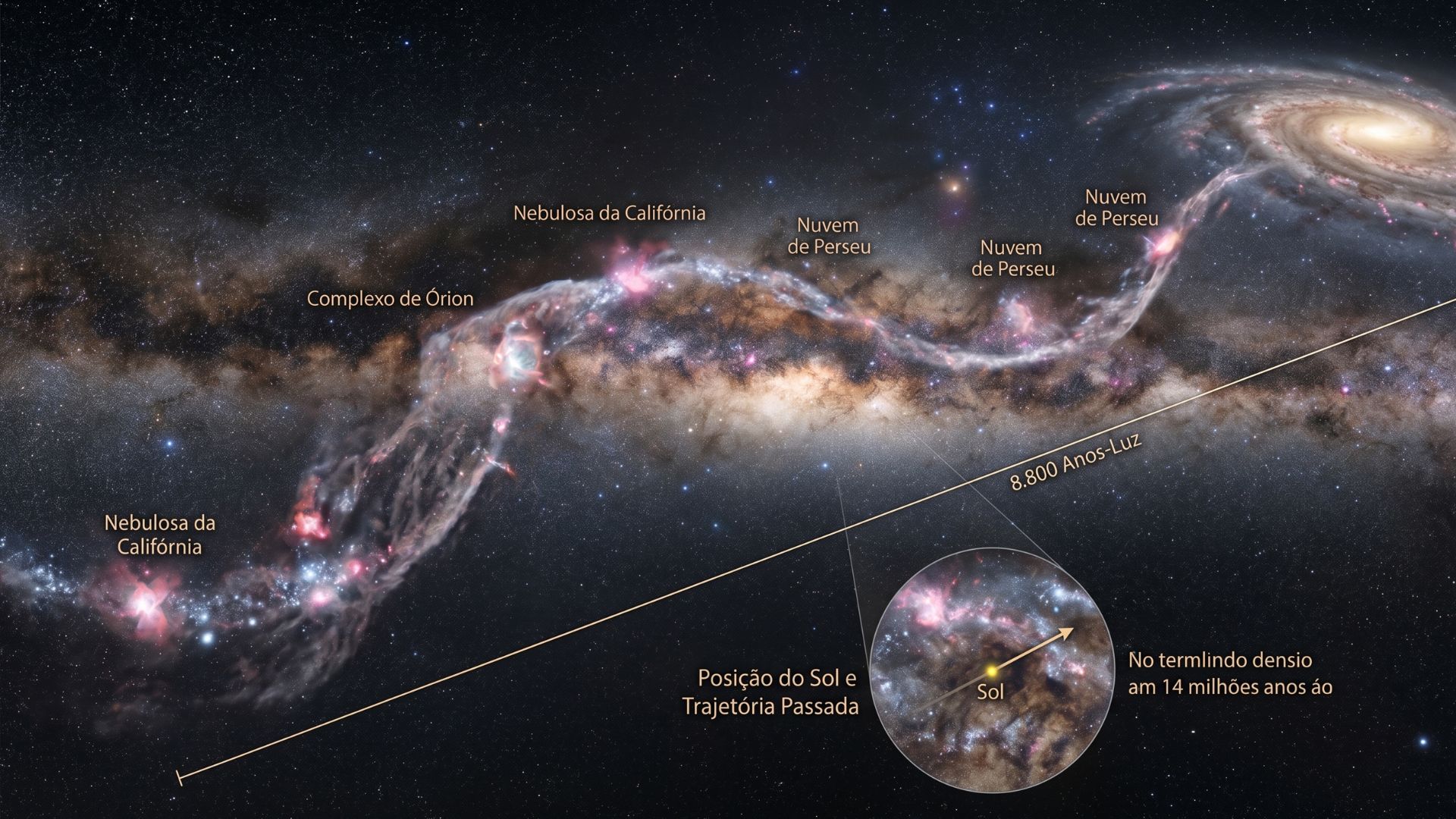


Radcliffe Wave spans 9,000 light-years of the Milky Way, oscillates like a cosmic wave, and is among the largest structures ever found near the Sun.
For decades, astronomers studied molecular clouds, star-forming regions, and large structures of the Milky Way without realizing that many of them were part of a single gigantic system hidden practically in the cosmic backyard of the Solar System. The revelation came only in 2020, when researchers identified a colossal structure formed by gas and dust that spans about 9,000 light-years of the galaxy’s local arm in a wavy pattern that resembles a gigantic serpent crossing the galactic disk. The discovery was named the Radcliffe Wave.
Four years later, new research published in the journal Nature revealed something even more surprising: the structure not only looks like a wave but actually behaves like one. Using data on the movements of young stars associated with the clouds of the Radcliffe Wave, scientists concluded that it is oscillating through the plane of the Milky Way like a gigantic cosmic string vibrating in extremely slow motion. The phenomenon occurs on such enormous scales that a complete cycle can take millions of years.
Structure spans 9,000 light-years and is considered one of the largest ever found near the Sun
The Radcliffe Wave is about 2.7 kiloparsecs long, equivalent to approximately 9,000 light-years.
-
China Develops Custom 140-Ton Electric Mining Truck with 770 kWh Swappable Battery, Deploys 290 Units in Xinjiang’s Largest Zinc Mine

-
Meta to Launch Arena, a New Prediction App Targeting 3.56 Billion Users, Competing with Polymarket and Kalshi

-
Scientist Challenges Famous Human Evolution Theory, Argues Homo Sapiens Evolved Gradually Over Thousands of Years
-
15-Year-Old American Builds Ocean Generator with PVC Pipe and 3D-Printed Propeller for $12, Wins National Prize, Presents at White House, and Makes Forbes 30 Under 30 List




It extends along the local arm of the Milky Way and connects various famous star-forming regions that were previously studied separately. Among them are areas like Orion, Cepheus, North America Nebula, and Cygnus X.


According to researchers involved in the project, it is the largest coherent structure known in the vicinity of the Solar System. The discovery significantly altered astronomers’ view of the distribution of interstellar gas in Earth’s galactic neighborhood.
Discovery was only possible thanks to the three-dimensional mapping of the Milky Way
The structure remained invisible for decades for a simple reason. Seen from Earth, the distribution of the clouds seemed fragmented and scattered across the sky.
The situation changed when scientists combined observations from the space mission Gaia of the European Space Agency with advanced techniques of three-dimensional mapping of interstellar dust.
When the positions were reconstructed in three dimensions, something unexpected emerged: a gigantic undulating chain of molecular clouds connected to each other. This is how the Radcliffe Wave was born.
Study of 2024 showed that the entire structure is moving
Initially, scientists only knew that the structure had an undulating shape. The major breakthrough came when researchers began to analyze the movement of extremely young star clusters that were born within the clouds of the Radcliffe Wave itself.

These stars act as natural markers of the movement of the gas where they were formed.
By reconstructing their trajectories, the researchers concluded that the entire structure is oscillating through the galactic plane.
Movement was compared to the famous “wave” in stadiums
The authors of the study used a simple comparison to explain the phenomenon. According to them, the Radcliffe Wave behaves similarly to the “wave” seen in sports stadiums.
People stand up and sit down in sequence as the wave passes through the stands. Something similar happens with the regions of the structure spread across the Milky Way.
The clouds and stellar clusters rise and fall in relation to the galactic plane as the oscillation pattern propagates along the structure. This causes the wave to literally “travel” through the galaxy.
The Sun is very close to the galactic structure
Although several popular publications claim that Earth is within the Radcliffe Wave, scientific data uses a more careful definition.
The study published in 2024 states that the Sun is located less than 300 parsecs, approximately 1,000 light-years, from the structure.

On galactic scales, this distance is extremely small. Therefore, the Radcliffe Wave is considered part of the immediate cosmic neighborhood of the Solar System.
Researchers believe the Solar System crossed the structure millions of years ago
Studies associated with the project indicate that the Sun may have passed through the Radcliffe Wave region in the past.
Researchers involved in the collaboration estimate that this crossing occurred approximately between 14 and 13 million years ago. This does not mean that the Solar System is currently immersed in the structure.
But it shows that there is a dynamic relationship between the solar orbit around the galaxy and nearby large interstellar formations.
Structure may help explain how stars are born on a large scale
The Radcliffe Wave is not just a geometric curiosity. It contains some of the most active star-forming regions of the Milky Way.
Researchers believe that understanding its dynamics can help explain how large molecular clouds evolve, collapse, and form new generations of stars. This turns the structure into a natural laboratory to study the mechanisms that shape the evolution of the galaxy.
Despite recent advances, the origin of the structure remains a mystery. Researchers discuss hypotheses that include supernova explosions, gravitational disturbances caused by satellite galaxies, and internal processes linked to the dynamics of the galactic disk.
So far, no explanation has been confirmed. The discovery of the oscillatory movement has opened new possibilities to investigate the origin of the structure.
The Milky Way may be much more dynamic than astronomers imagined
One of the most important consequences of the study is not just in the Radcliffe Wave. If a structure of this size oscillates through the galaxy, other spiral arms and cloud chains may also exhibit similar movements.
This suggests that parts of the Milky Way may function less like rigid structures and more like dynamic systems in constant motion.
The 9,000 light-year cosmic serpent discovered near the Sun may be revealing that our galaxy is much more alive, unstable, and changeable than traditional models imagined.






