






 Portuguese
  Spanish
  4 min of reading
  0 comments


Amazon’s forecast indicates that useful quantum computers should first emerge in smaller systems, aimed at chemistry, materials, and complex simulations.
A major technological forecast was made by Amazon, reigniting the global race for quantum computing.
Executive Peter DeSantis stated in an interview with CNBC released on June 17, 2026, that the first systems with relevant commercial use may emerge in five to seven years.
Currently, DeSantis leads a strategic area at Amazon focused on artificial intelligence, custom chips, and quantum computing.
-
What does a Covid-19 vaccine have to do with heart attack and stroke? A study with over 1 million veterans reveals an unexpected link between immunization, the heart, and seniors over 75 years old.

-
Helicopters drop 6,000 logs into 38 km of remote rivers in Washington to reverse decades in which biologists removed wood from the water thinking they were doing the right thing.

-
WhatsApp prepares messages that disappear after a single reading and tests on iPhone a feature that could change the way users send private, temporary texts that are harder to keep saved in conversations.

-
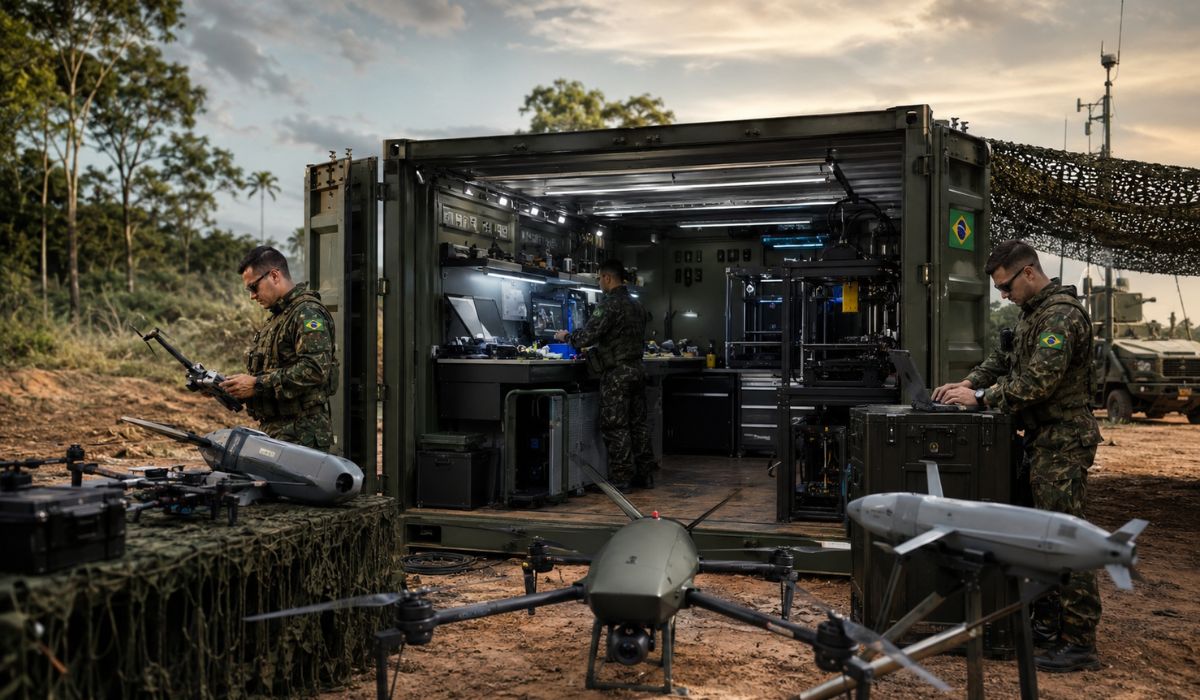
The factory that fits in a container: Brazilian Army wants to produce bomber and kamikaze drones on the front line with 3D printing, seeks partners to set up a mobile combat unit, and tries to shorten in Brazil the war logic that exploded in Ukraine.




The estimate indicates a more concrete horizon for a technology that, until recently, seemed distant from the market.

Gradual development marks the new phase of quantum technology
Amazon’s forecast does not point to a sudden arrival of commercial quantum computers.
On the contrary, the advancement should occur progressively, with smaller, limited systems aimed at highly specific tasks.
According to DeSantis, this evolution may resemble the advancement of semiconductors, marked by continuous gains in capacity over time.
The comparison involves the so-called Moore’s Law, used to describe the gradual growth of traditional chip power.
Among the expected first steps are:
- still small quantum systems;
- initial use in specific problems;
- gradual performance advancement;
- continuous growth of computational capacity;
- technology still in experimental phase.
Quantum computing will not just be a faster computer
Quantum computing should not be seen as a sped-up version of current computers, despite the growing interest in the sector.
In practice, the logic of operation is different.
Traditional computers work with bits. Quantum systems, on the other hand, use qubits, which allow dealing with certain problems in a different way.
According to Peter DeSantis, a quantum computer should solve specific challenges that classical computers do not handle well today.
Moreover, these systems can perform this type of task with much superior performance when the technology is mature.

Ocelot Chip targets one of the biggest challenges in the sector
Amazon had already reinforced its entry into this race in February 2025, when Amazon Web Services introduced the quantum chip Ocelot.
According to Amazon itself and Amazon Science, the Ocelot was developed to tackle one of the main obstacles of quantum computing: error correction.
This point is essential because qubits are sensitive to interference and can lose stability during calculations.
Reuters also highlighted that the chip seeks to reduce the resources needed to make quantum computers commercially viable.

Big techs accelerate the race for space in the quantum race
The race for quantum computing involves some of the world’s largest technology companies.
Google, Microsoft, IBM, Amazon, and various startups continue to invest in their own architectures to try to overcome technical limitations.
In this scenario, Amazon bets on chips, error correction, and integration with its artificial intelligence strategy.
Technology, however, continues to develop, without a wide commercial application available to the public.
Where Quantum Computing May Make a Difference First
The first practical impacts should appear in areas where traditional computers face clear limitations.
For this reason, Amazon points to quantum computing as a possible tool for high-complexity scientific simulations.
The initial applications may involve:
- advanced chemistry;
- complex reactions;
- materials studies;
- precise scientific simulations;
- problems beyond the reach of current classical computing.
What to Expect in the Coming Years?
Amazon’s forecast shows that quantum computing may enter a more concrete phase by the beginning of the next decade.
Even so, the advancement should be technical, gradual, and restricted in the early years.
The expectation is not to replace common computers, but to solve very specific problems with superior efficiency.
While companies like Amazon, Google, Microsoft, and IBM compete for space, quantum computing is consolidating as one of the most strategic areas of global technology.
Do you believe that quantum computing will reach commercial use sooner than expected or will it take longer to come out of the labs? Leave your opinion!


Be the first to react!