Portuguese
  Spanish


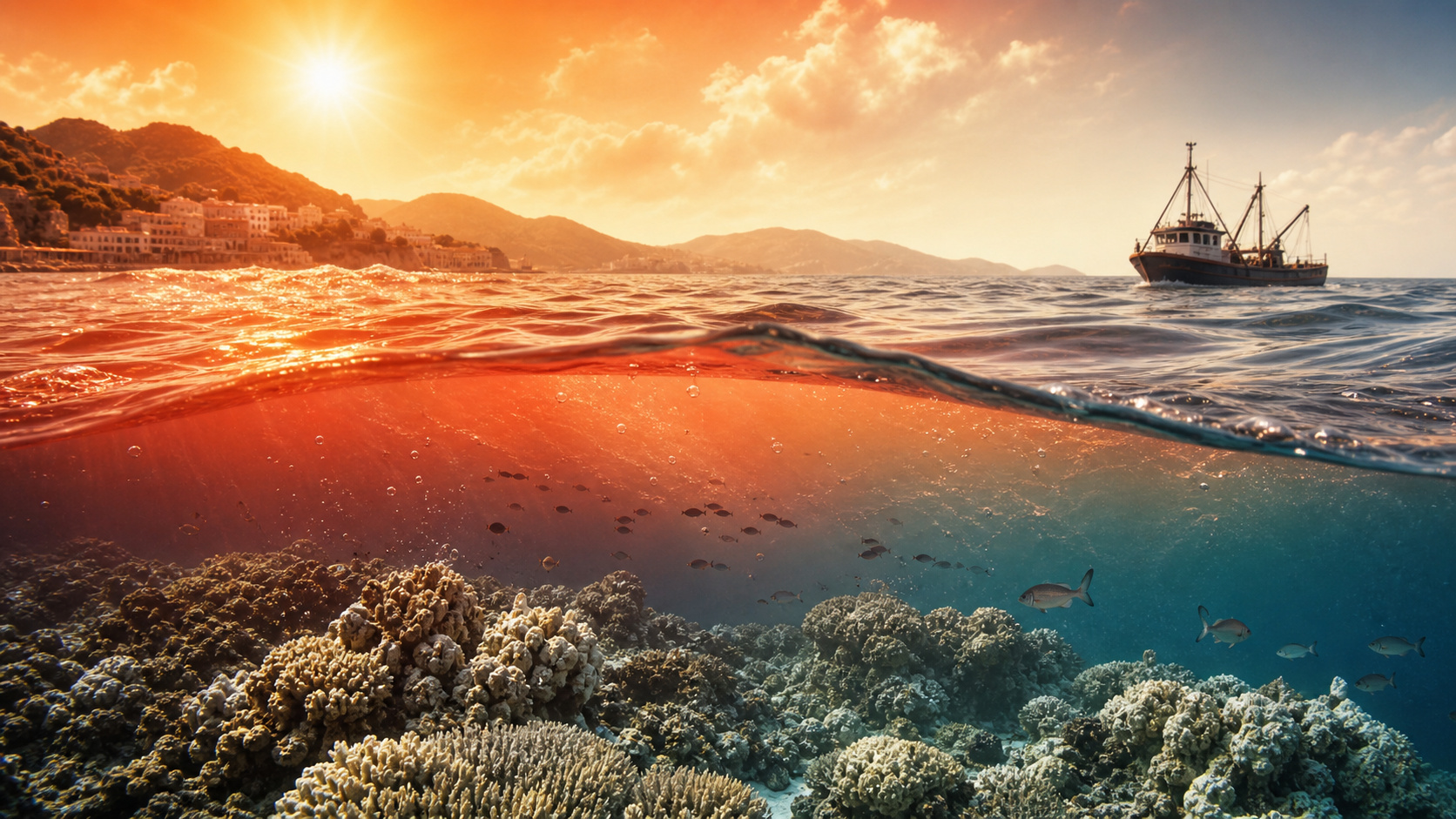

The Mediterranean Sea is warming rapidly with more frequent marine heatwaves, threatening biodiversity, fisheries, and coastal economies in one of the planet’s most sensitive climatic regions.
In 2025, the Mediterranean Sea, located between Europe, North Africa, and the Middle East, returned to the scientific spotlight after recording a sequence of intense marine heatwaves, with sea surface temperatures well above the historical average. According to the Copernicus Marine Service, June 2025 was the hottest June ever recorded in the Mediterranean, with an average sea surface temperature of 23.86°C ± 0.47°C and about 62% of the basin affected by marine heatwave conditions.
The most concerning data is that this warming did not appear as an isolated episode. The ocean temperature bulletin from Mercator Ocean International, linked to the Copernicus service, indicates that throughout 2025, the area affected by marine heatwaves in the Mediterranean fluctuated daily between 2% and 74% of the basin, with a rapid jump in June, when the extent of the phenomenon advanced from 2% to 62% in just 20 days.
This behavior reinforces a technical interpretation increasingly discussed in climatology: the Mediterranean functions as a kind of semi-enclosed heat retention basin, connected to the Atlantic by the Strait of Gibraltar, but with limited circulation compared to open oceans. When the atmosphere warms and high-pressure events persist over the region, heat accumulates more easily on the sea surface and dissipates with more difficulty.
-
Germany Opens World’s Largest Smart Power Semiconductor Factory with €5 Billion Investment, Creating 1,000 Jobs and Doubling Capacity for AI and Energy Needs

-
Kazakhstan’s Torysh Valley Holds Thousands of Giant Stone Spheres, Intriguing Scientists with Ancient Oceanic “Cannonballs”

-
Egypt Discovers 18 Ancient Tombs with Gold Tongues, Unveiling Unusual Funeral Rituals and Amulets Believed to Give Voice to the Dead

-
Nigeria Dumps 120 Million Tons of Sand into Atlantic to Build Massive City with 8.4 km Sea Wall for Protection Against Ocean Waves and Erosion

Mediterranean temperatures were several degrees above average and anticipated conditions typical of the peak of summer
In July 2025, Reuters reported that Mediterranean temperatures rose sharply during a marine heatwave in June, with scientists warning of a direct risk to sensitive species and a possible record period of warming. The report highlighted that the phenomenon was observed at an unusual time of year, before the traditional peak of the European summer, which increases pressure on ecosystems already entering the warm season under elevated thermal stress.

This point is important because the sea does not respond like the air. The atmosphere can cool in a few days after a cold front or change in winds. The ocean, on the other hand, stores heat for longer. When the surface of the Mediterranean reaches abnormal temperatures early in the summer, marine organisms begin to face weeks or months of continuous exposure to above-normal conditions.
In some areas of the western Mediterranean and the Balearic Islands, scientific records indicated even more intense anomalies in 2025. The Balearic Islands Coastal Observing and Forecasting System, SOCIB, reported in January 2026 that, during 2025, some parts of the Mediterranean showed sea temperatures up to 6.5°C above the 1982-2015 reference average.
Marine heatwaves are not just warm water, but extreme events capable of disrupting entire ecosystems
A marine heatwave occurs when the sea temperature remains for a prolonged period above an extreme statistical threshold for that region and time of year. In practice, this means that the ocean enters an unusual, persistent, and biologically aggressive thermal condition. In the Mediterranean, this type of event is concerning because many organisms live close to their thermal tolerance limit and depend on relatively stable seasonal cycles.


The problem is not just the maximum temperature, but the duration of the thermal stress. When marine heat prolongs, corals, gorgonians, algae, mollusks, fish, and microorganisms begin to face simultaneous changes in metabolism, reproduction, feeding, and geographical distribution. Species that cannot migrate or adapt quickly become more vulnerable to mass mortality.
A study published in 2025 in the journal State of the Planet, within the Copernicus Publications platform, highlighted that the 2023 marine heatwave in the Mediterranean was the longest in four decades and affected biodiversity, fisheries, and coastal livelihoods, in addition to favoring the expansion of invasive species, such as the Atlantic blue crab and the bearded fireworm in areas of the Italian coast.
The Mediterranean has become a climate laboratory because it warms rapidly and concentrates high human pressure
The Mediterranean is considered one of the most vulnerable marine regions on the planet because it combines three critical factors: accelerated warming, high coastal population density, and strong economic dependence on the sea. The region supports tourism, fishing, maritime transport, aquaculture, strategic ports, and coastal ecosystems of enormous environmental value.
When a marine heatwave hits the Mediterranean, the impact is not restricted to marine biology. It spreads to fisheries, the income of coastal communities, food security, tourism, and environmental management. Fish can alter routes and depths, invasive species can gain an advantage, sessile organisms on the seabed can die on a large scale, and entire food chains can be reorganized.

This is one of the reasons why scientists monitor the Mediterranean as an early warning sign of what may occur in other ocean regions. Being a relatively small, semi-enclosed, and intensely monitored basin, it responds quickly to atmospheric and oceanic changes. What appears there on a regional scale can help understand processes that, in other seas, are still developing less visibly.
Warming weakens water mixing, reduces oxygen, and changes the basis of marine life
The increase in temperature also alters the physical structure of the sea. Warmer water becomes less dense and tends to remain in the upper layers, hindering vertical mixing with deeper waters. This process increases stratification, reduces nutrient renewal, and can affect oxygen availability in certain regions.
In the Mediterranean, this dynamic is especially sensitive because biological productivity depends on circulation and nutrient replenishment. When the water column becomes more stratified, the food available for phytoplankton can decrease. Since phytoplankton is at the base of the marine food chain, any persistent alteration at this level can affect fish, crustaceans, mollusks, and larger predators.
Sea warming also reduces the water’s capacity to retain dissolved oxygen, creating more difficult conditions for organisms that depend on well-oxygenated environments. This type of change may not be visible to bathers or tourists but alters the internal functioning of the ecosystem.
Mediterranean biodiversity faces pressure from invasive species and mass mortality
The Mediterranean has been dealing for decades with the entry of species from other regions, especially through the Suez Canal and maritime transport. Water warming can amplify this process, favoring organisms adapted to warmer seas and pressuring native species that evolved in colder or more stable conditions.
This phenomenon is known as tropicalization. It changes the composition of marine communities and can generate concrete economic impacts. Some invasive species compete for food, prey on local organisms, or alter coastal habitats. In certain cases, they become direct problems for fishermen, bathers, and tourist activities.
The research on the Italian coast cited by Copernicus Publications shows exactly this type of transformation, associating marine heatwaves with the expansion of species such as the Atlantic blue crab and the bearded fireworm, both with potential impacts on ecosystems and human activities.
Fishing, tourism, and coastal cities are in the line of impact from Mediterranean warming
The Mediterranean is not just a natural system. It is also a vital economic space for dozens of countries. When the sea warms, fishing can lose predictability. Commercial species can migrate, reduce reproduction, or change depth. This affects small vessels, local markets, and entire production chains.
Tourism also enters this equation. Beaches, diving, navigation, and coastal activities depend on healthy ecosystems and environmental quality. When there is a proliferation of invasive species, mortality of organisms, loss of biodiversity, or more frequent extreme events, the attractiveness of coastal areas can be affected.
The greatest risk is that the Mediterranean will come to experience recurrent extreme events, and not just exceptional episodes. This changes the logic of adaptation. Governments, scientists, fishermen, and tourism sectors stop dealing with a rare anomaly and start facing a new environmental pattern.
Recent records indicate that the Mediterranean is accumulating heat at a rate difficult to ignore
The year 2025 reinforced the European and oceanic warming trend. In April 2026, a Reuters report based on a report from the World Meteorological Organization and the Copernicus Climate Change Service informed that 2025 had above-average temperatures in 95% of Europe and that 86% of European waters faced strong marine heatwaves.
This data broadens the context of the issue. The Mediterranean is not isolated from a larger change. It is part of a European and global climate system that recorded extreme heat, oceanic records, and severe environmental events. What makes the Mediterranean region especially sensitive is its geographical configuration, its human density, and its highly pressured biodiversity.
Copernicus itself has already pointed out that June 2025 was exceptional in the Mediterranean, both for the average surface temperature and the extent of the marine heatwave. When an event of this type occupies more than half of the basin in a few days, the signal ceases to be isolated and begins to indicate a large-scale thermal reorganization.
Scientists investigate how much of this extreme heat already carries the mark of human-caused climate change
The relationship between marine heatwaves and global warming is one of the most active fields in climate science. A scientific preprint published on the EGUsphere platform in 2026 analyzed the attribution of the 2025 Mediterranean marine heatwave and described the event as a record, investigating its relationship with human-induced climate change. As the work is still in preprint format, it should be treated with caution, but it reinforces the scientific relevance of the episode.
The physical basis, however, is already well established: oceans absorb a large part of the excess heat from the climate system. When the atmosphere warms, the sea accumulates energy. In semi-enclosed regions like the Mediterranean, this accumulation can produce more intense extreme events, especially when combined with atmospheric blocks, weak winds, and strong solar radiation.
The central question for science now is not whether the Mediterranean is warming, but at what speed this warming will reorganize its ecosystems and coastal economies.
The Mediterranean shows how an entire sea can change before the impact is visible on land
The most unsettling aspect of this issue is that much of the transformation happens outside of direct view. The sea may appear normal on the surface, with crowded beaches and seemingly calm waters, while the accumulated temperature alters invisible processes below the waterline. This difference between appearance and reality makes marine heatwaves especially dangerous from an environmental perspective.
When corals, gorgonians, fish, mollusks, and microorganisms begin to respond to heat, the system may already have been under pressure for weeks. When fishing observes a decline or displacement of species, the ecological change has already progressed. When invasive species become established, returning to the previous equilibrium becomes much more difficult.
The Mediterranean, therefore, has become one of the most important regions for understanding the future of the seas on a warmer planet. The basin is showing, on an accelerated scale, how the ocean reacts when heat ceases to be an exception and becomes part of the regular functioning of the system.