Portuguese
  Spanish


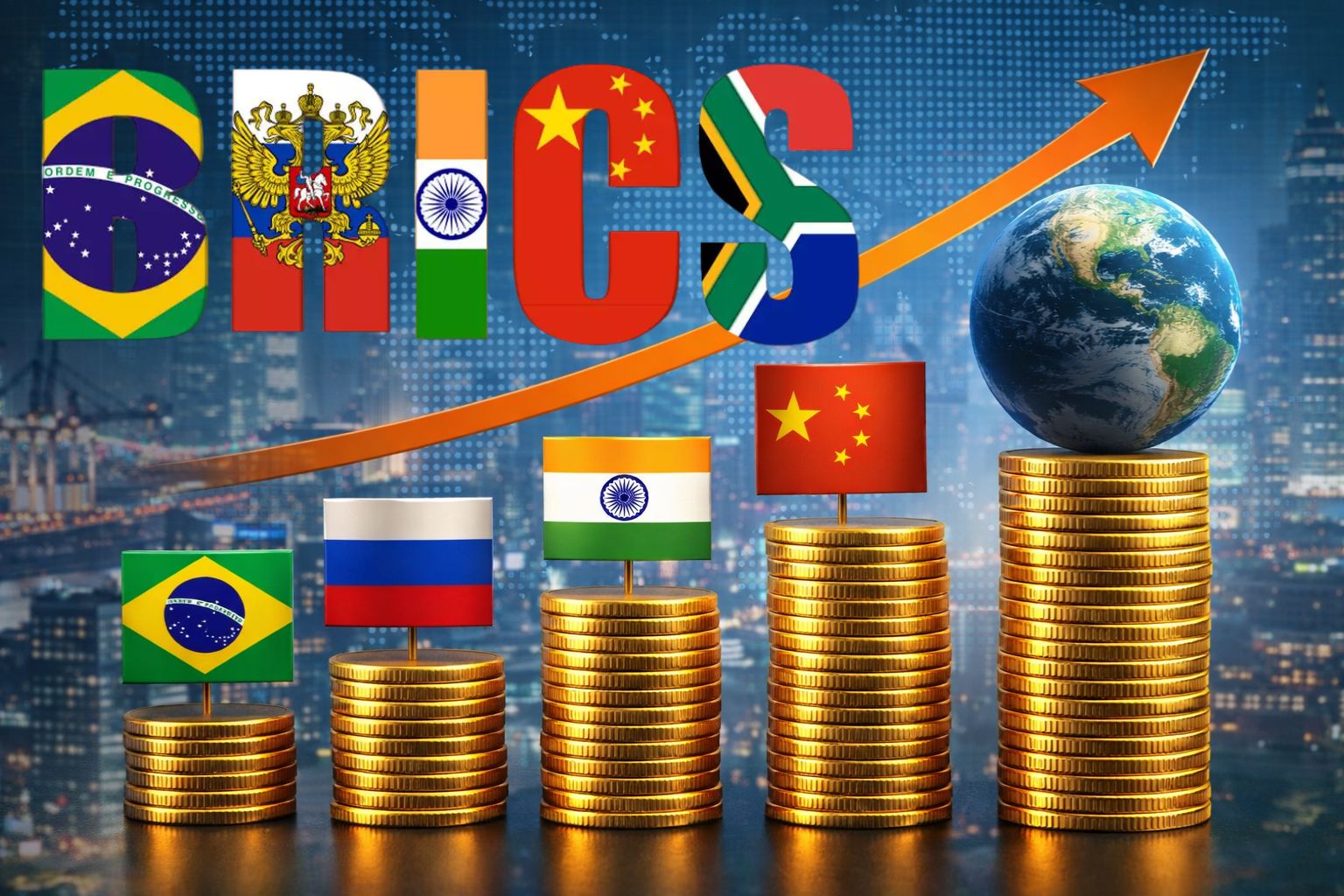


The IMF’s World Economic Outlook projects that BRICS countries and emerging economies will grow above the global average of 3.1% in 2026. Emerging Asia is expected to expand by 4.9%, Sub-Saharan Africa by 4.3%, and India leads with 6.5%. Meanwhile, Europe grows only by 1.1% and the United States by 2.3%, pressured by inflation, wars, and demographic aging.
The axis of the global economy is shifting, and the countries of the BRICS are at the center of this transformation. The latest World Economic Outlook report from the International Monetary Fund, released in April 2026, confirms that emerging economies and Global South countries are growing at a consistently higher rate than traditional powers. Emerging Asia is expected to expand by 4.9% in 2026, Sub-Saharan Africa by 4.3%, and India, the world’s fastest-growing economy, projects an average close to 6.5%, while the global average will be 3.1%. On the other end, Europe grows only by 1.1% and the United States reaches 2.3%, numbers that reflect high interest rates, inflationary cycles, and war spending that may have hit one trillion dollars in the American case.
The scenario described by the IMF is not an isolated surprise; it is the confirmation of a trend that is accelerating. BRICS countries combine expanding demographics, accelerated urbanization, infrastructure projects focused on the extractive sector, and investments driven by China, creating a positive growth differential that persists even in a global environment marked by uncertainties and geopolitical tensions. Guyana, driven by its oil reserves, leads the global ranking with a growth of 16.2%, but it is the major BRICS members that demonstrate that the shift of the economic center is structural, not cyclical.
What the IMF report says about the growth of BRICS countries
The IMF numbers show a clear divide between emerging and developed countries. Emerging Asia, which includes India and China, projects growth of 4.9% in 2026, nearly five times more than Europe (1.1%) and more than double that of the United States (2.3%). Sub-Saharan Africa appears with 4.3%, and Latin America grows driven by high commodities. The global average of 3.1% hides this divide: BRICS countries and their partners pull the average up, while advanced economies drag it down.
-
At 14 years old, she worked in a factory in Hong Kong, studied economics abroad, and then entered the Chinese real estate market, which helped change the landscape of Beijing.

-
While NATO secured more than $10 billion in missiles and space surveillance at a single forum, Brazil still spends 1.1% of its GDP on defense and is stalling its own anti-aircraft system.

-
Corn ethanol attracts R$ 23 billion in 21 new plants and prepares for a nearly 50% jump in Brazilian production by 2027, even with high interest rates.
-
A newly opened terminal in the middle of the Amazon has begun transporting soy and corn through Amapá, eyeing the queue of ships that is congesting the ports in the South.


India, a member of BRICS and the fastest-growing economy in the world by 2026, is the most emblematic case. The country combines population growth with the expansion of the middle class and the rapid adoption of artificial intelligence, with nearly 60% of Indian companies already using some form of AI, well above the global average. According to IMF simulations, productivity gains driven by AI could increase total factor productivity in emerging Asia by 0.3 to 3 percentage points over a decade, a differential that BRICS members are positioned to capture.
Why Europe and the United States Are Falling Behind BRICS
According to information from Revista Fórum, the modest performance of advanced economies has multiple mutually reinforcing causes. Europe is growing only 1.1% in 2026, pressured by the ongoing energy supply crisis stemming from reduced Russian oil and gas imports, by demographic aging that reduces the workforce, and by high interest rates that make credit more expensive and slow down investment. The continent that dominated the global economy for centuries now faces a cycle of stagnation that contrasts with the dynamism of BRICS countries.
The United States, with projected growth of 2.3%, is in a better position than Europe but faces its own bottlenecks. The country may have spent the equivalent of one trillion dollars on war efforts against Iran, according to a Harvard study, a budgetary pressure that adds to persistent inflation and fiscal constraints. While BRICS members invest in infrastructure and productive expansion, the U.S. directs massive resources to military operations that do not generate direct economic returns for the population.
The Convergence Effect Benefiting BRICS Countries
An economic concept called “convergence effect” or “catch-up” helps explain why BRICS countries are growing faster. Emerging economies that invest in technology and infrastructure achieve greater short-term gains than already developed countries, because they are starting from a smaller base and each investment generates a proportionally higher return. It’s like the difference between improving a dirt road and optimizing an already paved highway: the impact of the first improvement is much greater.
This effect becomes particularly relevant in the technology sector, where India, a BRICS member, is already establishing itself as a country of innovation in artificial intelligence. Advanced countries, which operate close to the technological frontier, rely on incremental innovation with more gradual gains, while emerging countries can make leaps by importing and adapting already existing technologies. The result is that the productivity of BRICS members grows faster, even though their absolute level is still lower than that of developed economies.
The Role of Commodities in the Growth of BRICS Countries
In Latin America and Africa, the accelerated growth of BRICS members and their partners continues to be strongly linked to commodities. In periods of high international prices, like the current one, driven by geopolitical tensions and oil supply constraints, exporting countries benefit directly, and Brazil is a clear example: the projection for Brazilian growth is expected to increase in 2026 precisely because the prices of the raw materials that the country exports are on the rise.
However, the IMF warns that this growth can be treacherous. The appreciation of commodities improves terms of trade and increases external revenues, but primarily generates short-term growth, subject to new shocks in demand. The Brazilian projection, for example, will be lower in 2027, reflecting the IMF’s expectation of a contraction in global oil demand. For BRICS members that depend on commodities, economic diversification remains the biggest challenge to transform cyclical growth into sustainable development.
What the economic shift to the South means for the global future
The IMF report confirms that the center of gravity of the global economy continues to migrate to the South. BRICS countries and emerging economies are not only growing faster: they are redefining who produces, who consumes, and who sets the rules of international trade. The geopolitical and commercial fragmentation that the IMF identifies as a risk is, at the same time, an opportunity for emerging economies to build their own value chains that reduce dependence on systems controlled by the Global North.
For citizens of BRICS countries, the scenario is one of opportunity with caveats. Growth is real and measurable, but it is not homogeneous or guaranteed, and depends on political choices that include investment in education, economic diversification, environmental protection, and income distribution. While Europe stagnates and the United States spends trillions on wars, BRICS countries have the chance to consolidate a development model that does not repeat the mistakes of the North. The question is whether they will seize it.
The IMF confirms that BRICS is growing faster than Europe and the US. Do you think Brazil is taking advantage of this opportunity? Will the Global South lead the world economy? Leave your opinion in the comments.