






 Portuguese
  Spanish


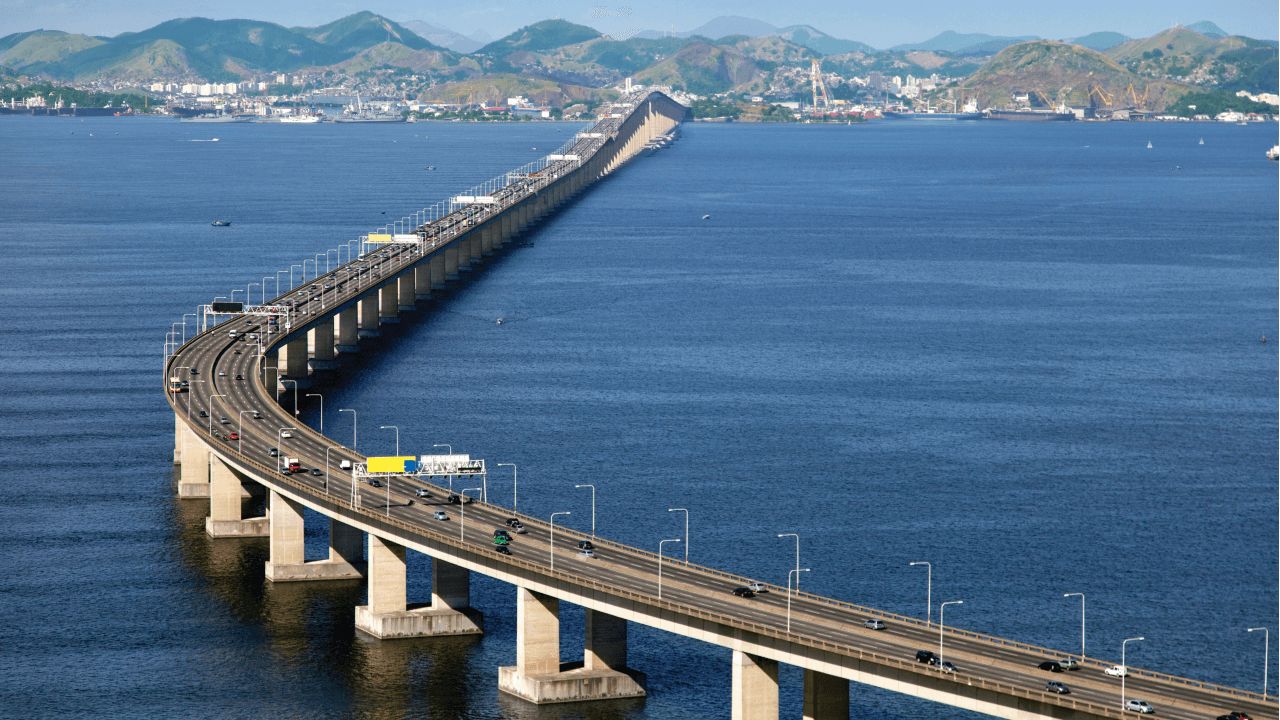


Rio-Niterói Bridge: discover the history, challenges, and secrets of the largest bridge in the Southern Hemisphere.
On March 4, 1974, a structure of concrete, steel, and daring forever transformed the relationship between two of Rio de Janeiro’s most important cities. The Rio-Niterói Bridge — officially named Presidente Costa e Silva Bridge — was inaugurated after four years and six months of construction, with over 10,000 workers mobilized and a total cost of US$ 674 million, according to information from O DIA and Ecovias Ponte. Today, the largest bridge in the Southern Hemisphere and the 23rd longest in the world celebrates its golden anniversary, receiving an average of 180,000 vehicles per day — and carrying decades of stories that go far beyond the asphalt.
Back to Guanabara Bay: what existed before the bridge
Before March 1974, those who needed to go from Rio de Janeiro to Niterói — or vice versa — had few options. The land route required a detour of over 100 kilometers, circling Guanabara Bay. The most practical alternative was the Ferries (Barcas), which crossed the bay but depended on schedules and weather conditions.
The idea of a fixed connection between the two banks, however, was not born in the 20th century. On March 4, 1876 — exactly 98 years before the inauguration — Emperor Dom Pedro II had already signed a decree authorizing the construction of a submarine tunnel that would connect the Empire’s capital to the “City of Nictheroy.” The initiative never materialized.
-
U.S. City Builds Tiny Home Village on Water Company Land to House 136 Homeless People: Inside the Social Housing Units

-
Woman Turns Shipping Container into Home, Embraces Rural Life to Cut Monthly Expenses to Just Over $330
-
France Revamps 530 Social Housing Units with Large Balconies and Glass Facades Without Demolishing Existing Buildings

-
Facing high rent, couple transforms parents’ garage into a fully functional apartment, creating a complete home at a fraction of the market cost.




Almost a century later, in 1966, the project gained new momentum during the military government. The decision to build the bridge was made, and funding came from a British loan of approximately US$ 20 million, made possible during the administration of President Costa e Silva — who gives the structure its official name. Queen Elizabeth II’s visit to Brazil at the time included a stop at the start of the construction work.

The inauguration, in 1974, was conducted by President Emílio Garrastazu Médici, who crossed the bridge in a Rolls Royce, accompanied by then-President João Figueiredo and Minister of Transport Mário Andreazza, considered the project’s mastermind.
The numbers that make the Rio-Niterói Bridge a global reference
With a total length of 13.29 kilometers, 8.83 km of which are over water, the bridge is one of the most impressive engineering works in the Americas. Its most emblematic point is the Central Span — the largest continuous straight beam in the world, 300 meters long and 72 meters high — through which large vessels pass.
The structure is composed of a monumental volume of materials:
- 1.152 million beams
- 43 thousand cables
- 3.250 million concrete segments
- 1.138 million marine caissons
- 103 pillar-block sets
- More than 2.150 million kilometers of internal cables — which makes it the largest prestressed structure in the Americas (a technique that increases concrete strength)
When it was completed, the Rio-Niterói Bridge ranked 3rd among the world’s largest bridges. Today, half a century later, it remains among the 25 largest on the planet.
The “father of the bridge”: the engineer who has been there since the beginning
Among the approximately 200 engineers who participated in the construction, one name stands out for the longevity of his connection to the project: Carlos Henrique Siqueira, a native of Paraíba who graduated from the Federal University of Paraíba, joined the project in October 1972 and, to this day, remains one of the structure’s greatest technical references.
His arrival at the bridge was almost by chance. In an interview for the website O DIA, he says he graduated ” from the Federal University of Paraíba and came to Rio de Janeiro to do postgraduate studies and a master’s degree, to later return to my hometown and teach at the School of Engineering. In the meantime, I was offered the option of working on the subway construction or on the Rio-Niterói Bridge. No need to say what my choice was, right?”, says Siqueira, proudly.

More than five decades later, he reflects on what the work represents: “The Rio-Niterói Bridge is the greatest symbol of Brazilian engineering. Globally, it is one of the biggest references in terms of maintenance of large structures. We have already given lectures in several countries, such as the United States, Canada, China, India, Nigeria, Switzerland, Germany, and South Korea, to show what we do here”, he states.
For him, the bridge is personal: “It represents what is most sublime and important in my career. The Rio-Niterói Bridge is part of my life forever. I have four sons, and the bridge is the daughter I never had”, declares Carlos Henrique.
The biggest challenges of construction — and the tragedies that marked the project
Building a 13.2-kilometer bridge over a bay was no simple task. Carlos Henrique lists the most critical challenges faced by the engineering team: the deep foundations, which reached rock 60 meters below sea level, submerged concreting, and the assembly of metallic caissons — which, at the time, represented the largest operation of its kind in the world.
The project also came at a high human cost. “40 employees died. In a single accident, involving a floating platform, there were 8 fatalities, three of whom were engineers. It was very sad”, recalls Siqueira. In addition to the losses, the construction faced financial difficulties and was even paralyzed for six months, under criticism of economic and social viability.
Why the bridge sways — and why that’s normal
Many drivers have felt the bridge sway and wondered if something was wrong. The answer is no. Carlos Henrique explains that the movement is part of the design:
“The bridge sways, and that’s natural. The passage of mobile loads moves and influences the structural behavior. If the bridge didn’t move, something would be wrong. So, it shakes, sways, and that’s perfectly normal. It’s the response the structure gives to the passage of vehicles.”
The same applies to the visible cracks in the roadway. Known as expansion joints, these are openings intentionally left in the design to allow the concrete to expand and contract with temperature variations — without causing damage to the structure.
Although the movement is normal, there was a problem: in winds between 58 km/h and 62 km/h, the Central Span of the Rio-Niterói Bridge would oscillate 65 centimeters up and 65 centimeters down — totaling 1.30 meters of variation. The effect caused panic among drivers.

The solution came in 2004, developed by the Alberto Luiz Coimbra Institute for Graduate Studies and Research in Engineering (Coppe/UFRJ): the Synchronized Dynamic Attenuators (ADS) system, installed under the Central Span. The equipment consists of 32 two-ton steel boxes each and 192 springs, which act as a counterbalance to movements caused by the wind.
“Today, when the bridge is excited by the wind, the attenuators counteract the movements of the wind action, and thus, the structure oscillates 5 cm up and 5 cm down”, explains Siqueira — a reduction of more than 90% in the amplitude of oscillations.
Rio-Niterói Bridge vs. ship: the 2022 accident and the engineering response
On November 14, 2022, around 6 PM on a Monday, an unusual incident put the bridge on high alert. The ship São Luiz, which had been anchored for six years in Guanabara Bay, broke loose during a strong gale and collided with six pillars of the structure, forcing the total closure of the roadway.
Carlos Henrique was immediately called. As traffic was stopped throughout the city, the concessionaire sent a speedboat to pick him up. “At night, when I arrived to see the pillars, the bridge was already closed, as the extent of the accident was unknown. Even in the dark, but with large spotlights, I took a look at the damaged pillars and verified that the marks were not sufficient to warrant closing traffic,” he reports.
The lane closest to the guardrail was kept closed as a precaution, but the others were reopened on the night of the accident. The next day, a complete inspection was carried out and a technical report confirmed that there was no structural risk.
“It is worth noting that ordering the bridge to be closed is an act of extreme responsibility. But to order it open requires a lot of courage, determination, firmness, and security,” says Siqueira. He adds that this was not the first episode of its kind: “The bridge has been struck by a ship at least six other times.”

Modernizations over 50 years
The structure did not stand still. Over the five decades, several improvements have been implemented:
- 2004: installation of Synchronized Dynamic Attenuators (ADS) by Coppe/UFRJ;
- 2009: lane reordering, expanding from three to four lanes and increasing road capacity;
- 2015: the bridge began to be managed by Ecovias Ponte (formerly Ecoponte), a concessionaire of the EcoRodovias Group;
- 2016: expansion of the toll plaza, installation of LED lighting, and adoption of anti-glare lamellas — a system that eliminates night glare caused by vehicle headlights.
“It will still last another 100, 200 years”
With over 50 years, the Rio-Niterói Bridge has already overcome all the skepticism that accompanied its construction. For Carlos Henrique Siqueira, the future of the work is as solid as its foundations.
“We have problems, but we know how to monitor and repair them at the right times. We have control of the work in our hands. In Brazil, the bridge is incomparable. Worldwide, we are known for the level of quality in maintaining our structures. It will still last another 100, 150, 200 years,” says the engineer.








