Portuguese
  Spanish


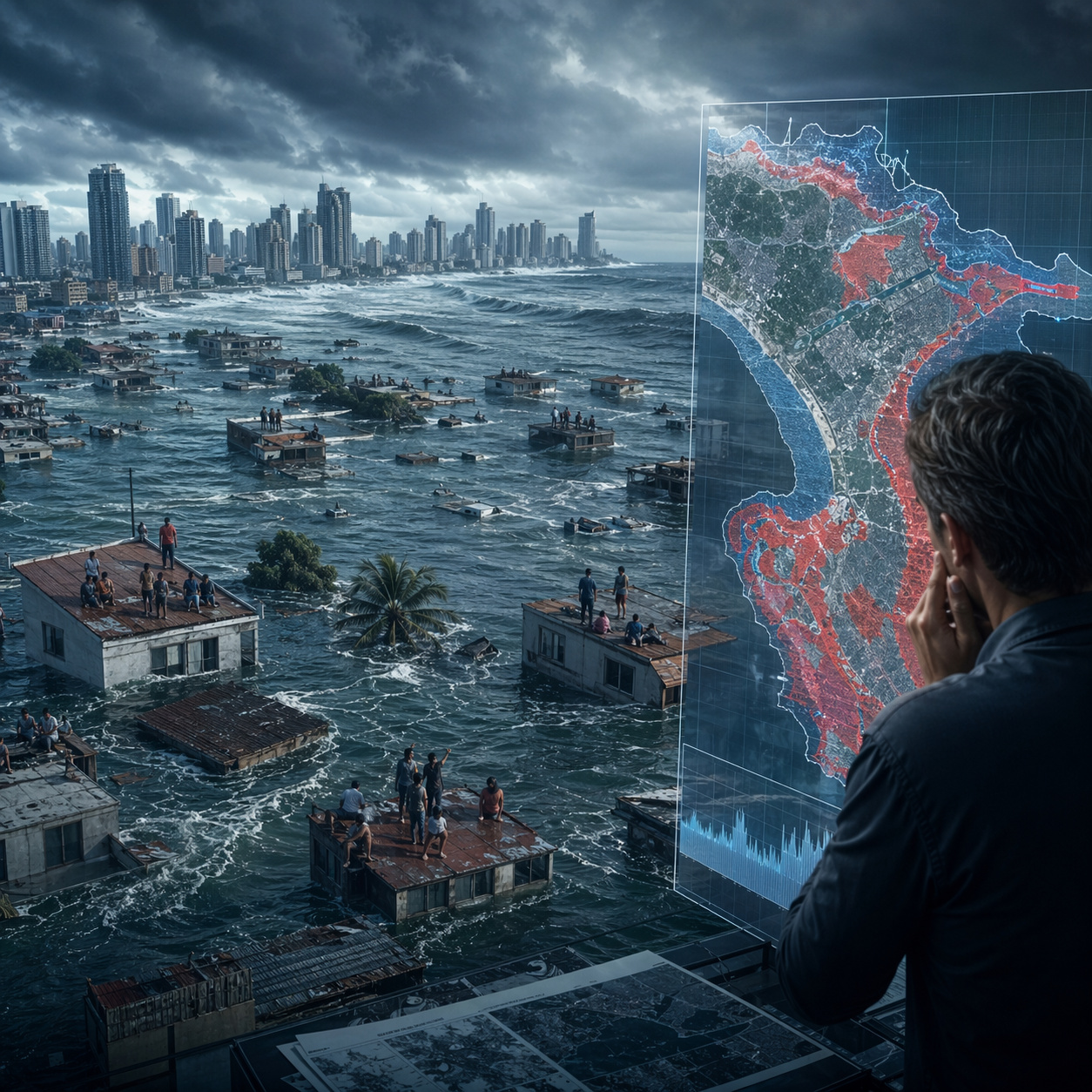

Study reveals error in over 99% of coastal analyses and indicates that up to 132 million people could be below sea level.
On March 4, 2026, a study published in Nature by Katharina Seeger and Philip S. J. Minderhoud raised an alarm that could significantly change how the world calculates the risk of sea encroachment on coastal areas. By reviewing 385 peer-reviewed scientific studies, published between 2009 and 2025, the researchers concluded that over 99% of the analyzed assessments inadequately addressed the relationship between sea level and land elevation, which may have downwardly distorted the actual exposure of coastal lands and populations.
The work, conducted by a team linked to Wageningen University & Research, the University of Cologne, the University of Padova, and Deltares, showed that the problem was not necessarily in the digital elevation models themselves, but in how these data were compared with inadequate oceanic references. In much of the reviewed literature, studies assumed coastal levels based on geoids instead of using actual sea measurements, ignoring that the oceanic level on the coast varies according to tides, currents, winds, and other local conditions.
This technical mismatch, although seemingly subtle, can strongly alter the global risk estimate. According to Nature itself, the measured coastal level is, on average, 0.24 m to 0.27 m higher than assumed in many studies, and in parts of the Global South, this difference can exceed 1 meter. With the correction, a hypothetical relative sea level rise of 1 meter would result in 31% to 37% more land and an additional 77 million to 132 million people being considered below sea level
-
16-Year-Old from Brazil’s Sertão Wins Young Scientist Award for AI Predicting Rainfall with 94.5% Accuracy to Aid Farmers

-
Netherlands Reports First Child Euthanasia Case Since Rule Expansion for Minors

-
Brazilian Innovator Survives Homemade Submarine Dive in Paraty Despite Hatch Leak and False Oxygen Alarm
-
China Develops Custom 140-Ton Electric Mining Truck with 770 kWh Swappable Battery, Deploys 290 Units in Xinjiang’s Largest Zinc Mine



Difference between real sea level and models used by science alters global estimates
The central point of the study lies in the distinction between two fundamental concepts: the real mean sea level and the so-called geoid, a theoretical surface used as a reference in many geodetic models.
While the real sea level varies according to factors such as ocean currents, temperature, and salinity, the geoid represents a global average based on Earth’s gravitational field. In many analyzed studies, land altitude was compared with the geoid, and not with the locally observed sea level.


This difference may seem small, but in flat coastal regions, where a few centimeters make a big difference, the impact is significant.
By correcting this deviation, researchers discovered that large coastal areas are closer to sea level than previously believed, increasing the number of people potentially exposed to flooding.
Review indicates that up to 132 million people could be below the waterline with a 1-meter elevation
Based on the methodological correction, the study recalculated the impact of a relative elevation of 1 meter in sea level. The results show that between 77 million and 132 million people could live in areas that would be below the waterline in this scenario.
This range reflects different levels of uncertainty in the data, but all scenarios point to a significant increase compared to previous estimates.
Furthermore, the authors indicate that the affected land area could be between 31% and 37% larger than what had been considered in previous studies. This means that the global risk not only exists but may already be underestimated on a planetary scale.
Densely populated coastal regions concentrate greater vulnerability
The impact of this review is especially relevant in regions where large populations live near sea level. Areas such as Southeast Asia, the Ganges-Brahmaputra delta, parts of coastal China, and urban regions of developing countries show high population density in low-lying areas.
In these locations, small differences in elevation measurement can mean the inclusion or exclusion of millions of people in risk zones.
The correction proposed by the study indicates that many of these regions may be more exposed than urban planners and governments have been considering.
Sea level rise is driven by global warming and ice melt
Sea level rise is one of the most direct effects of climate change. It occurs mainly through two mechanisms:
- The thermal expansion of ocean water as it warms
- The melting of glaciers and ice sheets in Greenland and Antarctica
According to the Intergovernmental Panel on Climate Change, the average sea level has already risen about 20 centimeters since the beginning of the 20th century, and the rate of rise has accelerated in recent decades.

Projections indicate that, by the end of the 21st century, the increase could reach values close to or exceeding 1 meter, depending on the emissions scenario. This context makes the precision of coastal analyses even more relevant, as adaptation decisions depend directly on these estimates.
Methodological error can affect public policies and urban planning
Coastal risk estimates are used by governments, international organizations, and companies to plan investments in infrastructure, flood protection, and climate adaptation.
If these estimates are underestimating the risk, important decisions may be being made based on incomplete information.
This includes:
- Planning of coastal cities
- Construction of dikes and barriers
- Definition of residential zones
- Risk assessment for insurance
An underestimation of risk can lead to insufficient or misdirected investments, increasing vulnerability to future events.
Model adjustment can redefine global climate risk maps
With the correction proposed by the study, global coastal risk maps may need to be revised. This means that areas previously considered safe may now be classified as vulnerable, while regions already identified as at risk may require even more urgent measures.
This revision does not happen automatically. It depends on the incorporation of new methodologies into climate models, planning systems, and public policies. The process can take years, but the warning has already been issued: the real risk may be greater than what appears on current maps.
Economic and social impacts can reach a global scale
Sea level rise does not only affect isolated areas but can have broad consequences for economies and societies. Coastal cities concentrate a large part of the world’s population, as well as critical infrastructure such as ports, industries, and financial centers.
Frequent floods, loss of territory, and the need for relocation can generate significant economic impacts.
Furthermore, forced migration of populations can increase pressure on internal regions and generate social and political challenges. The increased risk identified by the study expands the dimension of these possible consequences.
Study reinforces the importance of scientific precision in climate analyses
One of the main messages of the research is the importance of methodological precision. Small errors or simplifications in models can translate into large differences when applied on a global scale.
In the case of coastal analyses, the choice of reference for measuring altitude proved to be a critical factor. Correcting this point can significantly improve the quality of forecasts and support more informed decisions.
Following the study’s publication, researchers from different areas began discussing ways to incorporate the new approaches into future analyses. This includes using more precise altimetry data, integrating with local sea-level measurements, and reviewing methodologies used in previous studies.
While there is still no complete consensus on all aspects, there is recognition that the identified problem is relevant. The ongoing debate indicates that science is in a process of adjustment, but the impacts of these changes still need to be fully understood.
Given this scenario, global coastal risk may have been underestimated for decades
The combination of sea-level rise and methodological error in analyses creates a scenario that demands attention. If current estimates are underestimating the risk, it means millions of people may be more exposed than previously believed.
The question that emerges from this study is direct: how many decisions around the world were made based on maps that may now be incomplete or underestimated?
Given this new picture, the challenge is not just to update models, but to ensure that new information is quickly incorporated into public policies and adaptation strategies, before the advance of the sea makes these corrections too urgent to be ignored.