Portuguese
  Spanish


In Japan, the power of the waves turns into clean energy in a gyroscopic converter created at Osaka University, with a flywheel inside a floating structure. The 50% is the theoretical efficiency limit, proven only in computer simulations, with no prototype at sea or commercial plant in operation.
The power of the waves turns into clean energy with almost no waste, as indicated by the simulations of a gyroscopic converter created in Japan. According to Osaka University, released in June, the device couples with the sea’s sway and reaches the theoretical limit of 50% utilization, surpassing older marine generators, which yield less. For now, the result comes from mathematical models and computer tests.
According to the researchers, the system uses gyroscopic precession, a physical phenomenon that changes the direction of a flywheel’s spin. The flywheel is inside a floating structure, and when the waves tilt the base, it alters the rotation axis and activates an electric generator. The study was conducted at Osaka University, Japan, and there is still no prototype in the ocean or commercial plant in operation.
How the power of the waves turns into clean energy in the Japanese converter
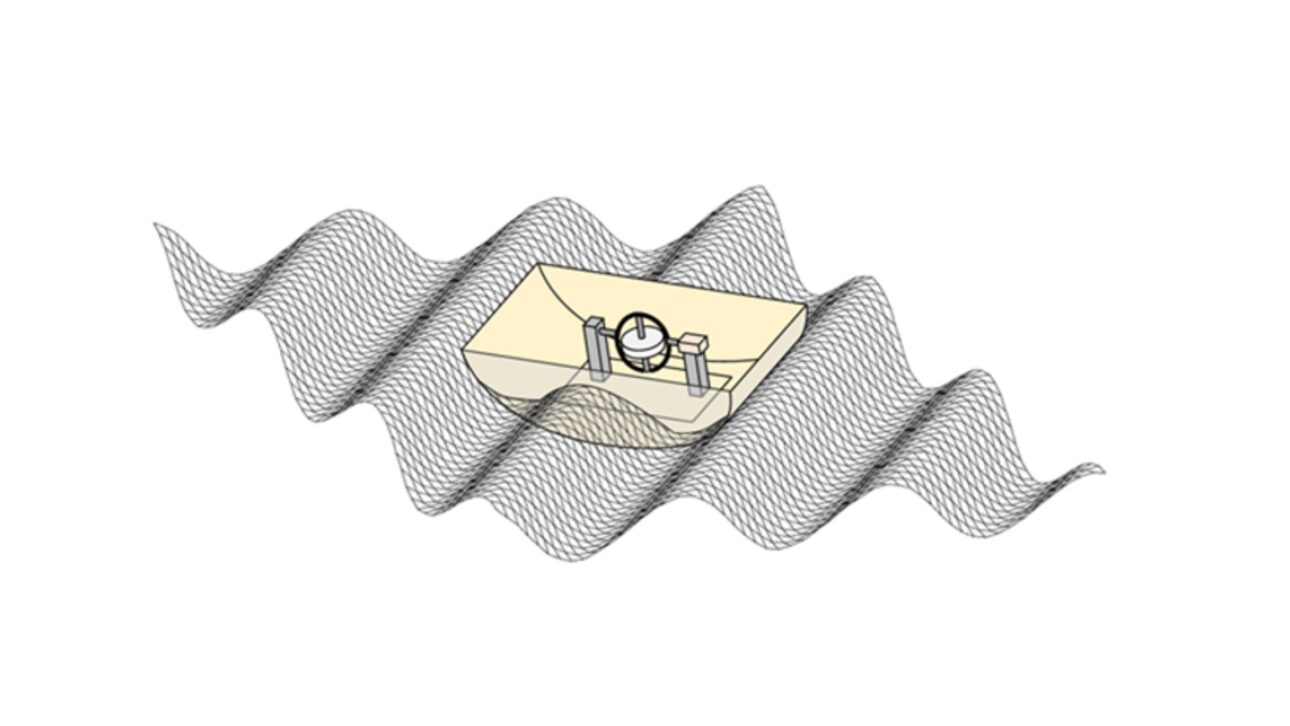
The principle behind the converter is mechanical. According to Osaka University, the device couples a rotating flywheel inside a floating structure that follows the sea’s sway. When the waves tilt the floating base, the flywheel changes its rotation axis through specific physical forces, and this movement directly activates an internal electric generator. This is how the power of the waves turns into clean energy in this gyroscopic system.
-
Hurricane Katrina: Engineering Failures by U.S. Army Corps Led to 80% of New Orleans Flooding

-
Hisense Unveils 615-Liter PureView Fridge with Transparent Door, Smart Display, Voice Control, and UV Purification to Compete with LG and Samsung

-
Are Cleaning Staff in Large Buildings Becoming Obsolete? Autonomous Robots Now Clean Airports, Hospitals, and Shopping Centers for Hours, as Companies Invest in Automating Repetitive Tasks

-
Xiaomi Launches Compact Photo Printer with Bluetooth, Extra Black Ink, and Augmented Reality Photo Printing




The set has five main parts. According to the university material, there is an internal flywheel, a heavy disc that reacts to ocean movement; precession, the phenomenon that alters the direction of the spin to generate stable energy; an integrated generator, connected to the gyroscopic mechanism; a floating structure, which protects the equipment from adverse sea conditions; and a dynamic adjustment, which tunes the rotation according to the variation of the waves on site.
The theoretical limit of 50% and what it really means
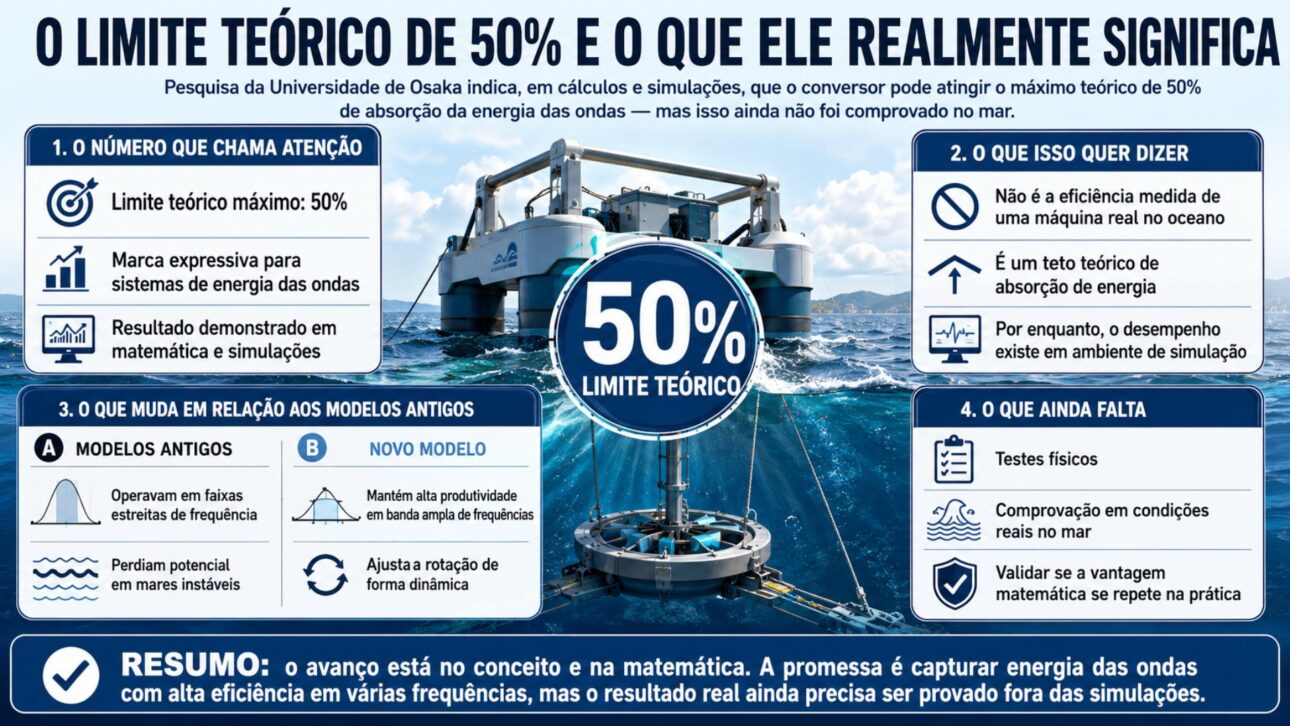
The number that draws attention is efficiency. According to Osaka University, mathematical research showed that the converter can reach the theoretical maximum limit of 50% energy absorption, an impressive mark for systems that harness wave energy. It is important to separate what this data means: it is a theoretical limit, demonstrated in calculations and simulations, and not the efficiency measured by a real machine in the ocean.
The difference compared to old models is in frequency. According to the researchers, traditional devices operated only in narrow frequency ranges and lost potential in unstable seas, while the new model maintains high productivity over a wide range of frequencies, dynamically adjusting the rotation. In other words, the advancement is in the concept and mathematics, and the real performance still needs to be proven in physical tests. For now, the power of the waves turns into clean energy only in a simulation environment.
What the researchers from Osaka University say
The study coordinator highlighted the system’s stability. According to Osaka University, Professor Takahito Iida explained that the equipment usually faces difficulties due to the constant changes in ocean conditions. He pointed out that the gyroscopic system offers stability in operation, which opens up prospects for the energy industry. The proposal is that the power of the waves turns into clean energy more stably than in previous models.
The differential pointed out by the team is the dynamic adjustment. According to the researchers, the ability to adjust parameters in real-time keeps the device close to the optimal capture point, over a wide range of frequencies, breaking old engineering limits. Among the benefits cited by the team are continuous operation even in difficult sea conditions, reduced energy waste compared to previous models, and a robust architecture designed to lower maintenance costs.
The simulations that support the theory, and what is still missing
The validation so far has been done on the computer. According to Osaka University, to check the linear mathematical models, scientists ran computer simulations in the time and frequency domains, and numerical tests confirmed high performance near the resonance frequency. Additional studies included nonlinear behaviors of the gyroscope to map possible real structural limitations of the equipment.
The analyzed parameters help to understand the next steps. According to the study, the rotation speed of the flywheel under strong impact of currents, the coupled interaction between the waves, the floating body and the generator, and the best configurations to maximize continuous energy capture were evaluated. The work itself presents as a roadmap for the development of adaptable and efficient converters, indicating that the next step is to move from simulations to testing in the real sea to see if wave power turns into clean energy as the model predicts.
The study from Osaka University shows a converter where wave power turns into clean energy with a theoretical efficiency limit of 50%, with a system that adjusts to a wide range of frequencies and surpasses, in simulations, narrow-band marine generators.
Even so, balance is important: for now, the result comes from models and computer tests, without a prototype in the ocean or a commercial plant, and talking about unlimited energy exaggerates what wave energy, a renewable but finite source, can deliver. The path is promising, but now it depends on moving from theory to proving the concept at sea.
Would you trust the sea as a source of energy for the future, or do you still bet more on solar energy and other already established renewables? Share your opinion and exchange ideas with other readers about the potential of wave energy, respecting different views.