Portuguese
  Spanish


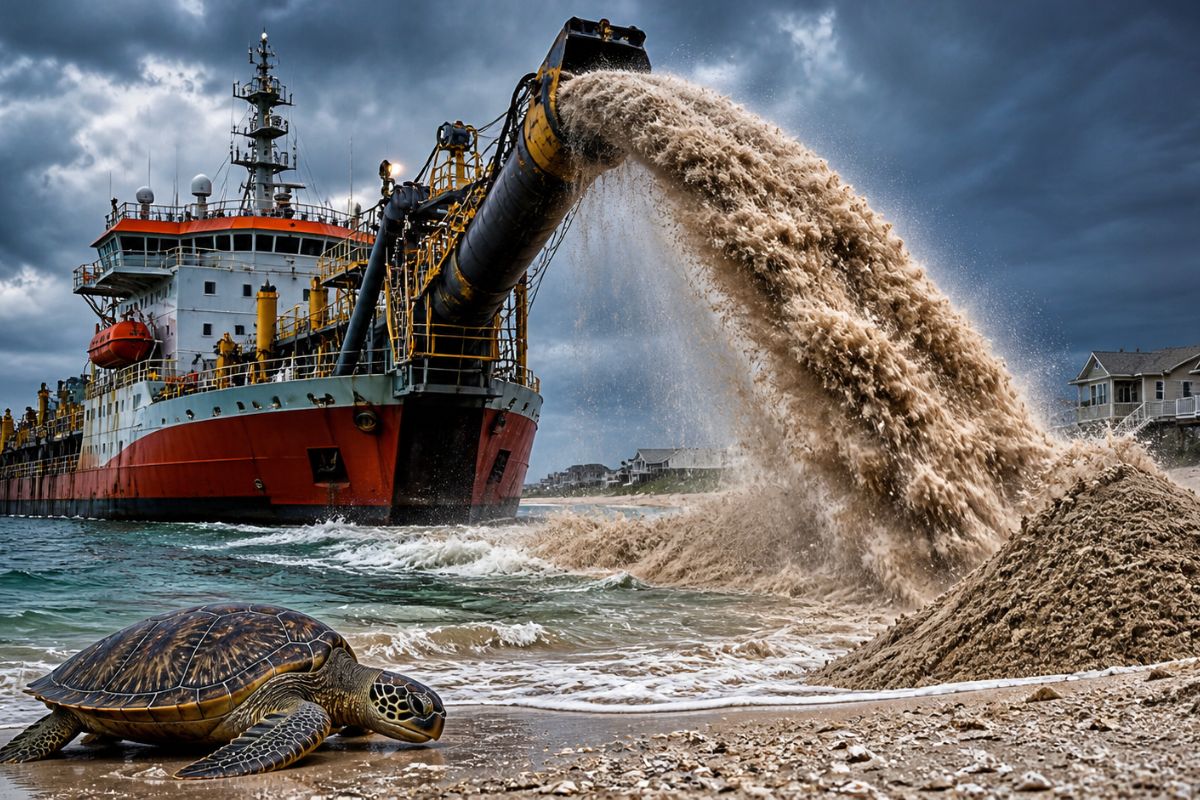


Tourism tax-funded operation pumps sand from offshore deposits to five critical areas of Hilton Head Island, South Carolina, totaling 46,500 feet of coastline in beach revitalization, shielding the coast against storms and coastal erosion, and aiming to preserve sea turtle habitats in a project that has been advancing uninterrupted 24 hours a day since July 2025.
The city hall of Hilton Head Island, South Carolina, has launched since July 2025 one of the largest beach revitalization projects in the eastern United States, involving the suction and discharge of 2.2 million cubic yards of sand extracted from offshore deposits on the ocean floor to rebuild 46,500 feet of coastline along the Atlantic Ocean and Port Royal Sound. Heavy equipment, submarine pipelines, and dredges operate continuously, 24 hours a day, seven days a week, for approximately six months per phase.
According to the Hilton Head Chamber, the project is primarily funded by the Beach Preservation Fee paid by tourists and addresses five critical areas affected by coastal erosion: South Beach and South Island, Central Island, The Heel, Fish Haul Creek, and Pine Island. As per the schedule released by the entity, the project was divided into three phases, with the first completed in November 2025, the second in its final execution phase in this stretch of May 2026, and a third stage, dedicated to the installation of rock breakwaters in Pine Island, still without a confirmed date within the 2026 calendar.
How sand reaches South Carolina beaches

The operation functions like a large production line over the sea and coast. Dredges positioned at specific points in the ocean suck sand directly from the seabed and transport it via pipelines to the beach areas of Hilton Head Island. On land, heavy equipment spreads, shapes, and levels the material according to the project, restoring the beaches to the width and profile that had been lost due to the action of tides, storm surges, and storms in recent years.
-
After 40 Years of Research, Powdered Coconut Water to Be Produced in Brazilian Biorefinery, Aiming to Revolutionize Health for Children, Elderly, and Hospital Patients

-
Queen Guitarist Brian May Collaborates with ESA Scientists to Study Asteroids Bennu and Ryugu Using 3D Simulations
-
Largest Known Single-Piece Meteorite, Weighing 60 Tons, Puzzles Scientists with Its Intact Fall and Lack of Visible Crater

-
Oceanographer Turns Abandoned Fishing Nets from Brazilian Waters into Bags, Creating Jobs and Earning Over $7,000 Monthly



The pace is industrial. The works continue 24 hours a day, seven days a week, for approximately six months per phase, with no breaks for weekends or holidays. It is this uninterrupted cadence that allows entire stretches of coastline to be restored in a short window, before the next Atlantic hurricane season once again erodes what has been rebuilt.
The five areas receiving sand in Hilton Head Island
South Carolina’s reinvestment targets five main fronts along Hilton Head Island, each with a volume calibrated to the level of coastal erosion observed in the section. South Beach and South Island received the largest contribution, with 750,000 cubic yards of sand distributed over 10,230 feet of coastline. Central Island, with the project’s most extensive stretch, absorbed 700,000 cubic yards along 28,860 feet.
Meanwhile, The Heel, the island’s northeast tip, received 500,000 cubic yards over 5,280 feet. Fish Haul Creek, a smaller area, was allocated 50,000 cubic yards over 2,130 feet of coastline. Finally, Pine Island combines 180,000 cubic yards of sand with the installation of six rock breakwaters near Dolphin Head, in a package that blends volumetric replenishment and permanent wave defense structure.
Three-phase schedule

Phase 1 began in July 2025 with activities in Port Royal (The Heel) and Fish Haul Creek, followed by the start of works on Pine Island in August 2025, and was completed in November 2025. Phase 2, focused on Central Island, South Island, and South Beach, began in November 2025 at the northern end of Central Island and is now scheduled to conclude in May 2026 at the southern end of South Beach.
Phase 3 is the only one still open. Focused on the installation of the Pine Island rock breakwaters, near Dolphin Head, it still has no defined date and is expected to be executed sometime in 2026, completing the most ambitious beach revitalization project ever undertaken on the island and closing the gap against coastal erosion at Hilton Head Island’s most vulnerable point.
Who pays for the beach revitalization


The detail that differentiates this project from so many others of its kind is the funding model. Most of the investment comes from the Beach Preservation Fee, a charge applied locally to tourism on Hilton Head Island. In practice, it is the visitors themselves who, by staying, renting vacation homes, and consuming on the island, finance the maintenance of the coastline they came to enjoy.
This mechanism creates a cycle where tourism pays for the sustainability of the very structure that attracts it, without burdening the budget of permanent residents or depending on uncertain federal government transfers. It is a model that has been highlighted as a reference in other American coastal states facing sea-level rise and the shrinking of their sand strips, and which returns to the agenda whenever a new hurricane season exposes how vulnerable the coast is.
The Brazilian coast faces the same coastal erosion that affects South Carolina, with entire cities seeing houses fall into the sea and beaches shrink year after year. Do you believe that charging a specific tourist fee to fund sand dredging, beach revitalization, and storm protection works, as happens on Hilton Head Island, would be a fair and viable solution for Brazil? Or would this only open space for more bureaucracy and charges without guaranteed results on Brazilian sands? Tell us what you think in the comments.