





 Portuguese
  English
  Spanish
  7 min of reading
  0 comments


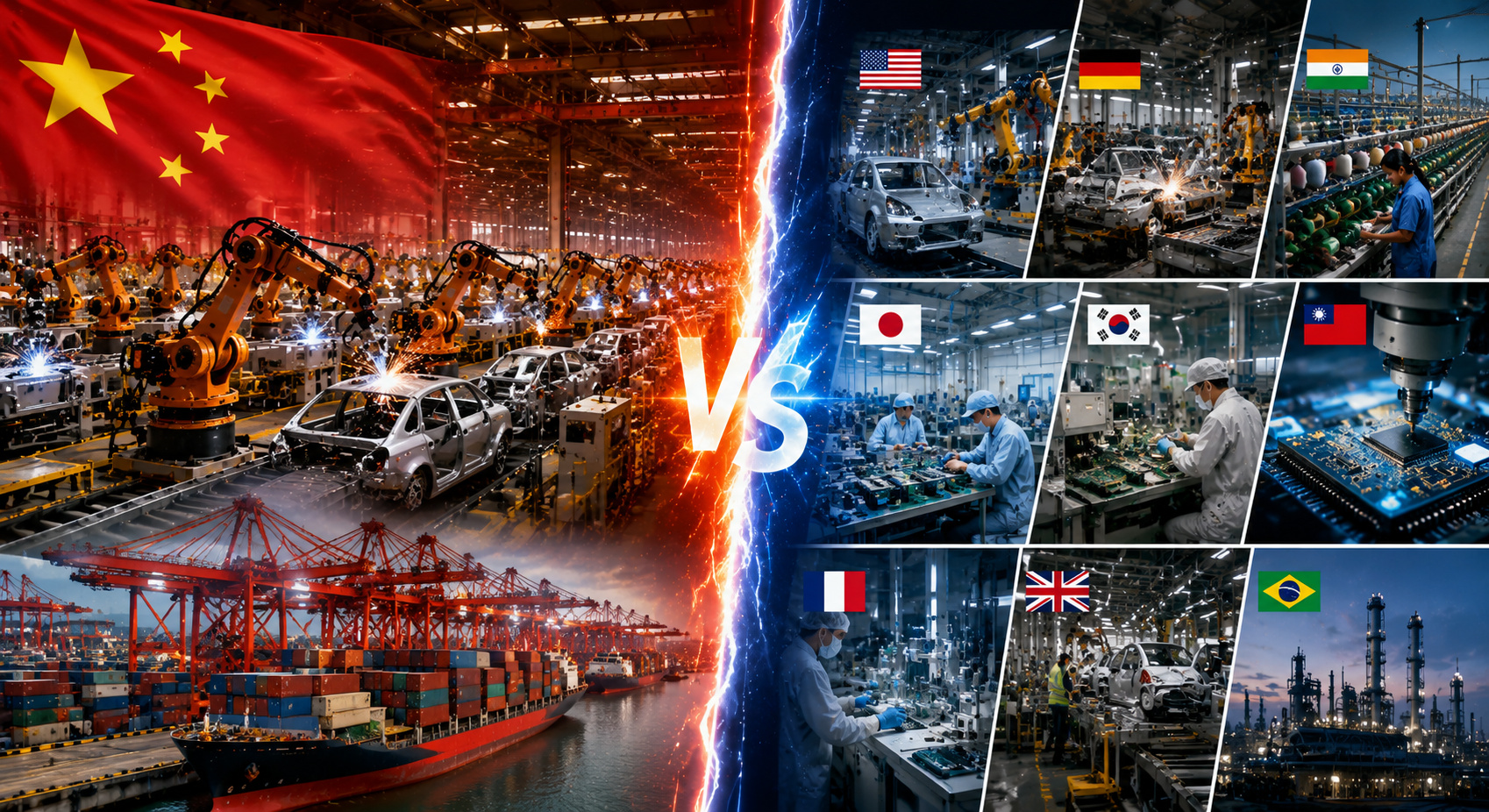
Hamilton Index 2026 shows that China went from 3.5% to almost 25% of global production in advanced industries and leads 7 of the 10 strategic sectors.
According to ITIF, the United States Institute of Technology and Innovation published on May 6, 2026, the latest edition of the Hamilton Index, an indicator that measures each country’s share in the production of the world’s 10 most strategic advanced industries. The survey covers sectors such as electronics, basic metals, machinery, chemicals, motor vehicles, information technology, and pharmaceuticals.
The result is straightforward: China’s share in global production of these advanced industries rose from 3.5% in 1995 to almost 25% in 2022, making the country a leader in 7 of the 10 industries analyzed. In basic metals, China controls more than 40% of world production; in machinery and equipment, it holds more than a third; in chemicals, it exceeds 28%.
In the same period, the share of OECD countries in advanced industrial production fell from 86% in 1995 to 58% in 2022, a drop of 28 percentage points in less than three decades. According to ITIF, China’s gains occurred directly at the expense of the United States and traditional Western allies.
-
Somali referee was close to fulfilling his dream of officiating at the World Cup, was barred in the USA and returned home welcomed as a hero in Somalia

-
Discovery of floating structure in Scarborough prompts Philippines to act and increases international attention on the South China Sea

-
Hungarian deputies approve a 40% cut in their own salaries, lose allowances, and place political privileges at the center of a change that surprised Europe.
-
US targets Alibaba, Baidu, BYD, Tencent, and Nio by including Chinese giants on the list of companies linked to China’s Armed Forces




China dominates advanced industries and leads 7 of the 10 strategic sectors of the Hamilton Index
The Hamilton Index shows that China has not advanced only in an isolated area of manufacturing. The country has built simultaneous leadership in several sectors considered strategic for the economy, technology, defense, and global industrial competitiveness.


China leads in 7 of the 10 advanced industries analyzed by ITIF. This dominance includes basic segments, such as basic metals and chemicals, and sectors of greater technological complexity, such as electrical equipment, machinery, and motor vehicles.
This combination is the most relevant point of the report. China is not just manufacturing more cheap products: it is increasingly taking control over industrial chains that support semiconductors, electric cars, infrastructure, defense, energy, and automation.
China’s share went from 3.5% to almost 25% in less than three decades
The Chinese trajectory between 1995 and 2022 reveals one of the largest transfers of industrial capacity in modern history. In 1995, China accounted for only 3.5% of the global production of advanced industries mapped by ITIF.
By 2022, this share was close to 25%. In other words, in 27 years, the country moved from a secondary position to occupy the center of world production in sectors that define economic and technological power.
The advance was not accidental. The Chinese expansion resulted from deliberate industrial policy, subsidies, cheap credit, protection of the domestic market, and technology transfer required from foreign companies seeking to operate in the country.
Basic metals show the greatest industrial turnaround of China in the 21st century
The case of basic metals is the most extreme. China’s share in this sector rose from 6.5% of the global market in 1995 to 42% in 2022, a multiplication of more than six times in a single generation.
This growth gave China a dominant position in an essential industrial base. Metal production supports machinery, vehicles, heavy construction, electrical equipment, energy infrastructure, defense, and transportation.
According to the Hamilton Index, the largest increase in China’s share occurred precisely in basic metals, with an advance of 39.5 percentage points. When a country dominates metals, it not only controls an industry: it controls the physical base of several other production chains.
Machinery, electrical equipment, and chemicals expand China’s advantage
China also advanced strongly in machinery and equipment, a sector in which it already holds more than a third of global production. This dominance is strategic because machines are the equipment that allows the manufacture of other industrial products.

In chemicals, China’s share exceeds 28%. This sector supplies fertilizers, industrial materials, medicines, batteries, plastics, pesticides, paints, semiconductors, civil construction, and numerous manufacturing chains.
In electrical equipment, China also expanded its presence rapidly. The combination of machinery, chemicals, metals, and electrical equipment creates an industrial ecosystem difficult to replicate outside Chinese territory.
China’s industrial growth consumed the share of Germany, Japan, and the United States
The report shows that the Chinese advance did not occur in a vacuum. In various advanced industries, China’s growth was accompanied by a loss of market share from countries that once dominated global manufacturing.
In machinery and equipment, while Germany lost $16.4 billion and Japan lost $14 billion in production, China expanded its production by $69.4 billion. In basic metals, Japan lost $17.2 billion, while China grew by $86.4 billion.
This dynamic reinforces ITIF’s view that industrial competition is a zero-sum game in many sectors. When one country gains market share in a mature global chain, another country loses space, factories, suppliers, and technological capacity.
China produces more than all countries outside the top 10 combined in strategic industries
The 10 industries of the Hamilton Index accounted for more than $10 trillion in global production in 2020. Within this universe, China was already leading 7 sectors and producing more than any other individual nation.
The most striking data is that China produced more than all other countries outside the top 10 combined. This level of scale was not achieved even by the United States at the industrial peak post-World War II nor by Japan at the height of its manufacturing expansion in the 1980s.
This places China in a category of its own. The country is not just another large manufacturer: it has become the main center of advanced industrial production on the planet in volume, scale, and sectoral diversity.
United States still lead in IT services but lose strength in advanced manufacturing
The United States maintains a clear lead in only one of the ten categories of the Hamilton Index: information technology services, with 36.1% of global production. It is a strategic sector, dominated by companies like Google, Amazon, Microsoft, Apple, and Meta.
American leadership in software, cloud, digital platforms, and IT services remains relevant. The problem is that this sector depends on a physical base composed of semiconductors, equipment, servers, electronic components, and industrial infrastructure.

Outside of IT services, other transportation, and pharmaceuticals, China already surpasses the United States in global share in advanced industries. American software remains strong but increasingly depends on material chains where China has a growing influence.
Location Index shows China more specialized in advanced industries than the USA
One of the most revealing data points of the Hamilton Index is the Location Index, which measures how much an economy specializes in a particular sector compared to the global average.
The Chinese economy performs 36% above the world average in the concentration of advanced industries. Meanwhile, the American economy appears 12% below the global average in this same segment.
In simple terms, China is more specialized in advanced manufacturing than the world in general, while the United States is less specialized. This difference helps explain why China can scale factories, suppliers, and industrial chains at a faster pace.
Chinese industrial dominance affects global supply chains and countries like Brazil
Chinese dominance in advanced industries has implications that go beyond rivalry with the United States. Any country dependent on global supply chains is exposed to Chinese industrial concentration.

This includes Brazil. Industrial equipment, electrical components, processed metals, chemicals, agricultural machinery, infrastructure inputs, and electric vehicles increasingly depend on production chains in which China has a dominant share.
A disruption due to geopolitical tension, tariffs, sanctions, conflict, or logistical shock can directly affect prices and availability of inputs for Brazilian industry, agribusiness, construction, and energy projects. Industrial dependence has ceased to be an abstract topic and has become a concrete economic risk.
China builds industrial ecosystems while rivals maintain isolated specializations
The difference between China and other industrial countries lies in the breadth of the production base. Taiwan dominates semiconductors in critical segments, and South Korea has strength in electronics and batteries, but both operate with more concentrated specializations.
China, on the other hand, builds simultaneous strength in metals, machinery, chemicals, vehicles, electronics, and electrical equipment. This breadth creates complete industrial ecosystems, where suppliers, manufacturers, universities, credit, and logistics reinforce each other.
This model reduces external dependence and accelerates technological development. When several advanced chains are concentrated in the same territory, innovation circulates faster between sectors and reduces the cost of scaling new products.
West tries to react with CHIPS Act, Inflation Reduction Act, and European industrial policy
The ITIF report was published at a time when the United States, European Union, Japan, and South Korea are trying to regain ground in strategic sectors. The Western response comes in the form of subsidies, tax incentives, and reindustrialization programs.
The American CHIPS Act allocated $52 billion to domestic semiconductor production. The Inflation Reduction Act placed $369 billion in subsidies for clean energy and green manufacturing.
In Europe, the European Chips Act mobilized €43 billion, while the Net Zero Industry Act seeks to strengthen local production of clean technologies. The West has returned to industrial policy, but it is trying to recover in a few years a disadvantage accumulated by China over nearly three decades.
To reach China’s industrial intensity, the US would have to add $1.5 trillion in production
The ITIF calculates that to match China’s level of industrial intensity, the United States would have needed to increase advanced industry production by nearly $1.5 trillion in 2022.
This would equate to a 56% growth in American production in these sectors. In practice, it would be comparable to almost doubling all US semiconductor production, quadrupling electronics, or multiplying pharmaceutical production by six, all at the same time.
This number shows the size of the industrial gap. The dispute will not be resolved with just a new chip factory or an isolated package of incentives, but with a broad reconstruction of productive capacity, suppliers, and specialized workforce.




Be the first to react!