






 Portuguese
  Spanish


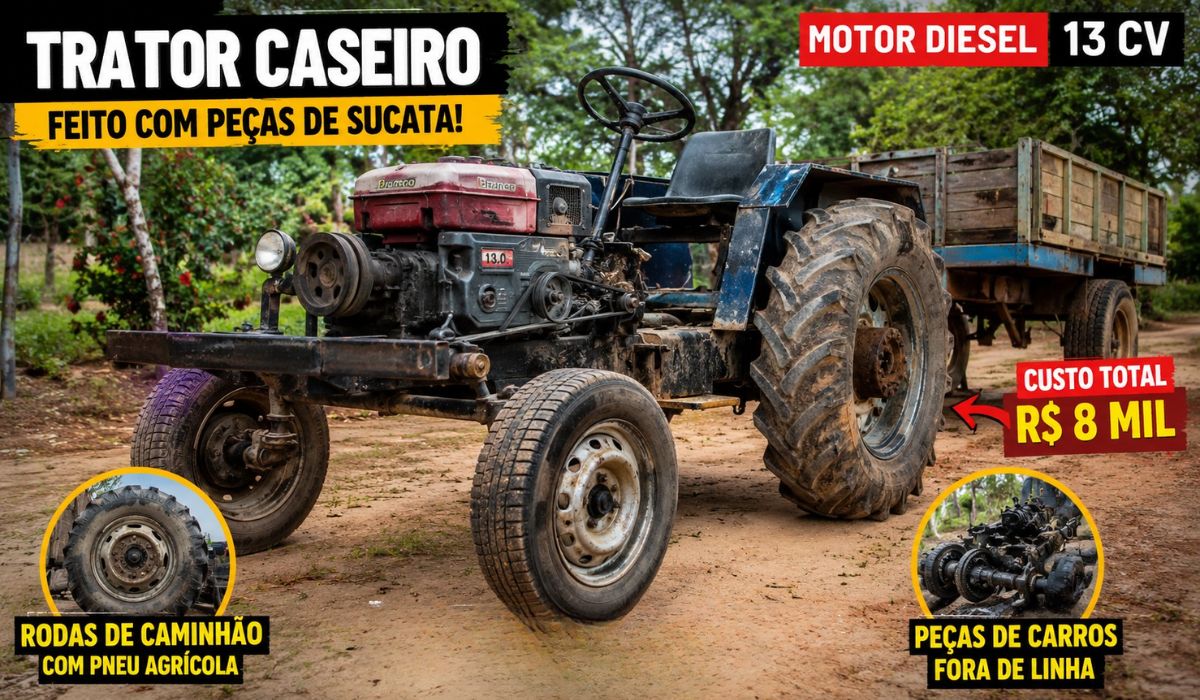


Rural project made with reused parts shows how old car and truck components can gain a new function in the field, in a handcrafted solution aimed at daily tasks of small properties.
A homemade tractor assembled with a 13 hp diesel engine, old truck wheels, and reused parts from discontinued cars has started being used on a property of approximately 30 hectares, according to the report presented on the LF homemade inventions channel.
The handcrafted machine is said to have cost around R$ 8,000, a value gradually applied in the purchase of scrap, used components, and metallic materials.
The project was developed to meet internal demands of the rural area, such as pulling a trailer, moving a sprayer, operating a mower, and transporting loads over short distances.
-
Brazilian Woman Turns 1.3 Tons of Waste into Over 4,000 Sustainable Bags and Accessories

-
Brazilian Container Factory Innovates by Halving 40-Foot Units Seamlessly to Create Autonomous Market Pods

-
Former XP Partners Launch Yuool, a Recycled PET Bottle Shoe Brand, Becoming Brazil’s First B Corp Footwear Company with $15 Million Revenue

-
Man Who Spent 27 Years Cleaning Classrooms in Louisiana Becomes Principal of the Same School at 39




According to the description presented, the proposal does not involve replacing modern industrial tractors, but assembling a functional structure for low-speed activities within the property.
The construction starts from the reuse of parts that have lost space in the automotive market but can still be used in mechanical adaptations.
Differentials, gearboxes, wheels with tubes, metallic profiles, and stationary engines form the base of the assembly described in the video.
How the homemade tractor was assembled with used parts
The project was organized based on a logic of economy through reuse.
Instead of buying a ready-made machine or acquiring all new components, the builder gathered used parts over time, as he found compatible items in junkyards, workshops, and tire shops.
The engine used is a 13 hp stationary diesel.
This type of equipment is usually applied in continuous and low-speed uses, a characteristic compatible with rural tasks that require slow movement and traction.
In the reported case, it was combined with a reused transmission system.
The assembly mentioned in the project involves parts associated with models like Chevette and Monza, discontinued vehicles that still have components available in the used market.
The function of the gearboxes and differential is to multiply the reductions, allowing the engine’s power to be converted into force for low-speed movement.
This arrangement also helps explain why a low-power engine can be used in a handcrafted tractor.
With the adapted transmission, the machine is not aimed at speed, but at controlled movement in tasks such as towing a light trailer, supporting implements, and moving within internal areas.
Used parts reduce the cost of the handmade tractor
The approximate cost of R$ 8 thousand, mentioned in the original account, is linked to the use of repurposed components.
The installment purchase of parts, made as opportunities arose, allowed the expense to be spread over the assembly period.
The metal structure followed the same pattern.
The chassis was produced with repurposed iron, including profiles similar to those used in power standards or materials sold as scrap.
After being cut, welded, and reinforced, these pieces formed the base to receive the engine, transmission, steering, pedals, axle, and hitch.
According to the project description, the final chassis was compact, just over 2 meters long.
This measurement allows for use in smaller spaces and maneuvers within the property.
The structure’s strength, however, depends on the quality of the cuts, welds, and reinforcements applied during assembly.
In practice, each stage requires manual adjustments.
Parts taken from different vehicles do not always fit without adaptation, making it necessary to manufacture supports, align axles, reposition controls, and ensure the set works without excessive play or mechanical interference.
Truck wheels enter the rural project
The rear wheels were assembled with repurposed truck components, according to the account.
The mentioned configuration uses old wheels with 1000x tire and tube, associated with an agricultural tire cover 12.4-24.
This type of wheel lost part of its use in trucks that started adopting tubeless tires.
In handmade projects, however, these parts can be utilized when they still have usable conditions and are compatible with the planned structure.
The agricultural tire cover increases the contact area with the ground and improves grip on rural terrains.
This feature is important for a machine intended to operate in fields, pastures, yards, or internal roads, where traction is more relevant than speed.
At the front, the solution can be simpler.
The described project allows for car wheels with rims 13 or 14, installed on an axle made from scrap.
The steering assembly also utilizes automotive parts, such as the steering wheel and steering sector, adjusted to the operator’s position.
Safety and Maintenance in the Use of the Homemade Tractor
A homemade tractor requires continuous attention to mechanical safety.
Since the machine does not come from a standardized industrial line, its operation directly depends on the quality of assembly, welding, fastening of parts, and maintenance performed by the owner.
Brakes, steering, transmission, protection of moving parts, and stability need to be checked before use.
It is also necessary to observe leaks, gaps, cracks in welds, tire wear, and the functioning of hitches, especially when the machine is used to pull loads or operate implements.
Another relevant point is circulation outside the property.
Tractors and agricultural machines have specific rules for traffic on public roads, and regularization depends on the documentation applicable to the equipment and the owner.
The project description should be understood as a case of internal use on rural property, as presented in the report.
Any movement on public roads requires verification of current traffic regulations and the requirements of the competent authorities.
Why Small Producers Resort to Homemade Machines
On small farms, the cost of acquiring agricultural machinery can limit the mechanization of simple tasks.
The rental of equipment, in turn, depends on availability, transportation, service price, and work schedule in the region.
In this context, some producers resort to adaptations made with used parts.
This practice appears in trailers, mowers, sprayers, carts, and small tractors assembled from automotive components.
The goal is to reduce costs and maintain basic operations without always relying on third parties.
The junkyard becomes a frequent source of components for this type of assembly.
In a single search, wheels, axles, gearboxes, steering parts, sheets, and metal profiles may appear.
The feasibility, however, depends on the condition of the parts, the available technical knowledge, and the ability to adapt each item safely.
In the case reported by the LF Homemade Inventions channel, the tractor could still receive finishing and additional adjustments.


Even so, the main structure would already have been put into operation on the property, with daily use in an area of about 30 hectares.
The experience shows how old automotive parts can be reorganized into a low-cost rural machine.
The described result depends on self-labor, material reuse, and constant monitoring of operation, factors that directly influence the final cost and safety of the equipment.
For producers facing difficulty accessing agricultural machinery, projects like this spark interest by presenting an alternative built from materials available in the used market.
Even so, each assembly needs to be evaluated individually, without generalizing performance, cost, or safety for other properties.


