






 Portuguese
  Spanish


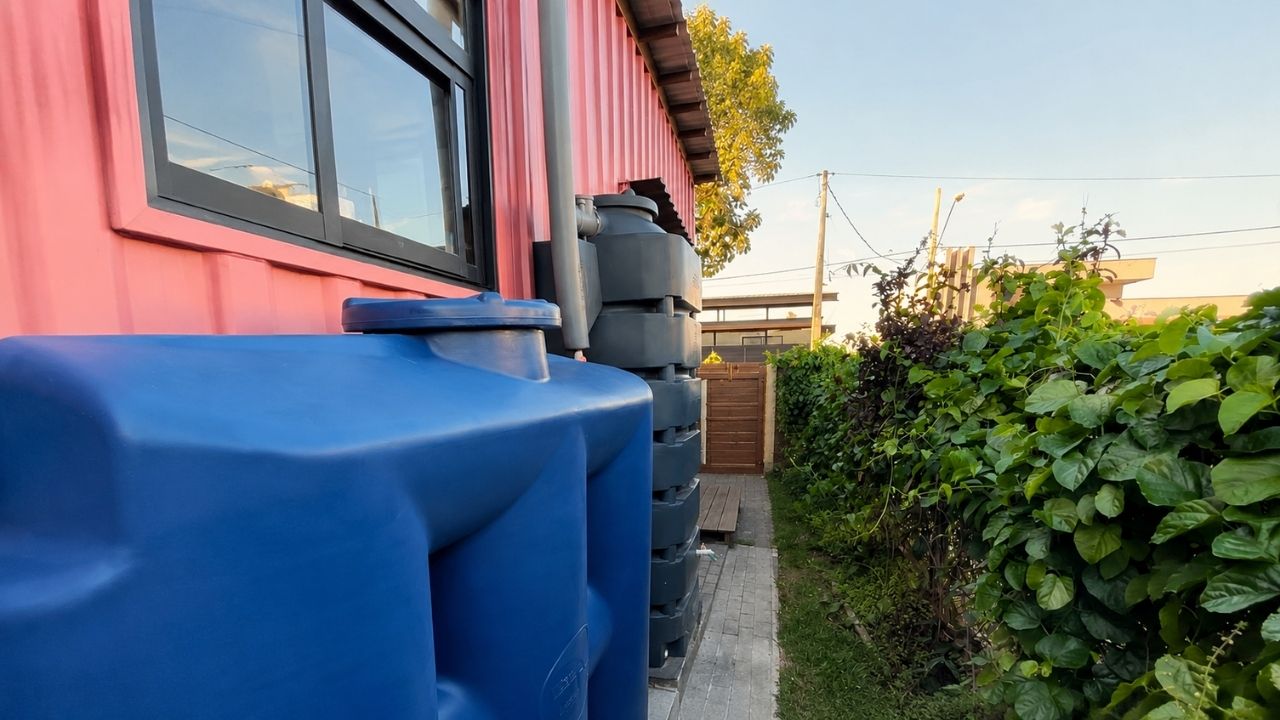
The vertical cistern used by Miriam in her container house stored 1,000 liters of potable water and started feeding a booster pump. The solution avoided a tower, underground tank, and aesthetic loss, but required a reinforced base, dedicated electrical bypass, and attention to reservoir maintenance in a compact home.
The vertical cistern was incorporated into the project of the container house as an alternative to the conventional water tank after the pressure of the water supplied by the street started to fluctuate. The resident Miriam explained in a video that the house initially received water directly from the network because the pressure was good.
With the densification of the neighborhood and the condominium, according to the report, the pressure began to decrease and was no longer constant. The adopted solution was to install a vertical reservoir specifically for potable water, connected to a booster pump, to improve internal supply without using an elevated tower or underground tank.
Solution replaced tower and underground tank
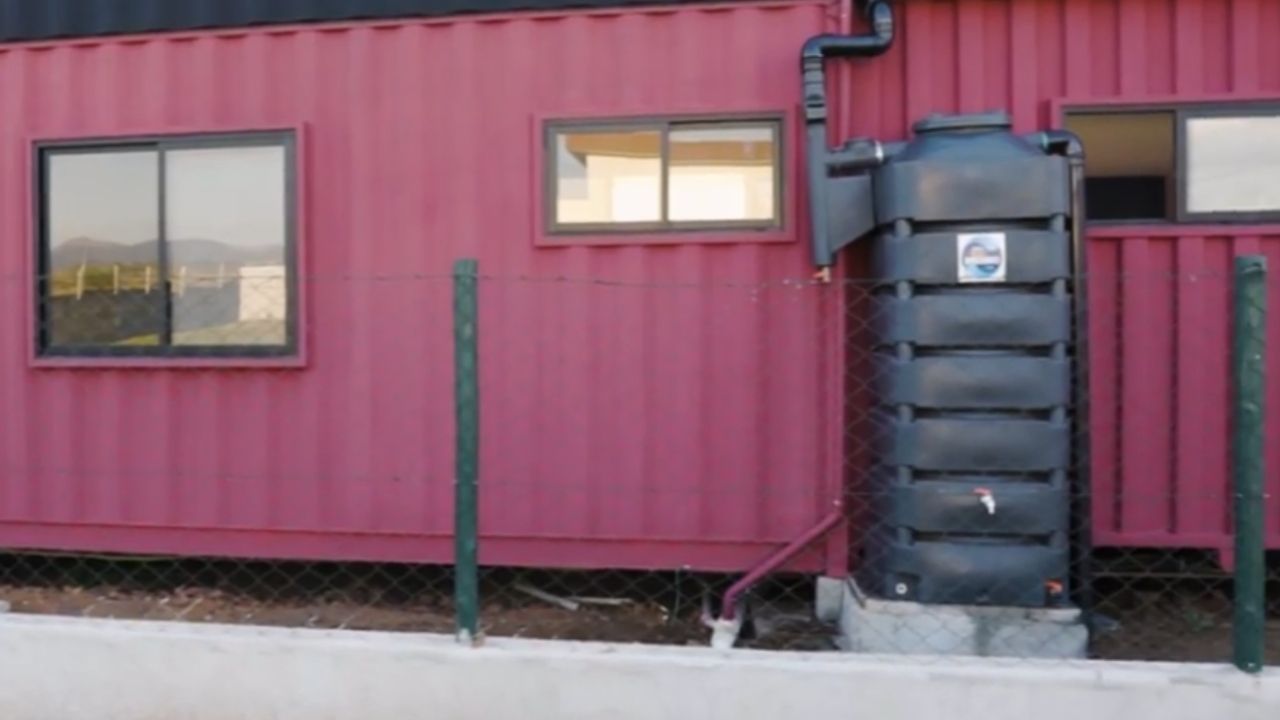
In the original project of the container house, the conventional water tank was discarded for technical and aesthetic reasons. To work well by gravity, it would need to be in a structure higher than the house, which would require a tower and change the appearance of the construction.
-
Rio de Janeiro Traffic Relief: Long-Awaited Change Promises to Cut 15-30 Minutes from BR-040 Commute, Easing Access to Avenida Brasil.

-
China Installs Massive Domes Over Urban Construction Sites, Blocking Up to 99% of Dust

-
Brazil’s Minas Gerais Government Signs Agreement for Ring Road to Divert Heavy Trucks Away from Urban Center

-
The Great Wall of China was built with a surprising kitchen secret: sticky rice mixed with lime created a mortar so durable it has withstood centuries, earthquakes, and human destruction.



Another possibility would be an underground water tank, with pumping to the house. This option was also set aside because the soil of the land was described as very compacted, which would make the execution less interesting for the project.
The initial choice was to capture water directly from the street network, without its own storage. This decision worked for a period because there was no water shortage and the available pressure was considered sufficient for taps and shower.
The problem appeared later, when the pressure started to fluctuate. The house continued to receive water, but the variation affected the comfort of use, especially in the shower, where the change in pressure altered the temperature and required adjustments during use.
Vertical reservoir was chosen for potable water
The solution adopted was a vertical cistern specific for potable water. According to the technical explanation presented in the video, this model receives water from the utility company and is prepared to store domestic consumption water, with appropriate connections and components.
The chosen cistern has a capacity of 1,000 liters. The resident also showed that there are other sizes, including smaller models, but the decision considered the space available in the side corridor of the house and the need to store enough volume for residential use.
An important point is that the cistern for potable water is not the same as the reuse cistern. In the video, it is explained that the blue model has specific pigmentation and resin aimed at reducing the passage of sunlight into the reservoir.
This care seeks to reduce favorable conditions for the proliferation of microorganisms, a relevant aspect when the reservoir will be used to supply taps and showers. The source does not present a laboratory report but describes the constructive difference informed by the supplier Tecnotri.
Narrow corridor defined the installation format
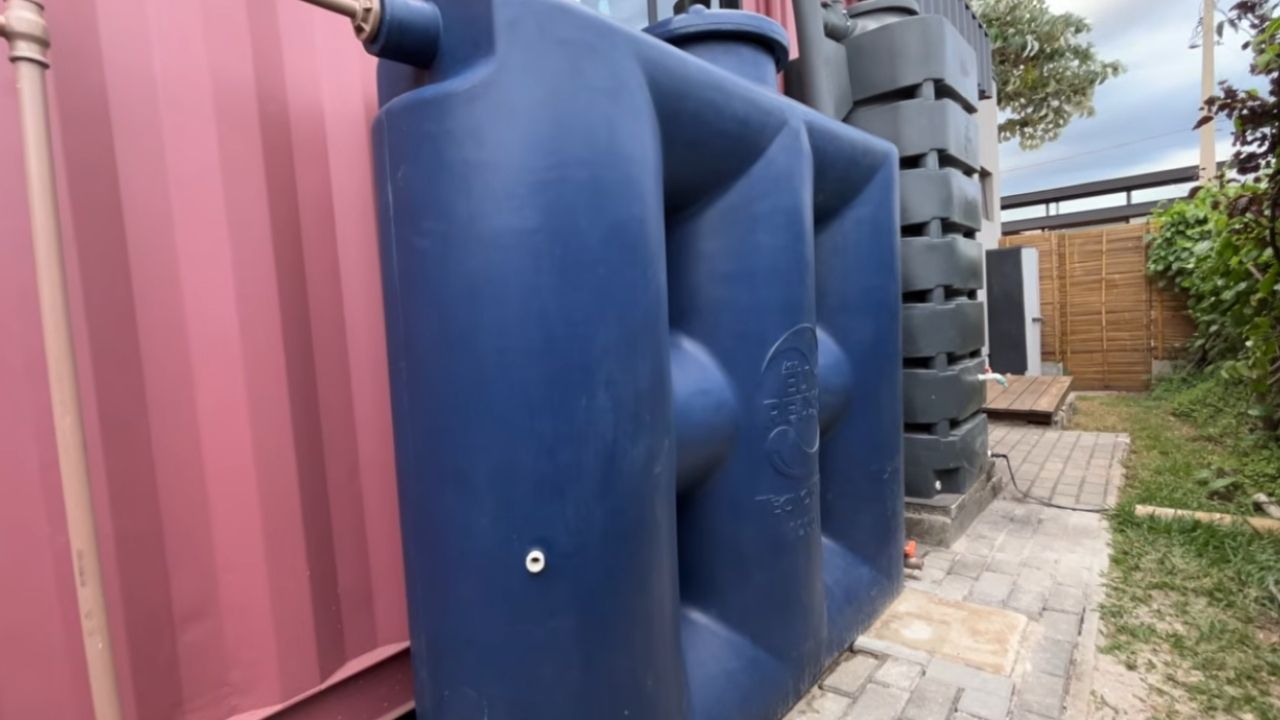
The container house had not originally been designed to receive this reservoir. Therefore, the width of the side corridor weighed in the choice of model. Miriam states that if the solution had been planned from the beginning, the corridor could have been wider.
Even so, the installation was possible because the vertical cistern occupies less horizontal area than underground solutions or external towers. The reservoir was positioned in the service corridor, where it does not directly interfere with the main facade.
The compact installation is one of the main arguments for this type of reservoir. In smaller plots or already constructed projects, a vertical tank can be fitted into side areas, provided there is a base, maintenance access, and space for piping.
The video also highlights the aesthetic concern. The resident chose a model that matched the house and was partially hidden by the vegetation on the wall, preventing the reservoir from dominating the view of those observing the construction from the street.
Reinforced base was necessary because of the weight
A full 1,000-liter reservoir weighs more than a ton, considering the water and the structure itself. Therefore, the cistern was not simply placed on the interlocking floor. The installation received a prepared base to keep the reservoir flat and stable.
In the case shown, the team made a base and also used a steel cable to increase safety against tipping. In another rainwater cistern installation, the video shows an elevated masonry base to allow for connections and lower outlets.
This detail is crucial because a vertical reservoir cannot be treated as a decorative piece. It needs to support the load, remain level, have stability, and allow access to hydraulic connections.
The choice of base depends on the model, the floor, the full weight, and the installation location. In similar projects, it is correct to evaluate support, drainage, fixation, and circulation around the cistern before connecting the system to the house network.
Pressurizing pump solved the pressure variation
To provide water with adequate pressure to the faucets and the shower, the installation included a Texus pressurizing pump, described in the video as a 1-horsepower model. The pump was chosen because the consumption points are at the same level as the tank or above it.
The function of the pump is to draw water from the reservoir and send it to the house’s internal network with constant pressure. According to the report, the equipment also has a frequency inverter, a feature used to maintain stable pressure even when more than one consumption point is open.
In practice, the system no longer depends solely on the variable street pressure. The water enters the cistern, is stored, and then sent inside the house by the pump, reducing fluctuations in the shower and faucets.
The installation required technical care. The pump manual instructed priming the equipment before the first connection, that is, filling the suction pipe and the pump body with clean water to remove air and prevent improper operation.
Bypass maintained the alternative of using street water
In addition to the vertical cistern and the pressure pump, the installation received a bypass system. This feature allows changing the water path in case of a power outage or if the pump cannot operate.
With the bypass, the house can receive water directly from the street network again, as it did before the reservoir installation. This does not resolve pressure fluctuations in all situations, but it maintains an operational alternative for supply.
The bypass is a small detail in the plumbing but important for system safety. Without it, any problem with the pump could interrupt the internal supply until the equipment is restarted or repaired.
The video also mentions specific wiring for the pump, passing under the container, and a dedicated circuit breaker. Miriam states that she called an electrician to perform this part, precisely to reduce risks and make the electrical installation appropriate.
Maintenance became more accessible than in conventional tanks


One of the points mentioned by the resident is the ease of access for maintenance. In many houses, the water tank is located on a slab, in a high tower, or buried, which makes periodic inspection and cleaning difficult.
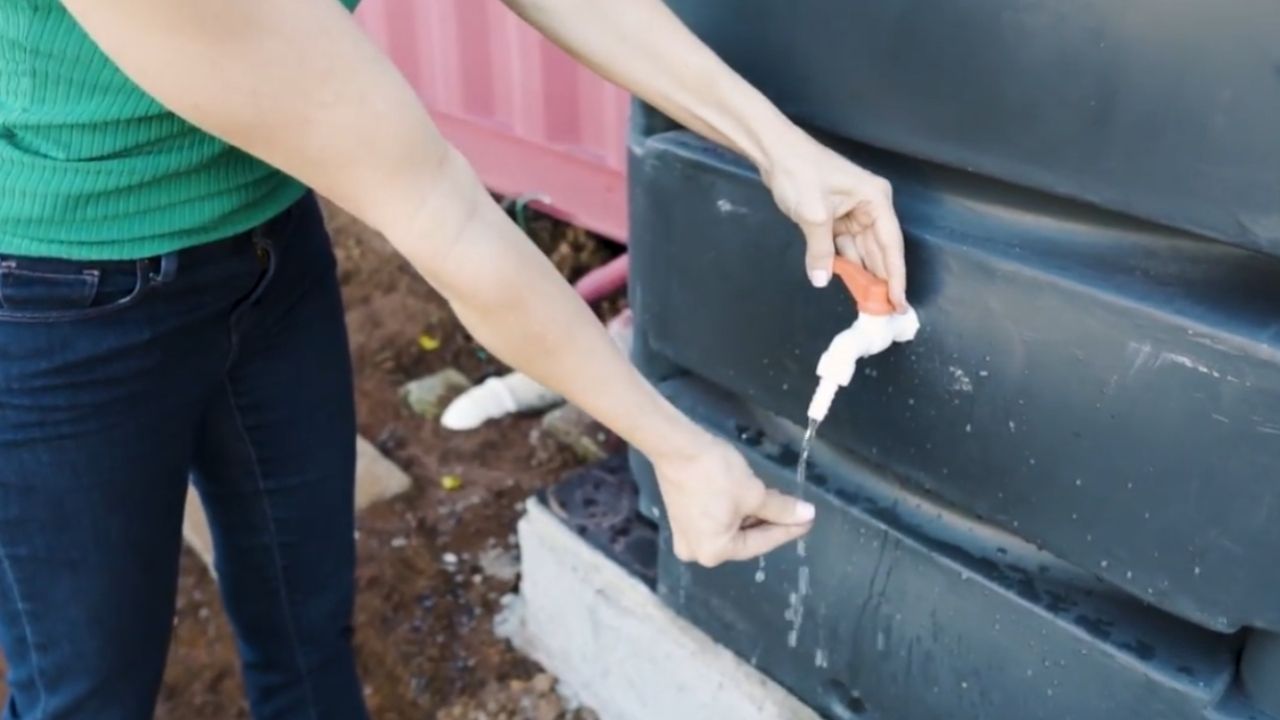
In the case of the vertical cistern, the lid can be accessed more easily. The installation also includes an inlet and outlet that allow the reservoir to be emptied, the interior to be checked, and cleaning to be performed when necessary.
Accessible maintenance is a significant advantage but does not eliminate the need for regular care. Stored potable water requires an adequate reservoir, cleaning, protection against dirt ingress, and attention to connections.
The resident also reported that she installed a filter at the inlet to ensure cleaner water reaches the reservoir. This element helps reduce debris before the water enters the cistern, although filter maintenance also needs to be considered for continuous use.
Previous experience with rainwater helped in the choice
Before using a vertical cistern for drinking water, Miriam already used external models for rainwater harvesting. In her account, she states that she has two external units, each with approximately 1,050 liters, used for garden irrigation.
These reuse cisterns receive water from the gutters, pass through a leaf filter, a decanter, and a fine filter. The water is used for drip irrigation and can also be drawn through a tap for watering cans and other external uses.
The experience with rain showed that the vertical format worked well in the available space. Therefore, the resident considered whether a similar model could be adapted for drinking water, provided it was specific for that purpose.
The comparison also makes it clear that the uses are different. The rainwater was destined for the garden. Meanwhile, the blue drinking water cistern was connected to the house’s internal supply, with a pressurizing pump and specific care for domestic consumption.
Solution does not dispense with hydraulic planning

The installation of the vertical cistern shows a possible alternative for houses where street pressure fluctuates and the conventional water tank was not planned in the project. Even so, the solution requires hydraulic, electrical, and structural planning.
It is necessary to evaluate the reservoir capacity, house consumption, installation location, access for cleaning, support base, connection with the street network, pressurizing pump, bypass, and equipment protection against sun and rain.
The pump itself cannot be exposed directly to the weather without adequate protection. In the video, Miriam reports that she would need to make a protective structure, as the temporary solution with a plastic box was not sufficient due to the piping.
This detail reinforces that the vertical cistern solves part of the problem but needs to be integrated into a complete system. Reservoir, pump, electrical, and piping need to work together to deliver stable pressure and secure storage.
What the solution shows for compact houses
In compact houses, containers, and projects without a tower, the vertical cistern can be an intermediate alternative between the conventional water tank and the underground reservoir. It occupies lateral space, can be visible or partially hidden, and maintains simpler access for inspection.
The case also shows the importance of planning for water storage from the project stage. When the house is already built, the solution may still be possible, but the available space limits size, position, aesthetics, and circulation.
The main technical lesson is that street pressure should not be treated as a permanent guarantee. It can change over time, especially in areas with densification, new connections, and increased demand on the network.
Would you use a vertical cistern as a water tank in a compact house, or do you still prefer the conventional elevated tank? Leave your opinion in the comments and tell us if the solution with a reservoir, booster pump, and bypass would make sense in a future project.


