





 Portuguese
  English
  Spanish
  5 min of reading
  0 comments


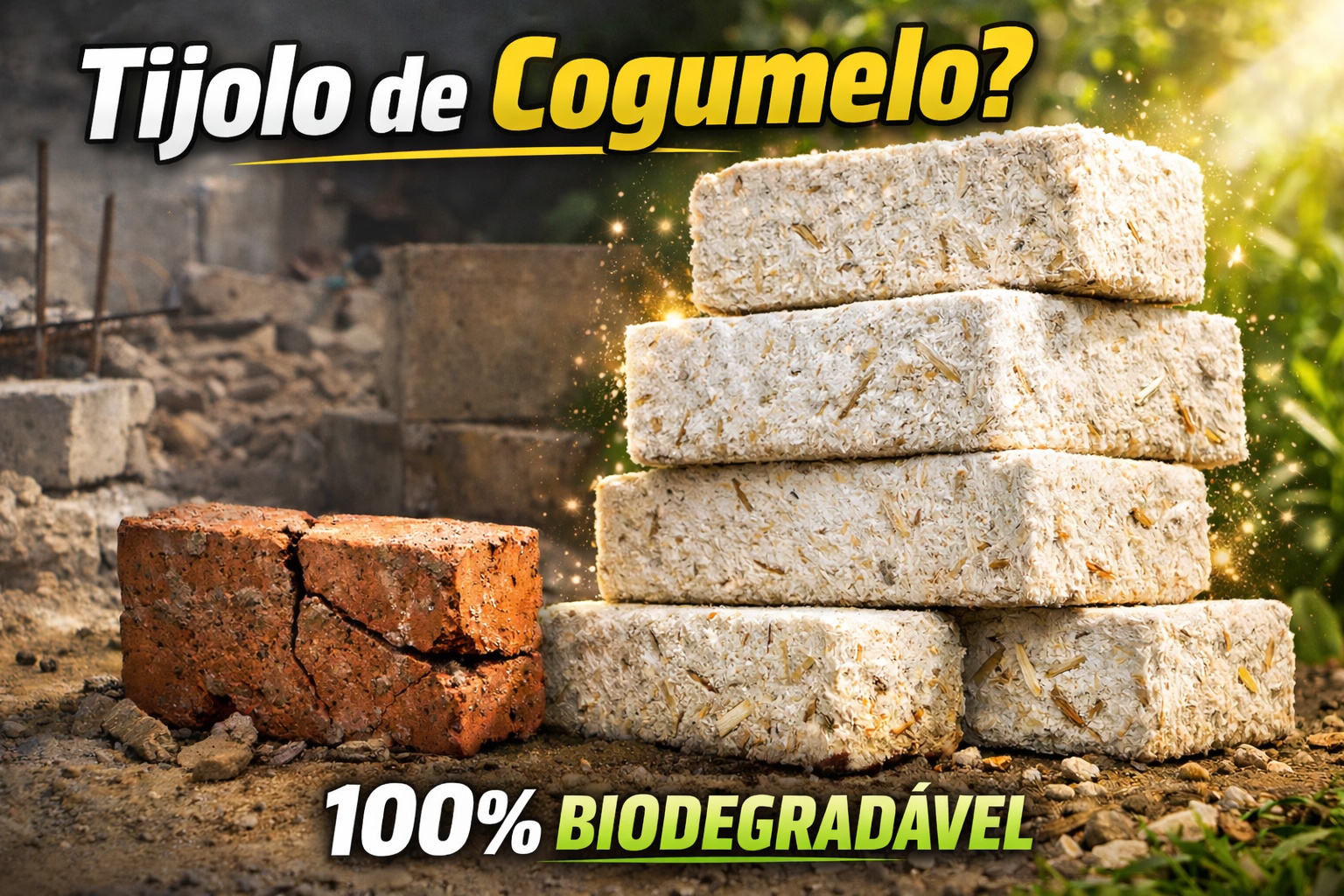
Mycelium, The Underwater Network Of Fungi, Turns Into Sustainable Material That Replaces Plastic, Leather, And Even Water, Mold, And Fire-Resistant Bricks.
Mycelium is the network of underground filaments that form the roots of fungi. A fragile structure resembling intertwined white threads that absorb nutrients from the soil. But when dried, it becomes surprisingly durable material resistant to water, mold, and fire.
Companies like Ecovative Design have discovered that mycelium grown on agricultural waste can replace virtually any synthetic material. Packaging, thermal insulation, building bricks, vegan leather, even furniture. All grown naturally without chemicals in less than a week.
How Mushroom Bricks Are Cultivated
The process starts with agricultural waste like grain husks, straw, or sawdust that would otherwise serve as garbage. The material is cleaned and put into molds of the desired shape. Spores of fungi are inoculated into the substrate where they begin to germinate.
-
China pours concrete for 60 hours non-stop to form the largest caisson in the world on a highway bridge over the Yangtze and prepare the base that will support a 1,600-meter span over one of the most important rivers on the planet.

-
Giant tunnel boring machine Mary completes mission underwater in a $3.9 billion project in the USA, drills the bay in a historic crossing, and paves the way for new tunnels that promise to relieve one of Virginia’s most congested corridors.
-
Group builds mud igloo next to a lake, mixes earth with straw, uses wire mesh as structure, and transforms an unlikely idea into a small handcrafted house where several people can enter.

-
How much does a bricklayer charge to build a masonry barbecue in 2026? In some cities, the cost can reach up to R$ 3,800 just for labor.



Under controlled conditions of humidity, temperature around 25°C, and aeration, the mycelium spreads throughout the material. Intertwined hyphae grow by digesting organic matter, merging everything into a cohesive and dense structure. The process takes only 5 to 7 days.

Once fully grown, the composite is treated with heat between 70-90°C for no more than half an hour. Cooking for growth transforms it into stable material. Mycelium does not come back to life again. The material is ready for use.
Companies like Ecovative can control the texture, strength, and porosity of the products through the manufacturing process. Different species of fungi grow at different rates. Oyster mushrooms grow quickly compared to other slower species.
13-Meter Tower With 10,000 Bricks
In 2014, architectural firm The Living built a tower called Hy-Fi in the courtyard of MoMA PS1 in Manhattan, demonstrating the possibilities of mycelium. The structure was 13 meters tall (40 feet) made entirely with 10,000 bricks of mycelium grown on agricultural waste.
The idea came from Ecovative, which had already been using mycelium in wine packaging. The tower stood for three months serving as an event space. Afterwards, the team dismantled the structure and composted all the bricks. The resulting soil was donated to local community gardens.

A dramatic demonstration that building materials can be naturally cultivated from fungi and then regenerated back to the Earth. A complete cycle with no permanent waste. Minimal environmental impact.
Growing Pavilion at Dutch Design Week followed a similar concept. A temporary structure built with mycelium panels and wood using a bio-based coating originally developed by the Incas in the 12th century. The lightweight panels could be easily removed and reused.
60 Times Lighter Than Traditional Bricks
Conventional bricks have a compressive strength of at least 28 MPa. Mycelium bricks only reach 0.2 MPa. Much less structurally strong. But they compensate by being dramatically lighter.
Mycelium weighs 43 kg/m³ compared to 2,400 kg/m³ of traditional bricks. They are 60 times lighter. Even with lower strength, it is still possible to stack them up to 13 meters high as the Hy-Fi tower demonstrated.
It makes more sense to use mycelium for non-load-bearing structures. Interior walls, insulation, decorative panels, cladding. Applications where weight and environmental impact are more critical than brute structural strength.
Superior Thermal Insulation
The thermal conductivity of mycelium composites falls in the range of 0.05 to 0.07 W/m·K. Similar to or comparable with most conventional insulating materials. fiberglass has 0.04 W/m·K. Extruded polystyrene 0.03 W/m·K. Sheep wool 0.05 W/m·K.
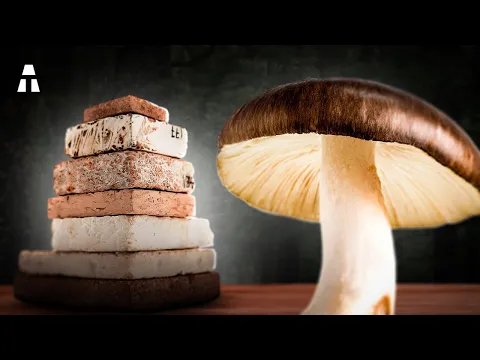

Studies show that mycelium grown with wheat straw can serve as an excellent thermal insulator with conductivity between 0.074-0.087 W/m·K. Properties directly compete with conventional insulators.
Additional advantages are comparatively lower cost and biodegradable characteristics. Potential to replace existing synthetic insulating products. Ecovative developed the “Greensulate” technology specifically for insulation applications.
Composites also absorb sound, making them excellent for interior partitions in homes and offices. A combination of thermal and acoustic insulation in natural material.
Naturally Fire-Resistant
Once treated with heat, mycelium carbonizes instead of igniting. It provides fire ratings equivalent to drywall. Natural fire resistance reduces dependency on harmful chemical fire retardants.
Researchers in Australia developed an eco-friendly and fire-resistant external building material using fungi. They cultivate thin sheets based on mycelium that form protective layers when exposed to flames. Effectively resisting fire and heat transfer.
Unlike traditional fire retardants containing harmful chemicals, mycelium burns cleanly, emitting only water and CO₂. No toxins released.
Applications Beyond Construction
IKEA has committed to mycelium packaging by partnering with Ecovative, recognizing the harms of polystyrene. Plastic foams take hundreds of years to decompose while mushroom-based materials decompose in weeks.
Dell has already integrated Ecovative packaging into its supply chains for electronics. Growing commercial viability demonstrated by adoption by large corporations.
The fashion industry is using mycelium leather called Reishi or Mylo. Brands like Adidas, Stella McCartney, and Hermès have formed partnerships. A biodegradable and cruelty-free substitute for animal leather.
MycoWorks leads with its Fine Mycelium technology, which allows for growing mycelium mimicking the texture and qualities of traditional leather. Applications expanding into automotive and other sectors.
Challenges And Future
Limited structural strength remains the main obstacle. While strong enough for non-load-bearing uses, it lacks compressive strength for primary structural elements without reinforcement or hybrid designs.
Production at scale and standardization still need refinement for broader adoption by the industry. Costs are decreasing but manufacturing infrastructure needs to expand.
Protection against moisture in outdoor environments requires improvements. Materials perform well indoors, but outdoor applications need further development.
Project MycoHAB of 2024 in Namibia is one of the first precedents as load-bearing construction applications exceeding temporary installation deadlines. It uses invasive shrub as raw material to grow gourmet oyster mushrooms, generating residual mycelium for construction.
Rapid advancements suggest that in the next decade, elements of our homes—from insulation panels to entire wall systems—could be cultivated from fungi. The construction industry contributes 39% of the global carbon footprint. Innovative alternatives like mycelium are crucial.






-

-

-

6 people reacted to this.