Portuguese
  Spanish


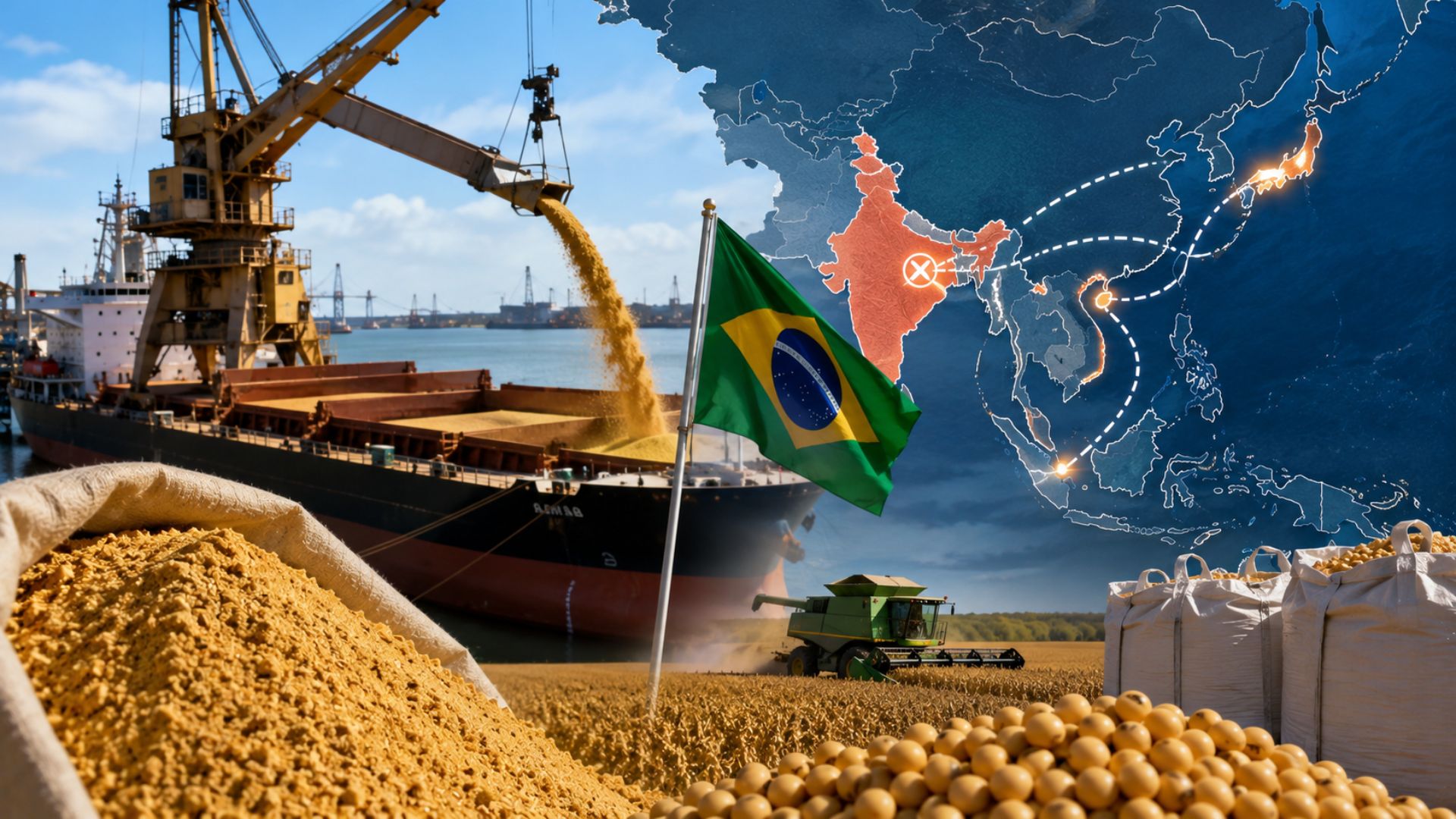


The turnaround came because soybean prices soared in India, with the crop failure making the product more expensive and rendering already closed contracts unfeasible. With the Indian offer costing around US$ 680 per ton, compared to US$ 430 from South America, Asian buyers are starting to look at suppliers like Brazil and Argentina.
Brazilian soybean meal exporters may gain a window of opportunity in Asia after India canceled export contracts for the first time since 2021. According to Reuters, Indian traders canceled about 25,000 tons of soybean meal export contracts and even booked 80,000 tons of imports from African countries, after the rise in domestic prices reversed trade flows.
The news, released on May 26, 2026, opens up space for suppliers from South and North America, including Brazil, to supply Asian buyers who traditionally source from India, such as Vietnam, Bangladesh, and Japan. Reuters itself highlights that the cancellations should help exporters from the American continent to increase their shipments to these markets, in a move that could directly benefit Brazilian agribusiness.
What is soybean meal and why it matters
Soybean meal is one of the most used ingredients in animal feed worldwide. It is produced from crushing soybeans to extract oil, and what remains from this process, rich in protein, becomes the meal intended for feed for poultry, pigs, and cattle. It is, therefore, a strategic input for global livestock and poultry farming.
-
Study of Brazil’s Tietê River Finds 25 Pesticides in Water, Including Cancer-Linked Substance Near Source

-
Young Entrepreneur Expands from 50 to 1,400 Chickens, Proving “Happy Hens” Can Be a Viable Business
-
Small Farm in Brazil’s Minas Gerais Produces 403 Liters of Milk Daily, Sets Benchmark for Rural Producers
-
Man Revives 1930s Abandoned Trout Farm, Learns from Scratch, and Earns $1.1 Million Annually Selling Fish to Michelin-Starred Restaurants



Brazil is a world power in the soybean chain, being one of the largest producers and exporters of the grain on the planet. Although the country mainly exports soybeans, the crushing industry and meal production also have significant weight in the trade balance, making any movement in the international meal market a matter of direct interest to national agribusiness.
Why India canceled the contracts
The root of the problem lies in the surge of domestic soybean prices in India. Local soybean meal prices jumped about 41% in just one month, reaching the highest level in four years, amid a restricted supply caused by the drop in Indian soybean production, affected by unfavorable weather conditions, while domestic poultry demand remained strong.
As a result, it became unfeasible for Indian sellers to fulfill export commitments previously closed at lower prices. According to one of the sources heard by Reuters, it was not possible for sellers to absorb an increase of about $200 per ton, so they agreed, in mutual agreement with buyers, to cancel the May and June shipments. These cancellations, known in the market as washouts, are rare in the meal trade and, in this case, did not involve penalties.
The price difference that favors Brazil
The central point for the Brazilian opportunity lies in the price comparison. The increase pushed Indian meal export offers to about $680 to $695 per ton, while South American suppliers offered the product for around $430 per ton, according to data cited by Reuters and Business Recorder. A difference of this magnitude makes the Indian product simply too expensive for Asian buyers.
In practice, this means that countries like Vietnam, Bangladesh, and Japan, which usually buy from India, now have a strong incentive to seek cheaper suppliers, and South America emerges as a natural alternative. Brazil, alongside competitors like Argentina and the United States, is well-positioned to fill part of this gap left by the Indian retreat.
The competition is not only from Brazil
It is important, however, to maintain balance in the analysis. The window of opportunity is not exclusive to Brazil: it opens to all major suppliers from the Americas, and Argentina, in particular, is historically the world’s largest exporter of soybean meal, with a very robust crushing industry. The United States also competes in this market.
That is, although the scenario is favorable, how much Brazil will effectively capture of this demand depends on factors such as crushing capacity, port logistics, exchange rates, and competitive prices at the right time. The opportunity is real and was pointed out by Reuters itself, but it will translate into concrete gains depending on the agility of Brazilian exporters in closing deals with Asian buyers.
The detail of non-GMO soybeans
There is also an interesting peculiarity in this market. India only allows the import of non-genetically modified soybeans, which restricts its supply to a handful of African nations, such as Benin, Niger, Togo, and Nigeria, where non-GMO grains are traded at a high premium compared to genetically modified varieties.
This is a differential of Indian bran, historically valued for being made from non-GMO soybeans, a characteristic appreciated by some buyers. India’s soybean imports could rise to a record of about 800,000 tons in the year up to September 2026, according to Vinod Jain, founder of the exporter Suraj Impex, compared to just about 2,000 tons the previous year, a clear sign of how the crisis has reversed the country’s role from exporter to importer.
Why this topic matters for the Brazilian agribusiness
For the reader who follows commodities and agribusiness, this episode is a clear example of how the global food market is interconnected and sensitive. A crop failure in India, on the other side of the world, can open concrete business opportunities for Brazilian producers and exporters, in a domino effect that runs through the entire soybean chain.
Agribusiness is one of the pillars of the Brazilian economy and the country’s trade balance, and soybeans are one of its flagships. Following movements like this helps producers, traders, and investors understand the windows of opportunity that arise in international trade, especially at a time of tight supply and volatile prices in the global grain and derivatives market.
The unprecedented cancellation of soybean meal contracts by India since 2021 reveals an opportunity for Brazilian exporters to target Asian buyers left without Indian supply. The price difference is significant and the space is real, but the competition will be fierce with Argentina and the United States. In the end, this is more a chapter of Brazil’s strategic position in the global food market, and a reminder of how distant climatic and economic events can directly reverberate in the Brazilian countryside.
And you, do you follow the soybean market and Brazilian agribusiness? Do you believe Brazil will be able to take advantage of this window opened by India in Asia? Leave your comment, share your vision about the future of Brazilian soybean meal exports, and share the article with those interested in agribusiness, commodities, and international trade.