Portuguese
  Spanish


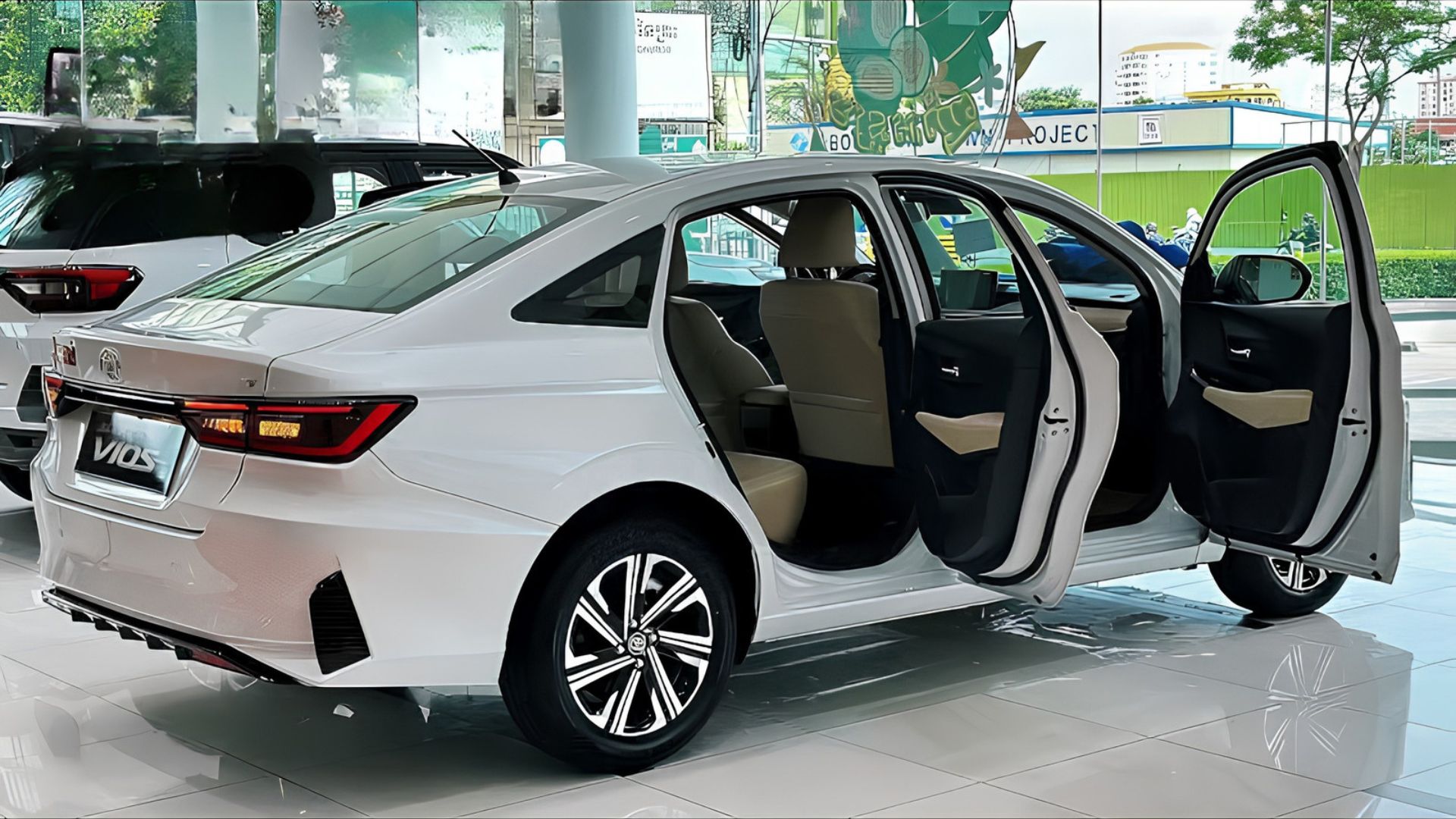


Toyota Vios remains strong in the Philippines with a 1.3 engine, manual and CVT versions, low cost, and a compact sedan proposal that disappeared from Brazil.
While Toyota stopped investing in affordable compact sedans in Brazil, other Asian markets continue to receive extremely popular models from the brand. One of the main examples is the Toyota Vios, a compact sedan sold in the Philippines and several Southeast Asian countries with an urban proposal, low consumption, and reduced cost. The model currently starts at approximately ₱738 thousand in the Philippines, an amount that is close to R$ 75 thousand in direct conversion, without Brazilian taxes, freight, import, or local fees. This range places the car below several compact sedans currently sold in Brazil.
The Vios is treated by Toyota as a global entry-level sedan for emerging markets and remains extremely relevant in Asian countries, mainly because of its focus on:
- economy;
- reliability;
- simple maintenance;
- and low operational cost.
The sedan uses a 1.3 four-cylinder engine with manual or CVT option
According to official information from Toyota Philippines, the current lineup uses a 1.3 Dual VVT-i naturally aspirated four-cylinder engine. The available versions work with:
-
End of an era in Brazil: beloved sedan by Brazilians is discontinued despite having a 2.0 engine with 151 hp, CVT transmission, 466-liter trunk, and up to 650 km of range.

-
New Law Proposal in Brazil Could Heavily Penalize Drivers: Dangerous Overtaking May Become a Serious Offense with Fines Increased Tenfold and a 12-Month License Suspension; Update on 2026 Progress

-
Electric Revolution: Watts W125 Motorcycle Offers 160 km Range, 90 km/h Speed, and Affordable Price Starting at $3,000
-
General Motors Replaces Over a Thousand Workers with 50 Cobots at Electric Vehicle Plant, UAW Union Criticizes Move Amid Industry’s Automation Push




- 5-speed manual transmission;
- or CVT transmission.

The proposal clearly prioritizes urban efficiency and mechanical simplicity, something that still has enormous demand in various Asian markets.
The mechanical set is quite different from the recent trend of turbo downsizing seen in many global markets. Instead, Toyota continues to bet on a small naturally aspirated engine with simpler maintenance and reduced cost.
The Toyota Vios measures more than 4.4 meters in length
Despite the affordable proposal, the Vios has dimensions relatively close to several compact sedans sold in Brazil.
Data released by Philippine automotive platforms indicate:
- about 4.42 meters in length;
- 1.73 meters in width;
- and a wheelbase close to 2.55 meters.
The result is a compact sedan focused on urban space and everyday family use. The design follows Toyota’s recent language, with:
- wide front grille;
- more aggressive lines;
- and a front inspired by the brand’s larger models.
Toyota still maintains extremely simple versions
Another curious aspect is that the Vios still offers quite basic versions in some markets. The entry-level configurations use:
- simple wheels;
- more traditional finish;
- manual transmission;
- and a minimal package.


Even so, higher versions already come with:
- multimedia center;
- rear camera;
- partially digital dashboard;
- smartphone connectivity;
- and more modern safety equipment.
This shows how Toyota keeps the model extremely flexible depending on the market and the desired price range.
The Vios has become one of Toyota’s most important cars in Southeast Asia
The model has become extremely relevant in markets such as:
- Philippines;
- Thailand;
- Indonesia;
- Malaysia;
- Vietnam;
- and other countries in the region.
In many of these locations, the Vios occupies a role similar to what the Corolla and Yaris have had in Brazil for years: a rational sedan aimed at families, app drivers, and consumers who prioritize durability. Toyota itself maintains regional production of the model to supply various Asian countries.
The sedan also gained sporty versions in some markets
In addition to the traditional versions, some countries received GR-S configurations inspired by the Gazoo Racing sports division. These versions add:
- more aggressive styling;
- recalibrated suspension;
- larger wheels;
- sporty details;
- and distinctive finishing.
Even so, the main focus of the Vios remains efficiency and low operational cost. Perhaps the most curious aspect of the Toyota Vios is precisely showing a segment that lost space in the Brazilian market.

For many years, simple compact sedans dominated sales in the country. Models like:
- Etios Sedan;
- Prisma;
- Siena;
- Logan;
- and Voyage
occupied a large part of the national market.
Today, much of this space has been taken over by compact SUVs and urban crossovers. Meanwhile, in several Asian markets, affordable compact sedans remain extremely strong.
The Toyota Vios shows that Toyota still bets on compact sedans outside Brazil
Even with the global rise of SUVs, Toyota continues to invest in traditional compact cars in various countries.
The Vios ends up functioning almost as a portrait of a category that lost relevance in Brazil but remains huge in other parts of the world.
And perhaps that’s exactly what makes the model draw so much attention: it shows that there is still a huge market for simple, economical, and cheap compact sedans — as long as consumers continue to prioritize rationality over the trend of sports utilities.