






 Portuguese
  Spanish
  4 min of reading
  0 comments


Understand the Differences, Advantages, and Risks Between Beams and Trusses and How to Get the Choice Right to Not Compromise the Efficiency of the Work.
Errors in choosing between a beam and a truss can increase the costs of a construction, compromise the safety of the structure, and harm the final performance of the project. The decision between these two structural solutions should be based on clear technical criteria, such as the span size, the load to be supported, the time available for execution, and the budget available.
In this exclusive content, we explain in detail the differences between beams and trusses, their applications, advantages and disadvantages, as well as how to avoid common mistakes when designing.
Understand the Difference Between Beams and Trusses: Essential Concepts
Although they are often used as supporting elements, beams and trusses have distinctly different structural behaviors.
-
Switzerland took 17 years to tear through the Alps and build the world’s largest railway tunnel, a 57.1 km passage under 2,300 meters of rock, with 50 °C heat and 28.2 million tons excavated to connect the north to the south of Europe.

-
With 1,415 m², a frontal view of the sea, and surrounded by skyscrapers, the mansion worth R$ 140 million bought by Luciano Hang is the last standing residence on the waterfront of the ‘Brazilian Dubai’ in Balneário Camboriú.

-
“Big Becky,” the 4,000-ton steel monster with the height of a four-story building, spent five years tearing through 10.2 km of solid rock beneath Niagara Falls to divert the river’s force and generate clean energy for 160,000 homes.

-
Luciano Hang buys for R$ 140 million the last mansion standing on the beachfront of the “Brazilian Dubai”: a 1,415 m² property with a front view of the sea, surrounded by skyscrapers in one of the most valuable square meters in the country, in Balneário Camboriú.



Beam: is a component that supports loads acting perpendicular to its axis, primarily designed to resist bending. Beams transfer the loads to columns or foundations, being fundamental elements in small to medium-sized structures.
Truss: consists of a composition of bars arranged in a triangular shape, which distribute the forces through compression and tension in the bars. Unlike beams, trusses avoid bending and are highly effective for spanning large distances.
When to Use Beams: Simple and Efficient Solutions for Smaller Structures
Beams are mainly indicated for works that require quick execution and do not demand large spans.
They are present in practically all types of buildings, from residential to commercial and industrial.
Main Types of Beams
- Simple: with support at the ends, ideal for short spans.
- Continuous: with multiple supports, allows greater load distribution and stability.
- Cantilever: fixed at only one point, widely used in balconies and canopies.
Advantages of Beams
- Quick installation, especially with prefabricated pieces;
- High resistance with materials such as reinforced concrete and steel;
- Flexibility of use in different types of construction.
Disadvantages of Beams
- Not recommended for large spans due to high weight and cost;
- May require more robust foundations, increasing the budget.
Truss: Light and Efficient Structure for Large Spans
When the project requires covering large spaces with minimal intermediate support, the truss is the best choice. It offers excellent structural performance with lower material consumption.
Most Used Models
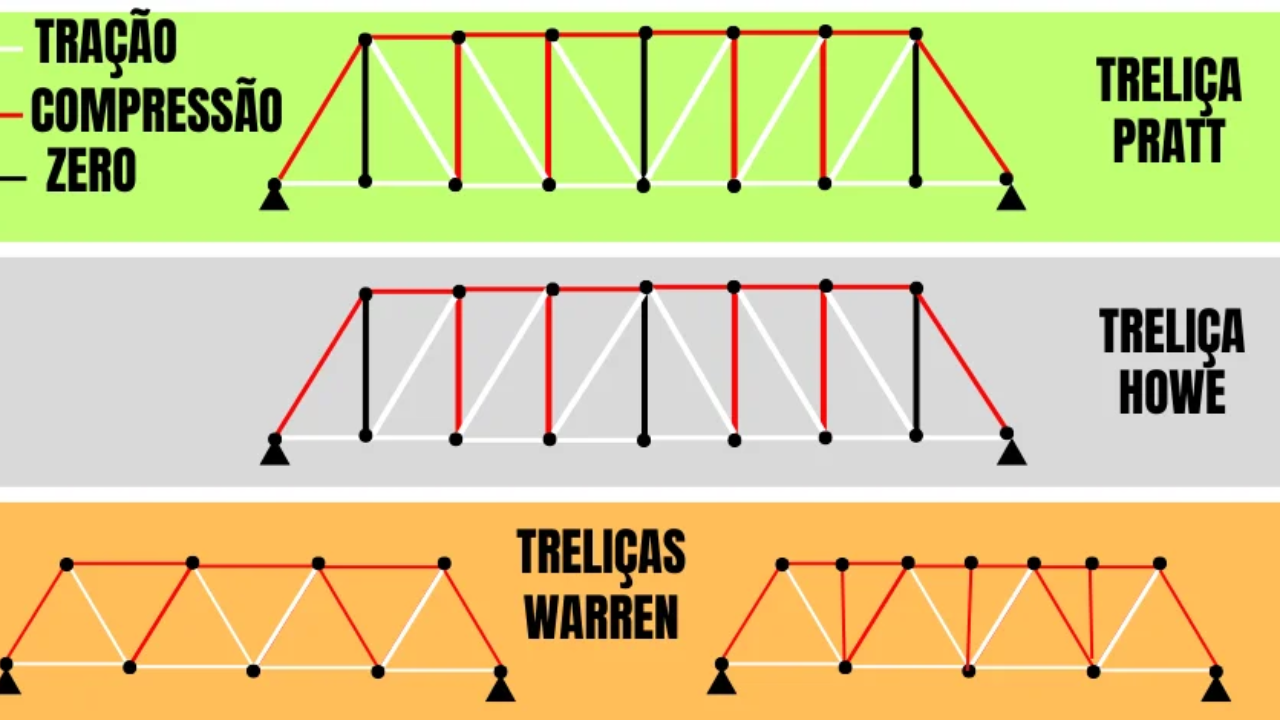
- Howe Truss: structural efficiency with compressed diagonals.
- Pratt Truss: ideal for metal roofs and bridges, with diagonals in tension.
Warren Truss: alternating diagonals for balanced force distribution.
Typical Applications
- Logistics and industrial warehouses;
- Metal bridges and walkways;
- Large commercial roofs;
- Event and fair structures.
Advantages of Trusses
- Allow for spanning large distances with lightness;
- Save material due to efficient geometry;
- Reduce foundation costs by decreasing structural weight.
Disadvantages of Trusses
- Require greater precision in manufacturing;
- Higher initial cost, compensated in the long run;
- Specialized assembly may increase execution time.
Ready Solutions: Agility with Quality in the Construction
To meet the demand for efficiency, the market has been offering ready-made structural solutions, such as ribbed trusses and welded columns. These alternatives combine agility, standardization, and high performance.
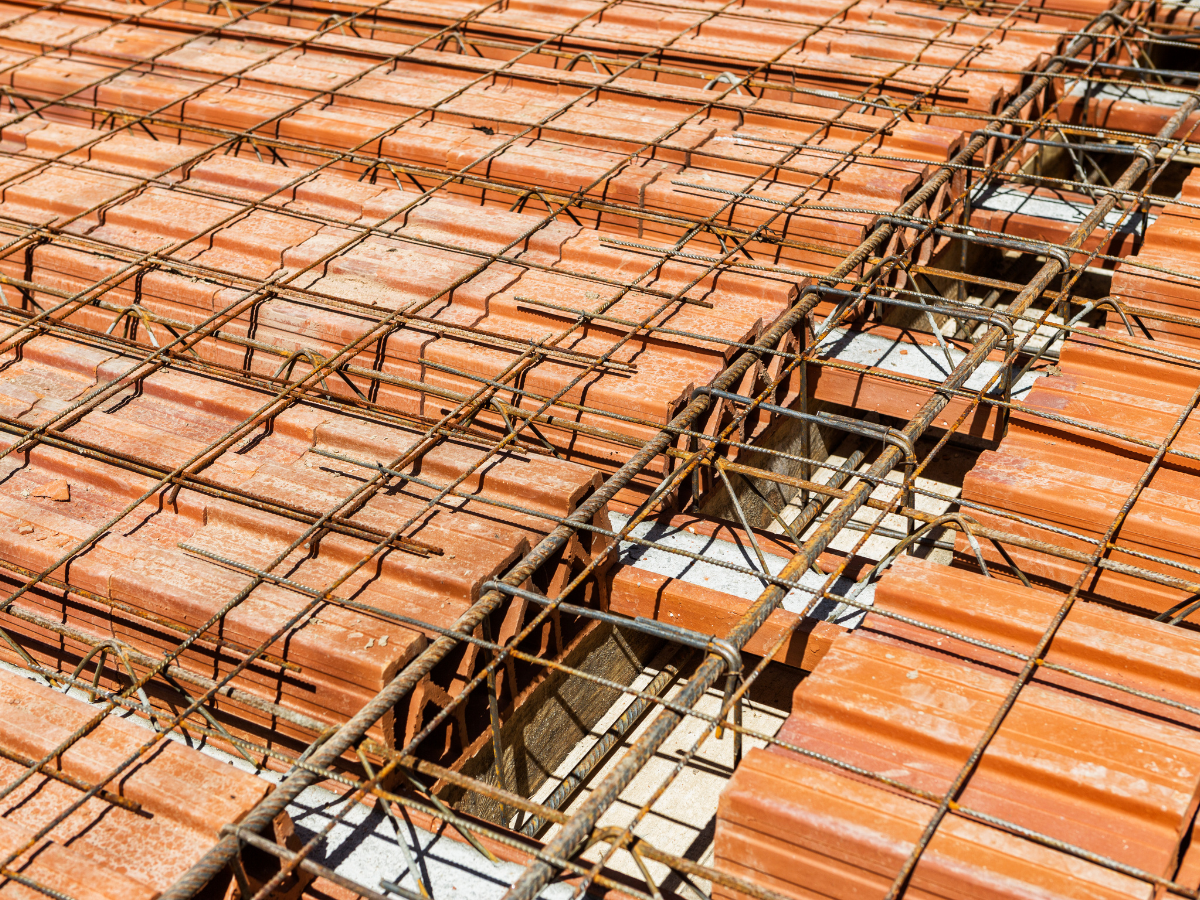
Ribbed trusses made of CA-60 steel, for example, are composed of wires welded together and ensure excellent adherence to concrete.
Their application is ideal in precast slabs, with standardized batch supply that facilitates transport and installation.
In addition, welded columns with CA-50 steel and CA-60 steel stirrups speed up the assembly of columns, beams, and footings. The regular spacing between the stirrups ensures uniformity and safety to the structure.
“Utilizing ready-made structural products such as trusses and welded columns guarantees greater agility, reduces errors in construction, and standardizes quality.”
All these solutions follow the standards of ABNT, such as NBR 14859-3, ensuring total technical compliance.
Technical Criteria for Choosing Between Beams and Trusses
To make the right decision between beams and trusses, it is essential to consider the following factors:
- Span size: small and medium spans favor the use of beams. Large spaces require trusses.
- Supported load: point loads are well distributed by beams. Loads spread over large areas require trusses.
- Time available: prefabricated beams are quicker. Trusses require more planning and assembly.
- Cost of the work: beams have a lower initial cost. Trusses offer better cost-effectiveness in larger structures.
Common Mistakes and How to Avoid Them
Two mistakes stand out in the practice of structural projects:
- Using a beam in large spans: this raises foundation costs and creates structures that are heavier than necessary.
- Using a truss in small spans: the manufacturing complexity may not justify the initial investment.
Both cases lead to extra costs, delays, and potential structural problems in the future.
The decision between a beam and a truss should be guided by technical and strategic criteria. By understanding the particularities of each structure, architects, engineers, and builders can define more efficient, durable, and economical solutions.
In a scenario where resource optimization is a priority, making the right structural choice means a safer construction, with less waste and on schedule.
Source: Somar Metais.






-

1 person reacted to this.