






 Portuguese
  Spanish


Wind Energy: Bladeless Turbine Is Suitable for Urban Areas, Does Not Threaten Bird Migration Patterns or Wildlife.
Vortex Bladeless, a tech start-up based in Spain, is developing wind turbines that do not require blades. One of the goals is to utilize these turbines in urban and residential spaces, where the impact of ecological parks would be too great. Similar to a “giant straw,” according to its creators, it is here to change the world of renewable energy.
David Yáñez, the inventor of these turbines, claims that it can be a complement to solar energy “because solar panels produce electricity during the day, while wind speeds tend to be higher at night.” “But the main benefit of the technology is to reduce its environmental impact, visual impact, and the cost of operation and maintenance of the turbine,” he adds.
The bladeless turbines are three meters tall and feature a cylinder with a curved cap fixed vertically with an elastic rod. The turbine is designed to oscillate with the wind, generating electricity through vibration.
-
Brazilian Innovator Survives Homemade Submarine Dive in Paraty Despite Hatch Leak and False Oxygen Alarm

-
China Develops Custom 140-Ton Electric Mining Truck with 770 kWh Swappable Battery, Deploys 290 Units in Xinjiang’s Largest Zinc Mine
-
Meta to Launch Arena, a New Prediction App Targeting 3.56 Billion Users, Competing with Polymarket and Kalshi

-
Scientist Challenges Famous Human Evolution Theory, Argues Homo Sapiens Evolved Gradually Over Thousands of Years




Bladeless Turbine Could Be the Future of Wind Energy and Renewable Energy
Vortex Bladeless claims that the turbine is not a danger to bird migration patterns or wildlife, especially when used in urban environments. Additionally, it states that the noise created would be at a frequency practically undetectable to humans.


“Today, the turbine is small and can generate small amounts of electricity. But we are looking for an industrial partner to increase our plans for a 140-meter turbine with a capacity of 1 megawatt,” reveals the inventor of the turbines.
The design has received approval from Norway’s state energy company, Equinor, which has listed it as one of the top 10 most exciting start-ups in the energy sector. The company will also provide support for the start-up’s development through its technology accelerator program.
Without Blades, the Vortex Can Transform Breezes into Energy
Its appearance may be deceiving, but even without blades, the Vortex can transform breezes into renewable energy, albeit in a different way. Instead of using the circular motion that blades create, the new turbine utilizes what’s called vorticity, an aerodynamic effect that produces a pattern of rotating vortices. Vorticity has been considered the greatest enemy of architects and engineers, who try their best to work around these whirlwinds of wind in certain types of structures. However, the founders of Vortex Bladeless, David Suriol, David Yáñez, and Raul Martín, saw this as an opportunity.
The Vortex’s shape was developed to ensure that the rotating winds travel in sync along the entire length of the mast, providing good performance.
Its current prototype is made of fiberglass and carbon fiber, allowing it to vibrate as much as possible. Two repelling magnets were placed at the base of the cone, which act as a non-electric motor. When the cone oscillates to one side, the magnets pull it in the other direction, providing a slight boost in its motion without relying on wind speed. This kinetic energy is then converted into electricity by an alternator that multiplies the frequency of the mast’s oscillation to improve energy extraction efficiency.
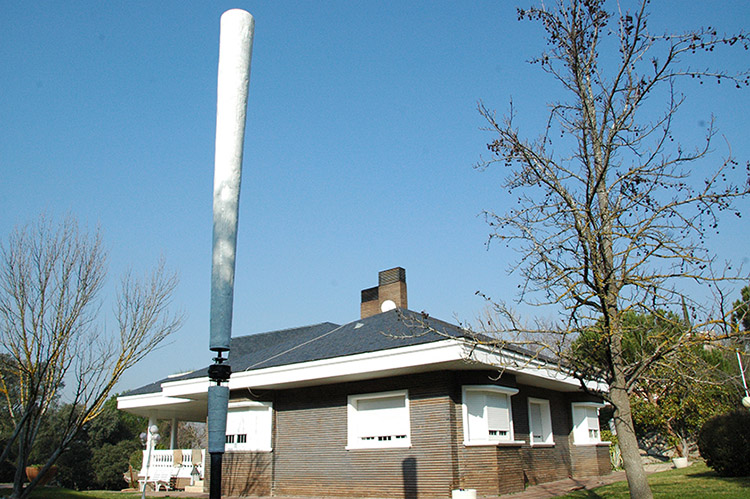
Vortex Nano: 1 meter tall and rated power of 3W . Designed primarily to provide energy to off-grid locations for low-power systems, working together with solar panels. Stage: pre-production of a first beta series.
Vortex Tacoma: 2.75 meters tall and rated power of 100W . Designed primarily for small-scale residential and rural autonomous operation, working with solar panels. Stage: prototype, being developed.
Vortex Atlantis/Grand: 9–13 meters tall and about 1 kW of rated power. Designed for autonomous residential and rural operation and complementary installation with solar panels on buildings and factories. Stage: designed but not yet being developed.
I would love to know what you think of this turbine. Let us know in the comments section if you are a professional in the field. Don’t forget to leave 5 stars and enable notifications from CPG to keep up with all the news in the world of renewable energy. Until next time!







Tomará que chegue logo no Brasil !!!
Incrível.
GOSTARIA DE TER INFORMAÇÕES MAIS DETALHADAS E SE OS SENHORES JÁ TEM REPRESENTANTE NO ESTADO PARANÁ