Portuguese
  Spanish


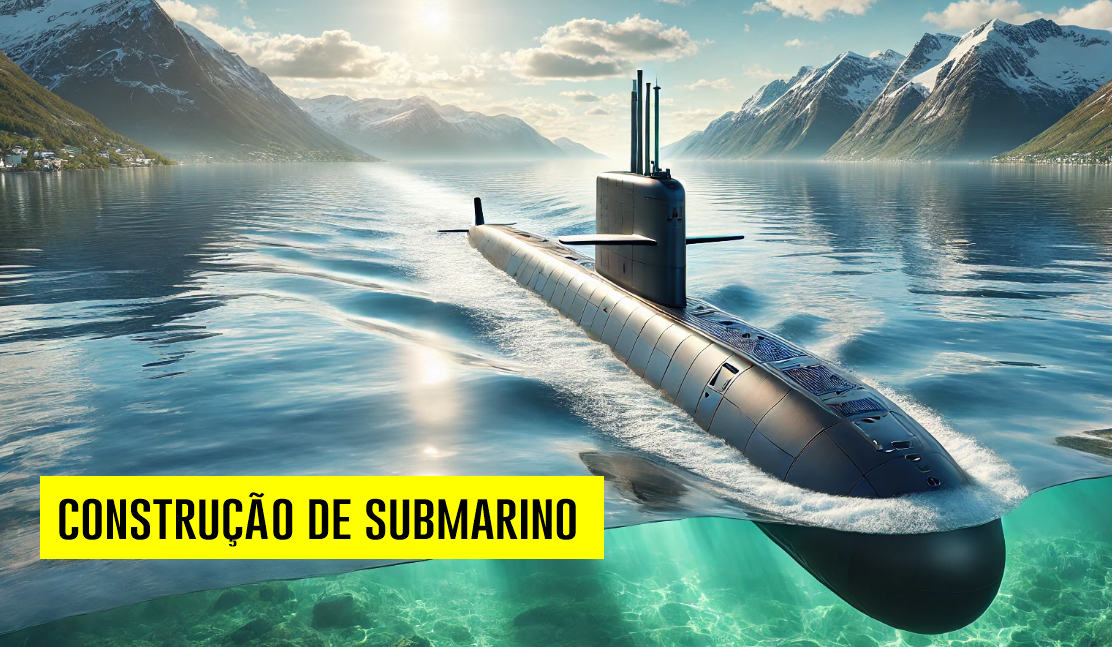


International Partnership Between South Korea and a Latin American Country Promises to Revolutionize Submarine Construction with Cutting-Edge Technology
Brazil stands out in Latin America as one of the few countries capable of designing and constructing modern submarines, thanks to its technological development program and partnerships with international naval powers. The Brazilian naval industrial base, led by the Brazilian Navy in conjunction with companies such as Itaguaí Construções Navais, has enabled the construction of conventional submarines and the development of Brazil’s first nuclear submarine, Álvaro Alberto.
However, another country in Latin America is studying the development of modern submarines to modernize its naval fleet.
On the last day November 17, 2024, the Presidential Palace in Lima was the stage for a milestone in bilateral relations between South Korea and Peru.
-
Global Shipping Faces Shortage of Certified Maritime Officers, Salaries in the U.S. Can Exceed $100,000 Annually

-
The FLIP: A 108-Meter Ocean Laboratory That Stood Vertically for 60 Years, Dismantled in 2023
-
North Korean Fiasco: Launch of the Largest Warship Ends in Sinking

-
While giant ships still burn heavy fuel and the maritime sector races against climate targets, Maersk and Vale are starting to bet on ethanol as a new route to reduce emissions at sea.



The South Korean president, Yoon Suk Yeol, and the Peruvian president, Dina Boluarte, led an official summit that resulted in the adoption of a joint declaration and the signing of several Memorandums of Understanding (MOUs), highlighting naval defense cooperation as one of the main pillars.
The main agreement reached during the meeting is the development of a set of submarines, a project that leverages South Korea’s advanced capabilities in naval engineering.
This agreement addresses Peru’s strategic interests in modernizing its naval fleet, strengthening its maritime capabilities in a context of growing geopolitical importance in the region.

Strategic Collaboration in Submarines
South Korea, with its established experience in cutting-edge projects such as the KSS-III class submarines, will play a crucial role in providing technology and expertise to Peru.
The agreement provides for technology transfer, industrial cooperation, and the possibility of greater interoperability between the naval forces of both countries.
In addition, the partnership is not limited to submarine development. The leaders also discussed plans to expand collaboration on surface combat ship projects and logistical vessels, leveraging South Korea’s advanced shipbuilding industry to meet the needs of the Peruvian Navy.
History of Naval Cooperation Beyond Submarines
The relationship between South Korea and Peru in the naval field is not recent. Since 2013, the two countries have been working together on important projects.
One of the most notable examples was the construction of the landing platform BAP Pisco, resulting from collaboration between the Peruvian shipyard SIMA and Daesun Shipbuilding & Engineering from South Korea.
This partnership was extended with the donation by South Korea of two Pohang-class corvettes: BAP Ferré in 2016 and BAP Guise in 2022. Such initiatives demonstrate the depth of the relationship between the two countries in the defense sector.
More recently, in April 2024, HD Hyundai Heavy Industries (HHI) secured a contract worth US$ 463 million with SIMA for the construction of four naval vessels. The project includes a 3,400-ton frigate, a 2,200-ton offshore patrol vessel, and two 1,500-ton landing craft, with completion expected by 2029.
Strengthening Strategic Partnerships
The meeting between Yoon and Boluarte reinforces a trajectory of high-level cooperation. At the APEC summit in 2023, both leaders already agreed to strengthen ties in the defense sector, consolidating a path for even more ambitious collaborations.
With the recent agreements, South Korea reaffirms its position as a strategic partner for Peru in Latin America. The nations demonstrate that by combining resources and expertise, they can achieve advanced advancements in their naval and defense capabilities.
Despite the satisfaction, the challenge remains to align schedules and coordinate the execution of projects efficiently. However, the long-term outlook is promising, with economic and military benefits for both countries.
This moment represents, therefore, a milestone in the history of bilateral relations, highlighting the importance of multilateral cooperation in an increasingly complex international landscape.