Portuguese
  Spanish


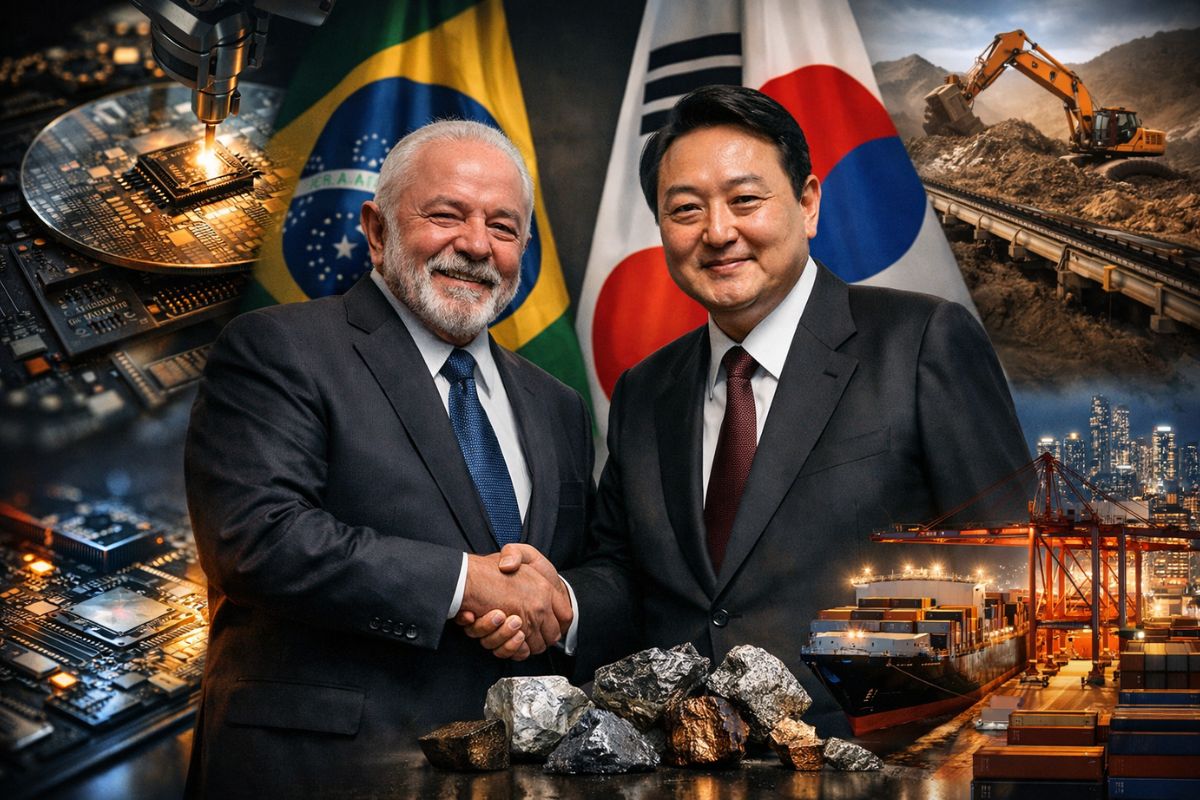


Lula and South Korean President Lee Jae-myung Officialize Strategic Partnership with a Three-Year Action Plan, After 16 Years Without a Brazilian Presidential Visit to Seoul. For Brazil, the package aims at regulatory harmonization, trade integration, financing, and cooperation in semiconductors, critical minerals, vaccines, digital health, AI, and decarbonization on a global scale.
Brazil left Seoul with a broad agreement that elevates its relationship with South Korea to the level of Strategic Partnership, signed by Lula and President Lee Jae-myung on Monday (23) in Seoul. The promise, in practice, is to organize a Three-Year Action Plan with measures that affect trade, industry, health, and technology.
The most sensitive point is that behind the technical words lies an attempt to reposition Brazil in global supply chains where South Korea is already a reference. The logic is to reduce friction, open doors, and accelerate cooperation in areas where time and scale turn into competitive advantages.
What Was Signed in Seoul and Why This Move Returned to the Center of the Agenda
The pact was signed in Seoul, ending a 16-year hiatus of Brazilian presidential visits to the Asian country. This return to high-level contact is important because it signals political priority to unlock projects and provide predictability to companies, universities, and research centers that depend on stable rules.
-
At 14 years old, she worked in a factory in Hong Kong, studied economics abroad, and then entered the Chinese real estate market, which helped change the landscape of Beijing.

-
While NATO secured more than $10 billion in missiles and space surveillance at a single forum, Brazil still spends 1.1% of its GDP on defense and is stalling its own anti-aircraft system.

-
Corn ethanol attracts R$ 23 billion in 21 new plants and prepares for a nearly 50% jump in Brazilian production by 2027, even with high interest rates.
-
A newly opened terminal in the middle of the Amazon has begun transporting soy and corn through Amapá, eyeing the queue of ships that is congesting the ports in the South.


By elevating the relationship to a Strategic Partnership, Brazil and South Korea create a “umbrella” for various instruments: trade and productive integration, financial cooperation, and sectoral agendas in technology, health, and energy transition.
The expected effect is to reduce the distance between intention and execution, with deadlines and deliveries focused on a three-year cycle, instead of scattered initiatives.
Trade and Investments: Where Bureaucracy Weighs and Where It Can Unlock
In the economic axis, the highlight is the Framework Agreement on Trade and Productive Integration, designed to tackle what usually hinders business between countries: different requirements, repeated procedures, and insecurity about how to comply with regulations.
Regulatory harmonization is central to simplifying rules and allowing Brazilian and Korean companies to operate with more predictability.
There were also discussions to resume negotiations between South Korea and Mercosur, which have been stalled since 2021. If this channel progresses, the impact on Brazil is likely to appear in how supply chains connect and the cost of doing trade.
Today, South Korea is Brazil’s fourth-largest trading partner in Asia, with a trade flow of US$ 11 billion, and Brazil is the main destination for Korean investments in Latin America, numbers that help explain why both governments are aiming for less friction and more scale.
Chips and Critical Minerals: Why Semiconductors Have Become the Most Strategic Core
The explicit presence of semiconductors in the Action Plan is a signal of industrial priority.
South Korea is a global leader in segments of the chip ecosystem, while Brazil seeks to strengthen its own integration, whether through supply chains or regulatory and innovation environments.
When chips enter the negotiation, it’s not just technology: it’s logistics, governance, and supply chain resilience.
The same reasoning applies to critical minerals, cited as essential for batteries and to add value within Brazil.
Instead of treating the subject merely as the export of inputs, the design points towards “technology to add value,” meaning cooperation that can involve standards, traceability, production processes, and integration with more sophisticated industrial demands.
If Brazil wants to climb the ladder in the supply chain, the decisive point tends to be how to transform resources into production with a higher technological content.
Health and Science: Vaccines, Genomics, and the Leap of Digital Health
The partnership places health as one of the most dynamic axes, ranging from development to modernization of systems.
Vaccines and medicines appear as a front for joint production and technology transfer, which, in theory, reduces dependencies and accelerates response in scenarios of high demand.
Here, the “how much” is not just budget: it’s installed capacity and delivery time, which tend to be the bottleneck in public health crises and in expanding coverage.
Moreover, there are cooperations in advanced genomics, focusing on research for personalized treatments, and in digital health, with the exchange of technologies to modernize the care and diagnosis of chronic and communicable diseases.
For Brazil, this focus combines two goals: advancing applied science and shortening the path between laboratory, healthcare system, and end user, without promising miracles, but aiming at efficiency and precision.
AI, Energy Transition, and Decarbonization: What Changes When the Agreement Points to the Future
Artificial intelligence appears as a field for joint development of new tools, a type of cooperation that usually involves research, training, and application in productive sectors.
For Brazil, the topic is ambivalent: it can mean gains in productivity and innovation, but it also requires governance, rules, and the capacity to absorb technology in a sovereign way. Without clear rules, AI becomes a race; with rules, it becomes a strategy.
In the energy transition, the agenda mentions projects aimed at decarbonization and clean energy. South Korea brings industrial and technological expertise, while Brazil tries to connect energy potential and resource base to higher value industrial chains.
The practical effect depends on how projects will be selected and financed, and that’s why financial cooperation, with a memorandum to strengthen financing for projects of mutual interest, appears as support to move initiatives from paper to reality.
Democracy, Disinformation, and Education: The Political Layer that Sustains the Rest
In addition to economy and technology, the presidents reinforced their commitment to defending democracy against extremism and disinformation.
In agreements of this type, this layer works as a signaling of institutional trust, something that impacts everything from investment to academic cooperation, because it defines the level of stability and predictability perceived by partners.
In the social field, the pact foresees an increase in cultural and educational exchange, facilitating the movement of students and researchers.
For Brazil, this is often a silent multiplier: it shapes people, creates networks, transfers methods, and accelerates institutional learning.
When talents circulate, the partnership stops being an event and becomes a routine, and it is this routine that ultimately defines whether the Three-Year Action Plan delivers effects that survive the news cycle.
The agreement signed in Seoul places Brazil in front of a strategic choice: to use the Strategic Partnership with South Korea to reduce friction, attract investments, and build capacity in chips, critical minerals, vaccines, AI, and clean energy, or to let the initiative remain limited to broad intentions and sporadic cooperation.
What differentiates one scenario from the other is execution, priority, and regulatory consistency over the next three years.
Considering the real Brazil of day to day, which of these points do you think should come first: chips and critical minerals for industry, vaccines and digital health for the healthcare system, or AI and decarbonization for competitiveness?
And, in your experience, where does bureaucracy slow things down the most: in regulation, in financing, or in the ability to turn partnership into a functioning project?