






 Portuguese
  Spanish
  4 min of reading
  1 comment


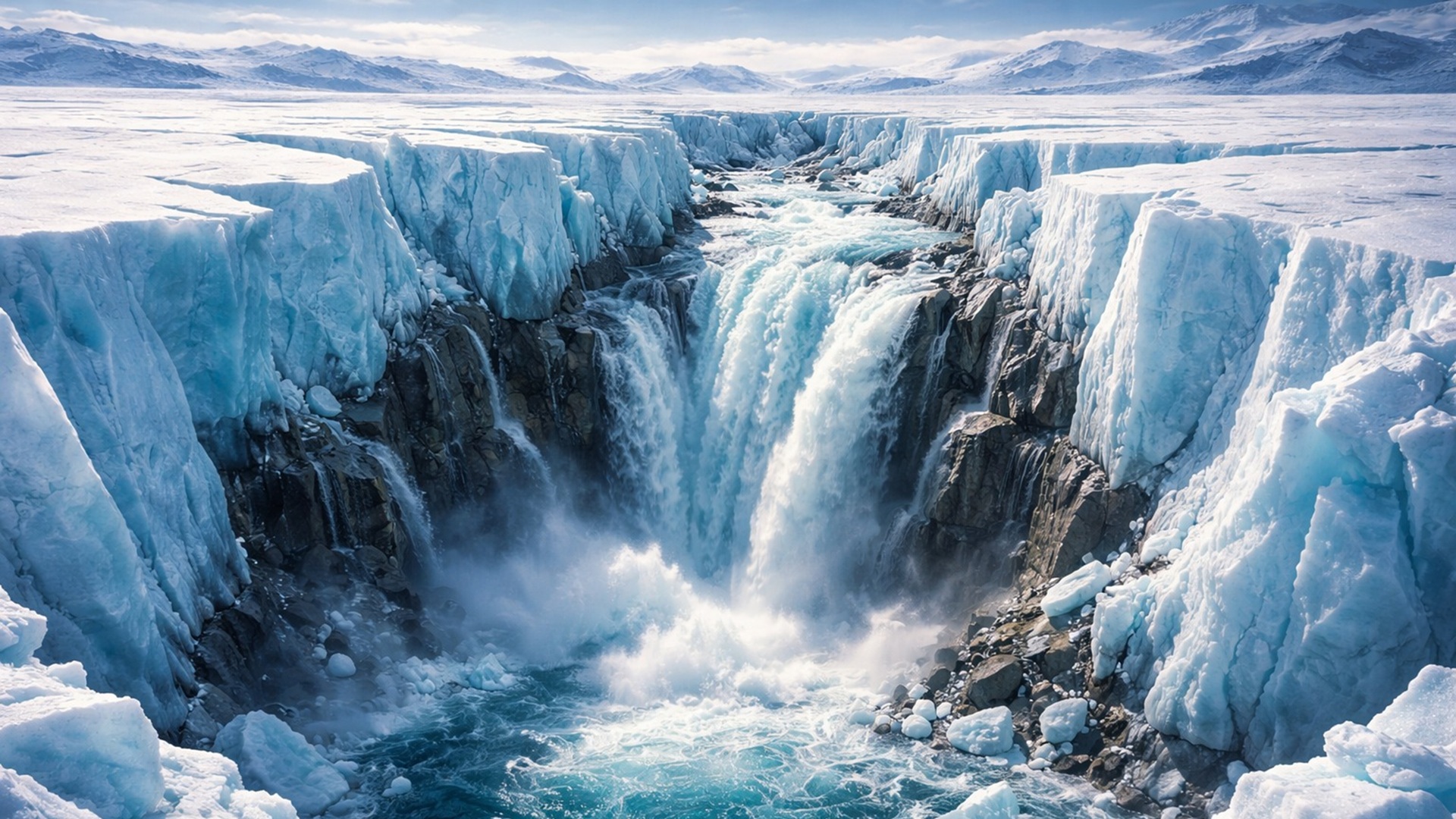


Identified From Data From Multiple Satellites, The Subglacial Flood That Occurred In 2014 Released About 90 Billion Liters Of Meltwater, Broke Up To 91 Meters Of Solid Ice, And Revealed Significant Flaws In The Models Describing The Internal Hydrological Functioning Of The Greenland Ice Sheet
Scientists documented a unprecedented subglacial flood that occurred in 2014 in Greenland, when 90 billion liters of meltwater broke through up to 91 meters of ice, opening a crater of 2 square kilometers and providing new data about the internal dynamics of the ice sheet.
Unexpected Event Under The Greenland Ice Sheet
Researchers identified a previously unknown flood under the Greenland ice sheet, recorded in 2014, which released an estimated volume of 90 billion liters of meltwater. The flow’s force was sufficient to fracture nearly 91 meters of solid ice from the base.
The event originated from a subglacial lake, a body of liquid water trapped beneath the ice, and was first observed in northern Greenland.
-
New oral medication for hair loss surprises in tests with more than 500 participants, uses extended-release minoxidil, shows hair growth four times greater than the placebo, and now raises expectations about when it might reach the market.

-
Europa, Jupiter’s icy moon, intrigues scientists after radar indicates an unusual brightness in the ice and raises new suspicions about what might be hidden in the deep layers of this distant world.
-
At 10 years old, a prodigy boy who claims to have learned to read as a baby is already explaining how the brain works to over a million followers and left the famous Dr. Sanjay Gupta speechless.

-
Hidden in a secret laboratory in Tokyo for over 25 years, an impossible lens made of 2,500 microlenses that saw like insect eyes promised to blow the minds of those watching TV.




This is the first documented record of such drainage in the country, according to the scientists responsible for the study.
The discovery occurred during retrospective analyses of satellite data. Initially, researchers considered the possibility of errors in the data due to the unexpected size of the flood and the sudden changes detected on the ice surface.
Satellite Data And Three-Dimensional Reconstruction Of The Phenomenon
To understand what occurred, the team analyzed information collected by multiple satellites, including ICESat, ICESat-2, and Landsat-8 from NASA, as well as Sentinel-1, Sentinel-2, and CryoSat-2 from the European Space Agency. These data allowed for a three-dimensional reconstruction of the subglacial flood dynamics.
The models revealed that, over about 10 days, between July and August 2014, a crater approximately 2 square kilometers in area and 85 meters deep formed. The collapse was caused by the sudden drainage of a meltwater lake located on the slopes of the ice sheet.
The volume released is equivalent to approximately nine hours of peak flow from Niagara Falls.
The scale of the event surprised scientists and indicated a water transport capacity much greater than previously expected for subglacial systems in Greenland.
Physical Impacts On The Ice Structure
Further down from the drainage point, researchers identified signs of extensive destruction on the ice surface.
The flood wave fractured a large area, removing ice blocks up to 25 meters high and sculpting a deformed surface about twice the area of Central Park in New York.
These evidences indicate that the water not only drained under the ice but also exerted enough pressure to significantly modify its internal and surface structure.
The phenomenon demonstrated that ice can respond abruptly to large inputs of meltwater.
The observations contradict the notion that the base of the Greenland ice sheet remains largely frozen and stable.
They also challenge models that described a more gradual and predictable flow of water from the surface to the ocean.
Review Of The Role Of Subglacial Lakes
Until recently, the role of meltwater in the dynamics of the ice sheet was poorly understood. The prevailing view suggested that water flowed from the surface to the base and then drained relatively directly to the ocean.
The new study focused on subglacial lakes, which are fed by meltwater and remain hidden beneath the ice.
Researchers suggest that these lakes can store large volumes of water and release them suddenly through extreme drainage events.
As the existence of these lakes beneath Greenland has only been recognized in recent years, there are still significant gaps regarding their evolution, drainage frequency, and impact on the hydrological system of the ice sheet. This lack of knowledge limits the accuracy of current projections.
Scientific Implications Of The Findings
The conclusions of the study indicate that the subglacial hydrology of Greenland is more complex than previously thought. Extreme events, such as the one recorded in 2014, demonstrate that large volumes of water can accumulate and be released quickly and destructively.
According to the authors, understanding these processes is essential to assess how the ice sheet responds to intense inputs of surface meltwater. The findings also highlight the need to improve models representing the internal behavior of polar ice caps.
The Greenland ice sheet covers about 1.7 million square kilometers and loses approximately 33 million tons of ice per hour. While these numbers are already known, the specific role of meltwater in this system remains one of the least understood aspects.
New Questions About The Future Of The Polar Caps
Scientists state that the results obtained provide vital information about processes occurring outside direct line of sight. The subglacial drainage documented in 2014 shows that the ice sheet can respond quickly to extreme conditions, with significant structural effects.
The study emphasizes the importance of continuous satellite monitoring and detailed analyses to detect similar events in the future. It also stresses that the hydrological system of the polar ice caps needs to be better understood both in the present and in future scenarios.
By revealing a previously unknown phenomenon, the research broadens scientific understanding of Greenland and reinforces the need to revise existing models. The data obtained in 2014 now integrates a critical set of evidence on the internal behavior of ice in response to accelerated melting.







Volcanic activity worldwide, rising Greenland coast (away from water), water rising elsewhere, it would seem Greenland is growing. This melt water may be an indication of volcanic activity underneath, it is after all, an island in the middle of a ocean and probably came into being with an earlier eruption.