






 Portuguese
  Spanish


A Giant Dam Could Save 15 European Countries From Flooding. Understand the Project That Both Scares and Impresses
Have you ever stopped to think that one day Europe might encircle the North Sea with a massive wall? It sounds like a movie plot, right? But it’s not fiction. A group of scientists, led by Dutchman Shoy Grooscamp, had an idea as bold as it is concerning: to build a dam over 600 kilometers long to protect much of Europe from rising sea levels.
The official name of the project is somewhat complicated: Northern European Enclosure Dam or, in English, Northern European Enclosure Dam (NEED). But the objective is quite straightforward: to save entire cities from the destruction caused by climate change.
Is the Idea Crazy? Maybe. But It Makes Sense
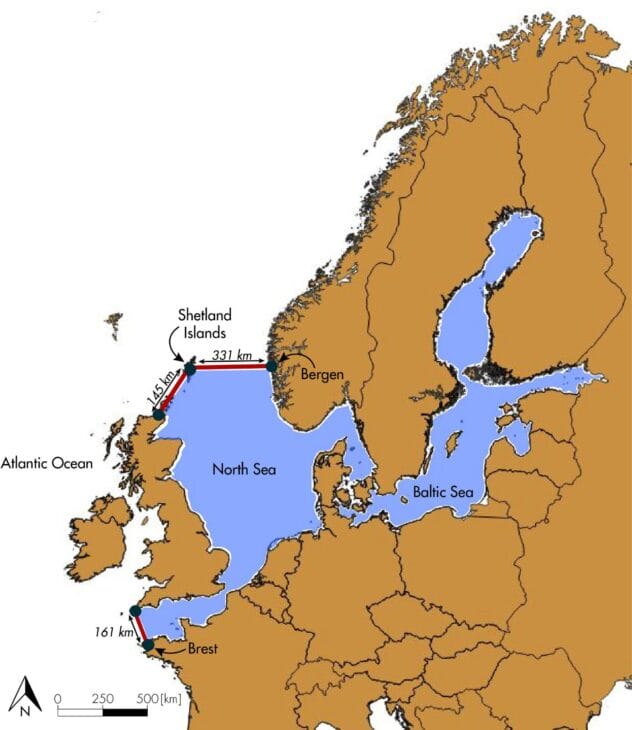
The scientists’ proposal is to build two giant barriers in the sea. One further south, called NID South, would stretch from England to France, with an extension of 161 km. The other, even more insane, is the NID North, which would be 476 km long, starting from Scotland and ending in Norway, passing through the Orkney and Shetland Islands. Altogether, it’s over 600 km of walls in the middle of the ocean.
-
Sweden Removes 200-Ton Concrete Gallery to Restore Pjältån River’s Natural Flow in Europe’s Largest Aquatic Restoration Project

-
Key Infrastructure Projects for Brazil’s Next President: Expanding Railways to Cut Transport Costs, Reduce Truck Traffic, Create Jobs, and Boost Industries Nationwide

-
While China Builds Undersea Rail and Mexico Connects Two Oceans, Brazil Struggles with Grain Transport Due to Lack of Railways
-
Students Build Kansas’ First Hemp-Insulated Social House for a Needy Family: 85% Less Concrete, Solar Roof Returns Energy to Grid, Carbon Negative in Under 20 Years


Just for comparison: the largest marine dam ever built is the Saemangeum Seawall in South Korea, which is 33 km long. In other words, the European project would be nearly twenty times larger.
But Why Build This?
The answer lies in climate change. Since the late 19th century, the sea level has already risen by more than 20 cm, and the most recent forecasts indicate that this increase could reach 2 meters by 2100. It may seem small, but it’s enough to cause catastrophic flooding in cities like Amsterdam, London, Hamburg, Copenhagen, and many others.
The rising sea level has two main causes: the melting of polar ice caps and the warming of the oceans (when water warms, it expands). Adding all this together, we have a serious problem brewing.
Grooscamp and his colleague Joaquim Kelsem didn’t create this project because they think building dams is cool. On the contrary. They did it as a wake-up call. A way to show the world the magnitude of the problem if nothing is done in the coming years.
Can It Really Be Built?
Well… yes. But it wouldn’t be easy.
To create these dams, more than 50 billion tons of sand, stone, and clay would be needed. That would be enough to cover the entire surface of the United Kingdom! And furthermore, some parts of the ocean where the dam would be built have over 300 meters in depth, like the so-called Norwegian Trench. Building under these conditions requires advanced technology, similar to that used in oil platforms.
In addition, the tops of the walls would be 50 meters wide and would extend 20 meters above sea level, functioning as a physical barrier against future ocean rises.
And the cost? It would be around 600 billion dollars. That sounds like a lot (and it is), but if divided among the 15 countries that would benefit from the protection, like the Netherlands, Germany, the United Kingdom, France, Denmark, Norway, and others, this amount would be relatively feasible. In 20 years, each country would pay a fraction representing less than 0.5% of the combined GDP.
But Not Everything Is Rosy…
Despite the potential for protection, the project has many side effects. The first and most obvious: the impact on European maritime trade. Giant ports like those in Rotterdam and Hamburg would be “trapped” inside this reservoir. Locks (like those in canals) would be necessary to allow ship traffic, but this would make transport slower and more expensive.
In addition, the environmental impact would be significant. By isolating the North Sea, natural ocean currents would be altered. This could hinder species migration, affect nutrient distribution, and completely disrupt local ecosystems.
Another problem: over time, freshwater from rivers would continue to flow into the North Sea, but salty ocean water would not. The result? Salinity would decrease, turning the sea into a large brackish lake. In 100 years, it could become up to 10 times less salty than it is today. This would harm not only marine life but also fishing, which generates billions of euros per year in the region.
Is It Worth It?
The big question is this. Is it worth investing so much in something so grand? The truth is that Grooscamp does not actually want to build this dam. He himself said: “If we need to build this, it means we have failed to act earlier”. The idea of the project is more symbolic than practical; it’s a clear warning of what could happen if the world continues to procrastinate on climate actions.
But time is ticking. With each passing year, the sea rises a little more, extreme events become more frequent, and the risks increase. The North Sea wall may seem exaggerated today, but it could be the only way out tomorrow.


So, What Do You Think?
Do you think Europe should invest in such a large structure to protect itself? Or would it be smarter to use that money to reduce emissions, invest in clean energy, and preserve the oceans? Either way, the message from the scientists is clear: we either change the present or we will have to face drastic decisions in the future.


