Portuguese
  Spanish


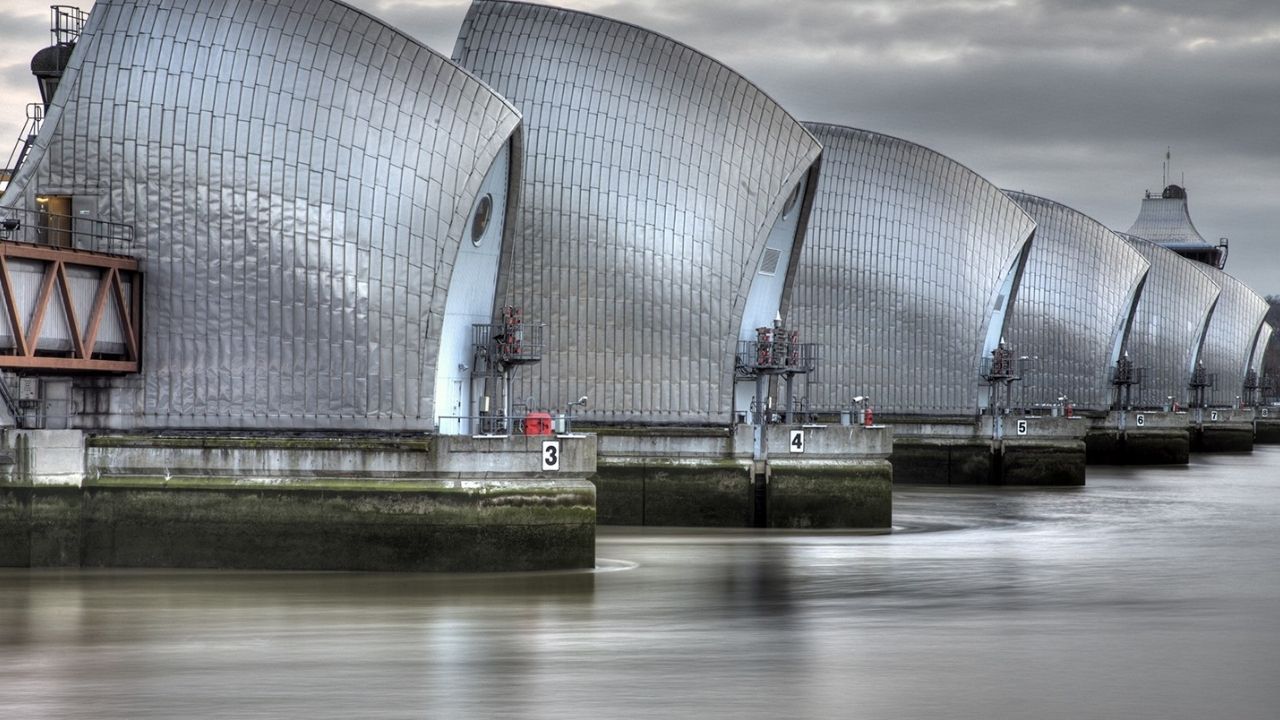


Mobile Structure With 520 Meters Can Be Erected To Contain Floods On The Thames River And Protect Strategic Areas Of The British Capital
London has a defense that seems fictional but has been operational on the Thames River since 1982. It is a mobile barrier measuring 520 meters, installed at the height of Woolwich, in the east of the city.
When the risk of flooding increases, the system rises and acts like a wall, holding back the water coming in from the North Sea. The operation helps prevent flooding in central areas and sensitive infrastructure.
What Happened And Why It Caught Attention
The barrier was created to control floods caused by high tides and storms that push seawater into the estuary. This type of event can rapidly increase the river level and pressure the city.
-
Unable to secure a mortgage as a self-employed single mother, she designed her own floating home from a 20-meter boat and now lives “off-grid” with her two children and solar panels on an English canal.

-
Man Transforms Rusty Shipping Container into Luxury Home with Insulated Walls, Large Windows, and Drywall Finish, Surprising Onlookers

-
“Super Grass” Miscanthus Grows Rapidly Without Pesticides, Replacing Heating Oil in Europe and Now Used in Carbon-Capturing Concrete and Walls in World’s First “Bale House”
-
Abandoned House Renovation Fixes Decades-Long Leak in Two Days with Red Steel Roof Installation




The noteworthy aspect is the size and the logic of operation. Instead of a fixed barrier, London uses a system that lies “down” and only becomes a wall when needed.
This choice maintains the river flow under normal conditions and allows for closing the waterway only at critical moments, directly impacting urban safety.
How The Barrier That Rises From The Riverbed Works

The structure is composed of 10 steel gates distributed along the protected stretch. Under normal conditions, they remain out of the main waterway.
When there is a forecast of dangerous elevation, the gates rotate and rise from the bottom, forming a continuous barrier. The idea is to interrupt the tidal wave and reduce the risk of overflow.
The movement is reminiscent of a giant faucet because it controls the passage of water at the most sensitive point, opening and closing as needed.
What These Giant Gates Can Hold Back
When raised, the gates reach the height of a 5-story building. This size gives an idea of the volume of water that can be contained in an extreme scenario.
Each one can weigh over 3,300 tons, which requires robust mechanisms and careful control to rise and fall safely.
The set was designed to operate during episodes of high tide and storms that can combine and quickly raise the river level.
What Changes In Practice For Those Who Live And Work In London
The protection covers about 125 km² of central London. This includes areas with a high concentration of people, businesses, and essential services.
The barrier reduces the risk of flooding in critical points, such as transport links and urban structures that cannot stop. In a dense city, a flood can create chain impacts.
The practical result is more predictability for daily routines and less chance of damage during extreme water events, especially when the city faces high tides along with severe weather.
How Many Times The Barrier Has Needed To Be Activated

Since the beginning of operations in 1982, the barrier has been closed over 221 times. This number indicates that the system does not exist merely as an emergency plan; it is activated over the years.
Each closure is a response to specific river and sea conditions. The operation needs to balance tidal containment with the need to maintain the flow of the Thames itself.
This routine of activations shows how the infrastructure has become part of the actual functioning of the city, not just a showcase project.
What Could Happen From Now On
The system was designed to meet a use window that approached 2030, but there are plans to maintain protection for a longer time, with a view until 2070.
This longer horizon reinforces the importance of maintenance and risk management in the estuary. The greater the pressure from tides and storms, the more strategic the operation becomes.
The barrier remains a central piece of flood protection, with a direct impact on London’s safety and the continuity of essential services.
London maintains one of the most well-known systems in the world for flood containment, with a mobile structure of 520 meters that can become a wall when the risk increases.
The Thames Barrier demonstrates how engineering and operational control can reduce damage during extreme events, protecting 125 km² and sustaining the routine of a metropolis that depends on the river to function.