






 Portuguese
  Spanish
  3 min of reading
  0 comments


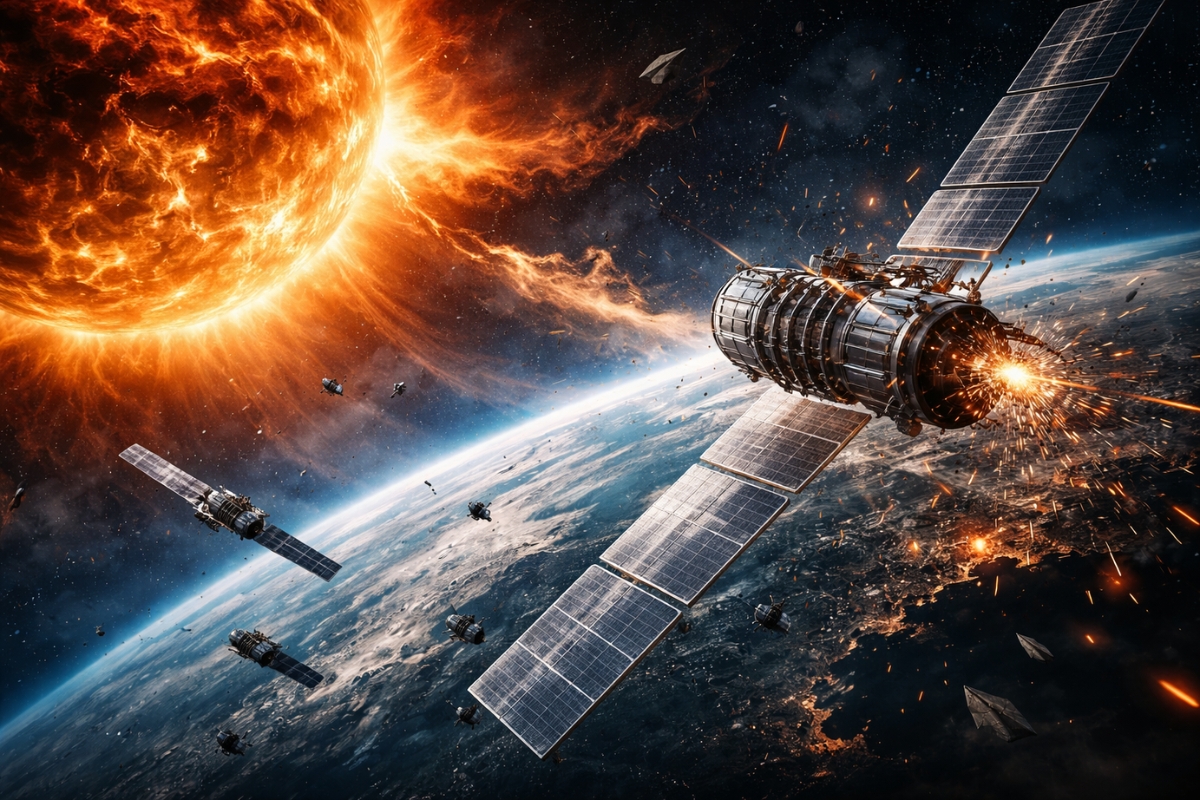
The Increase In Maneuvers And Vulnerability To Failures May Accelerate Collisions, And A Solar Storm Appears As A Factor That Could Worsen The Scenario.
The possibility of a solar storm affecting satellites in low orbit has entered the radar of researchers for a direct reason: space is more congested, with less margin for error.
The focus is on megaconstellations like Starlink, which require frequent corrections to avoid collisions and maintain operational orbits.
The concern is that in a strong solar event, communication and navigation failures could prevent evasive maneuvers, increasing the risk of a cascading series of impacts.
-
Helicopter Drops 180 Tons of Sand and Gravel on Swedish River to Revive Ecosystem Damaged by Decades of Exploitation

-
Brazilian Company Launches Retro Smartphone with 48 MP Camera, T9 Keyboard, and Privacy Features for Social Media-Free Use

-
Self-Taught Chinese Farmer Builds 5-Ton Submarine from Scrap, Launches It in Anhui River
-
Invisible Induction Technology Enables Wireless Power for Blenders, Coffee Makers, and Air Fryers, Reducing Countertop Cables





What Happened And Why It Gained Attention
Scientists warn that space congestion could spiral out of control and describe the situation as a house of cards, where small failures can topple the system.
Satellites within megaconstellations already need to carry out an increasing number of evasive maneuvers year after year.
The central concern involves the Kessler syndrome, a scenario where collisions generate debris, and that debris increases the chance of new cascading collisions.
Why Evasive Maneuvers Are Increasing
A presentation by the FCC in 2023 indicated that Starlink satellites performed 50,000 maneuvers to avoid collisions over the previous four years.
The projection for the coming years points to a significant jump in the need for corrections. If the trend continues, the operational demands would become much more intense.
The critical point is that maneuvering consumes fuel and requires precise control. The more maneuvers are performed, the lower the tolerance for technical failures or communication loss.
How A Solar Storm Pressures Orbit And Fuel

Solar storms heat the atmosphere, which increases atmospheric resistance and makes it difficult to maintain altitude. With more drag, there is a need to spend more fuel to stabilize the orbit.
This effect also complicates evasive maneuvers, as the satellite requires more corrections to remain in the expected orbital corridor.
In a preprint, a group from Princeton University describes this mechanism as a factor that could accelerate a scenario already stressed by the density of objects in low orbit.
What The Gannon Storm Showed In May 2024
The Gannon storm of May 2024 is cited as an example of operational pressure: more than half of all satellites in low Earth orbit used some fuel to reposition themselves.
This data reinforces that solar events can require quick and coordinated responses, consuming resources that are not infinite.
In addition to drag, solar storms can affect navigation and communication systems, the very elements that support commands and trajectory adjustments.
What Could Happen From Now On
There is a risk scenario where, with navigation and communication failures, satellites cease to perform evasive maneuvers. In a crowded environment, this can increase the chance of sequential collisions.
The final impact may extend beyond isolated losses. Cascading debris could elevate the risk so much that missions would struggle to reach orbit, due to the likelihood of impact with small fragments.
The strongest warning is that a long period of instability would not be necessary; just days of mass control loss could lead the system to collapse.
The CRASH Clock And The Speed Of Risk
To measure the problem, researchers proposed the Collision And Significant Damage Realization Clock, called CRASH. The metric estimates how long it would take for a catastrophic collision to occur if operators lost communication and maneuvering capability.
In June 2025, the CRASH was estimated at 2.8 days, a much lower value than in the past.
In 2018, the same count would have been 121 days. The change is associated with the start of the Starlink megaconstellation’s deployment into space in 2019.
The number of 2.8 days indicates that a powerful solar storm could push the system to a critical point in a short time, with the risk of the house of cards collapsing quickly.
The combination of more satellites, more maneuvers, and greater sensitivity to failures places orbital management under constant pressure, and solar events amplify this fragility.





Be the first to react!