






 Portuguese
  Spanish


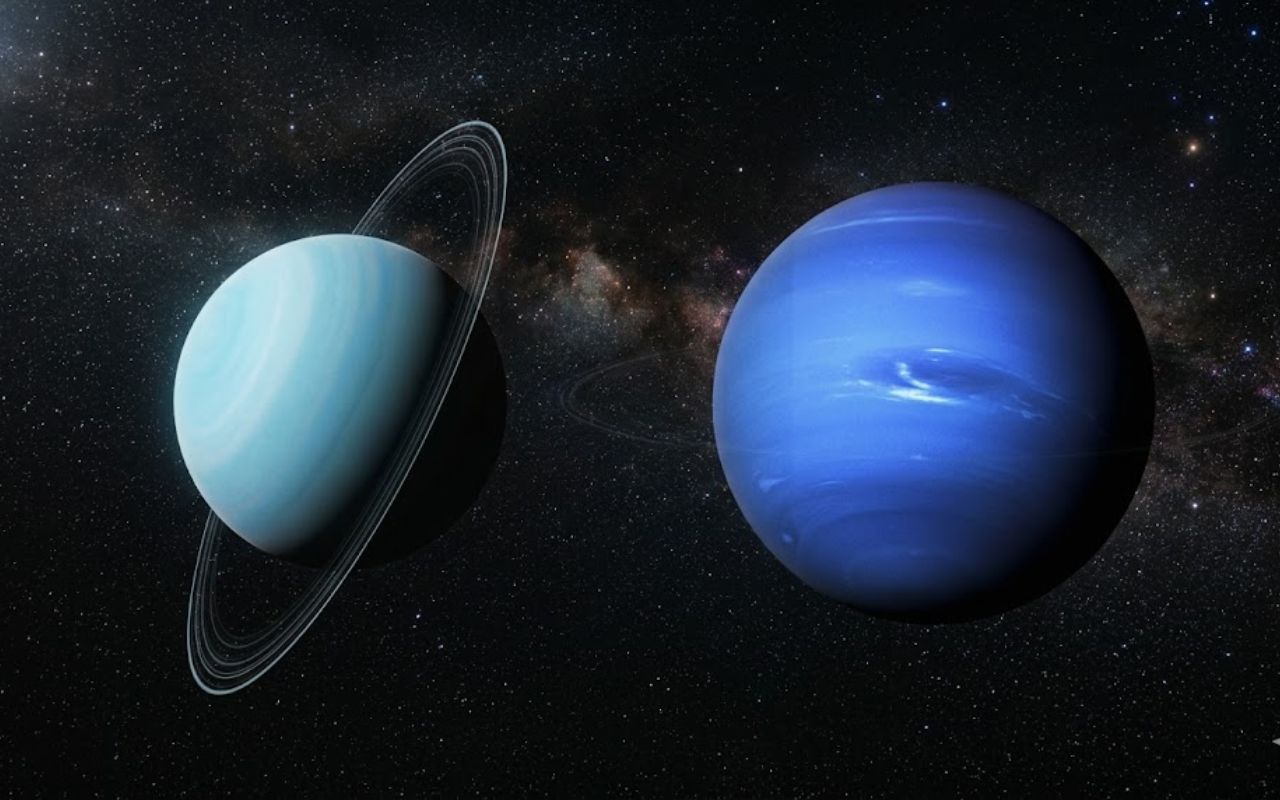

Study indicates that Uranus and Neptune may host an unknown state of matter with unusual properties in the interior of the planets.
A new study published in March in the journal Nature Communications suggests that Uranus and Neptune may host an unknown state of matter in their deeper regions. The discovery was made through computational simulations that analyzed the behavior of substances under extremely high pressures and intense temperatures. The results help explain unusual characteristics of these planets and expand the scientific knowledge about their internal structures.
Structure of Uranus and Neptune still challenges explanations
Even after decades of observation, the interior of Uranus and Neptune remains poorly understood. Data obtained from Earth and by the Voyager 2 probe indicate that, beneath the hydrogen and helium-rich atmospheres, there are dense layers known as “hot ice.”
These regions are composed of water, methane, and ammonia, forming an environment extremely different from any condition found on Earth. Additionally, under intense pressures, the carbon present can crystallize and form diamonds that sink toward the core.
-
Kazakhstan’s Torysh Valley Holds Thousands of Giant Stone Spheres, Intriguing Scientists with Ancient Oceanic “Cannonballs”

-
Egypt Discovers 18 Ancient Tombs with Gold Tongues, Unveiling Unusual Funeral Rituals and Amulets Believed to Give Voice to the Dead

-
Nigeria Dumps 120 Million Tons of Sand into Atlantic to Build Massive City with 8.4 km Sea Wall for Protection Against Ocean Waves and Erosion
-
German Engineer Developed Diesel Engine Running on Vegetable Oil Decades Before Electric Cars Became Popular; Can This Forgotten Idea Work in 2026?





Study reveals unknown state of matter under extreme pressure
To investigate these conditions, scientists conducted simulations based on quantum physics focused on carbon hydride, a molecule composed of carbon and hydrogen.
The conditions analyzed in the study were extreme:
| Analyzed factor | Simulated condition |
| Pressure | Millions of times greater than that of Earth |
| Temperature | Comparable to the surface of the Sun |
| Material | Carbon hydride |
The results indicated the emergence of a superionic material, characterized as a possible unknown state of matter.
Unusual behavior of the identified material
In this state, the matter exhibits mixed properties. Some of the atoms remain organized as in a solid, while another part moves freely, similar to a liquid.
According to the researchers, carbon forms fixed structures in hexagonal networks, while hydrogen moves in spiral trajectories. This unusual behavior may alter important physical properties in the interior of the planets.

Uranus and Neptune: anomalies may have a new explanation
The presence of this unknown state of matter may help to understand phenomena observed especially in Uranus. The planet has a magnetic field with a steep inclination and offset from its center, as well as a peculiar rotation, with the axis almost tilted on its side.
According to the study, this type of material may directly influence electrical conductivity and magnetism, offering a possible explanation for these unusual characteristics.
In addition to expanding the understanding of Uranus and Neptune, the research also suggests that this type of phenomenon may occur on other similar planets. In environments with extreme conditions, simple materials like carbon and hydrogen may exhibit behaviors that are still not well understood.
This scenario reinforces the idea that matter, in different regions of the universe, may exist in forms that are much more varied than those already identified by science.
With information from Olhar Digital


