Portuguese
  Spanish


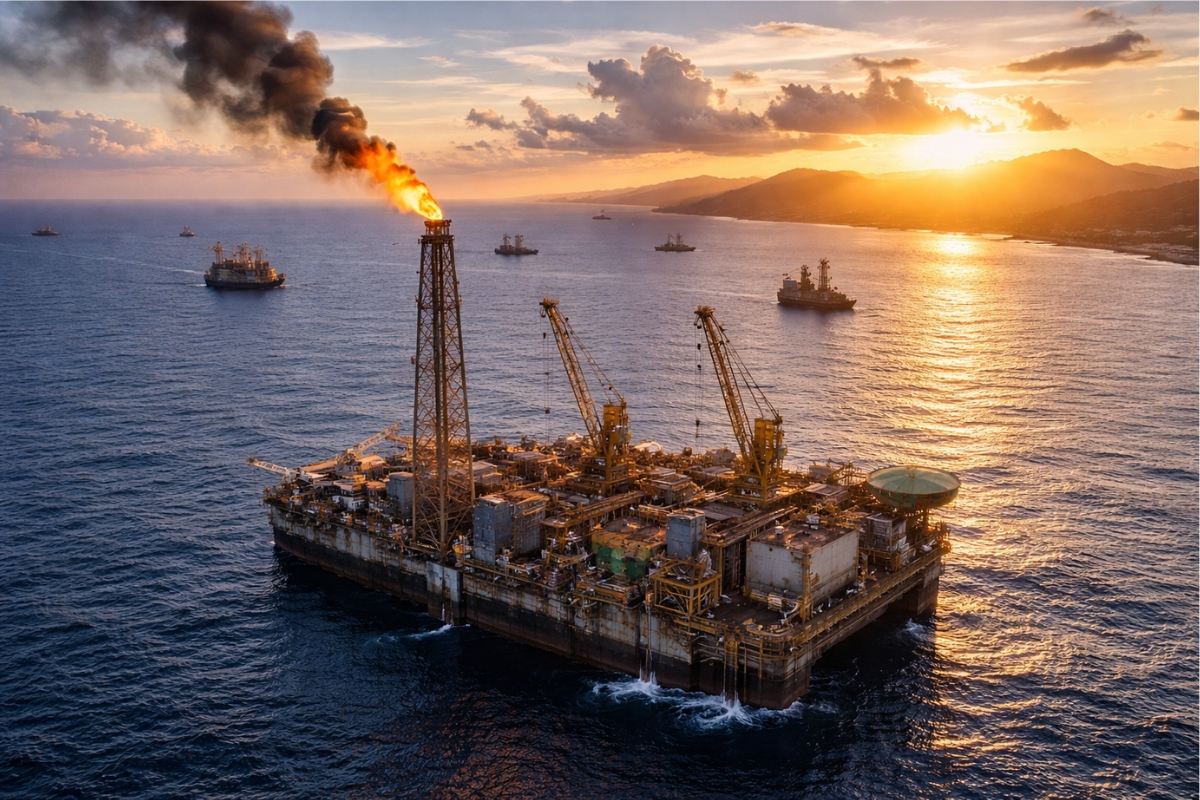

The recognition of the United States reinforces the weight of the pre-salt in the international scenario and shows how Brazil has stopped being a promise to consolidate itself as a strategic power in deep-water exploration
The United States has made clear what many people have not yet fully realized: Brazil has stopped being just a relevant producer and has taken a prominent place on the global energy board.
A commercial guide from the U.S. government describes the country as owning the largest recoverable oil reserves in deep waters on the planet. This statement changes the weight of the debate. Brazil no longer appears merely as a promise. It emerges as a power in one of the most valuable and challenging frontiers of the global industry.
The pre-salt has transformed the Brazilian coast into a billion-dollar gem
Underneath the Atlantic, Brazil hides a strip that has changed the history of the energy sector. The pre-salt extends along the coast between Santa Catarina and Espírito Santo, in a gigantic area marked by reservoirs buried beneath deep water layers and thick salt layers.
-
Petrobras Secures $2.2 Billion Contract to Build and Operate Four Support Vessels for Brazil’s Offshore Oil Fields

-
Oil production grows in Rio, but reserve replacement raises a warning sign

-
Petrobras is expected to complete the drilling of the Morpho well in the Foz do Amazonas in August 2026, the first well in the Equatorial Margin, an oil frontier that the ANP estimates at more than 30 billion barrels and could redraw the map of Brazil.

-
Oil returns to the center of concerns with tension between the US and Iran





This is not easy oil. It is quite the opposite. The strategic value of the pre-salt grows because few countries have managed to master this type of exploration at scale. What is at stake there is not just volume. It is technology, production power, and international influence.
More than 82% of Brazil’s proven reserves are in the pre-salt

The latest numbers show why the pre-salt has become the heart of Brazil’s oil wealth. Brazil closed 2025 with 17.488 billion barrels in proven oil reserves.
Of this total, about 14.4 billion barrels are in the pre-salt. The post-salt accounts for a much smaller share. In practice, this means that more than 82% of the country’s entire proven oil reserve is concentrated in this maritime province.
This data gives strength to the discourse. Brazil’s most valuable oil is buried in deep and ultra-deep waters, in a region that has become synonymous with energy power.
Brazil does not have the largest total reserves in the world, but dominates a territory that few can explore
When it comes to total reserves, Brazil still ranks behind the classic oil giants like Venezuela, Saudi Arabia, Iran, Canada, and Iraq. These countries remain far ahead in gross volume.
But this comparison alone hides the central point of the story. Brazil may not lead the absolute ranking of barrels buried on the planet, but it has entered the top of a much more exclusive club: that of countries capable of transforming ultra-deep reserves into massive and highly strategic production.
This detail changes everything. Brazil’s weight is not just in quantity. It lies in geological quality, offshore scale, and the ability to explore what many countries cannot even reach.
The pre-salt already dominates national oil and gas production
This strength is not just on paper. It is already brutally evident in production. In February 2026, Brazil set a national record for oil and gas, with over 5.3 million barrels of oil equivalent per day.
Of this total, the pre-salt accounted for more than 80% of national production. The center of gravity in the sector has already shifted. Brazilian oil today predominantly comes from the seabed.
The message is clear: the pre-salt is not a future bet. It is the machine that sustains the present and pushes Brazil to another energy level.
Búzios has become a symbol of Brazilian oil power
No field better summarizes this turnaround than Búzios, in the pre-salt of the Santos Basin. The field reached the mark of 1 million barrels of oil per day and has become a showcase of Brazilian productive strength.
Búzios draws attention not only for its volume. It represents the country’s ability to operate in ultra-deep waters with world-scale productivity. Brazil did not just discover a giant field. It discovered a mechanism that put the country on the radar of the largest energy powers.
The world has begun to look at Brazil differently
When an official document linked to the U.S. government highlights that Brazil has the largest recoverable reserves in ultra-deep waters in the world, the international reading shifts to a new level.
The country is no longer seen merely as an important exporter but is treated as a central piece of a new era of offshore oil. This change in perception weighs in the market, geopolitics, and the competition for billion-dollar investments.
Brazilian oil has gained a seal that attracts global attention. And this enhances the political and economic value of the pre-salt.
What is at the bottom of the sea can redefine Brazil’s size in the global energy game
For decades, the imagery of oil has been linked to the deserts of the Middle East and the vast land fields scattered around the world. Now, a part of that power has emerged in another setting: the Brazilian sea.
The wealth buried under kilometers of water, rock, and salt has transformed the country into a protagonist of a rare, complex, and highly coveted energy frontier. Brazil may not be the largest oil owner on the planet in absolute numbers, but it has already become one of the most strategic names in the sector when it comes to oil in ultra-deep waters.
This is the point that gives impact to the article: the world still measures oil power by the size of traditional reserves, while Brazil has advanced along a path that few have managed to master.
And you? Has the pre-salt already placed Brazil among the largest energy powers on the planet, or is the country still underestimated in the oil game? Leave your opinion in the comments and share this article.