Portuguese
  Spanish


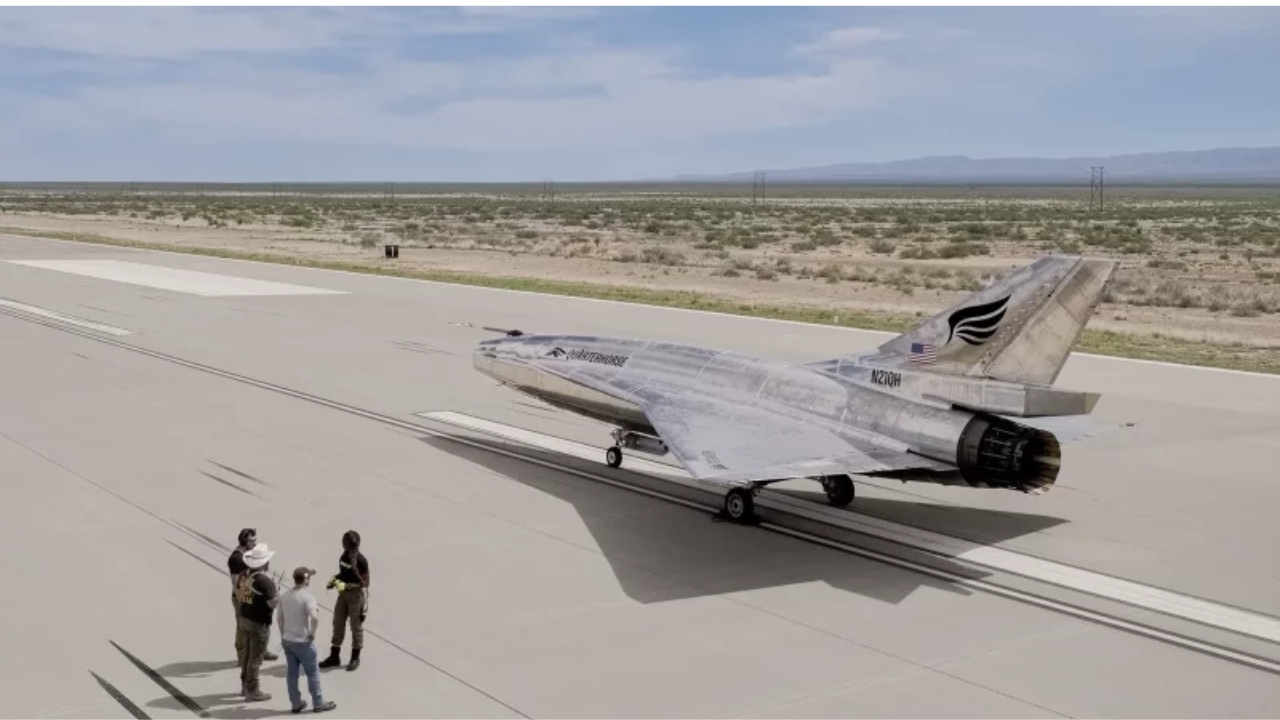

The new Hermeus prototype reached Mach 1.21 in flight in the United States and reinforces the ambition to lead the company towards manned and unmanned hypersonic aircraft.
The legendary SR-71 Blackbird has just gained a closer rival than it seemed. The unmanned prototype Quarterhorse Mk 2.1, from Hermeus, broke the sound barrier in a flight conducted in March 2026 over the airspace of the White Sands Missile Range, in New Mexico, from Spaceport America.
In practice, the test took the program to a new phase and reinforced the company’s goal of building aircraft capable of flying at speeds far above current ones. In the most recent flight, the Mk 2.1 reached Mach 1.21, a mark that places the project in supersonic territory and brings the company closer to more ambitious stages.
The progress also draws attention due to the pace. The flight occurred 364 days after the first flight of the Quarterhorse Mk 1, showing an accelerated sequence of tests for a project that targets the future of military and commercial aviation.
-
AI Data Centers Now Feature Built-In Nuclear Power Plants and Have Ordered Non-Existent Reactors

-
In India, thousands earn about $2.50 an hour cooking and cleaning with a phone strapped to their heads, as every move is recorded to train humanoid robots for jobs they might one day replace.

-
Nuclear Fusion Study Proposes Transforming Mercury into Gold Using Tokamak Neutrons, but Real-World Application Remains Uncertain
-
Brazilian Researchers Develop Floor Tiles That Convert Student Footsteps into Electricity to Reduce University Energy Costs





The new leap of the Quarterhorse
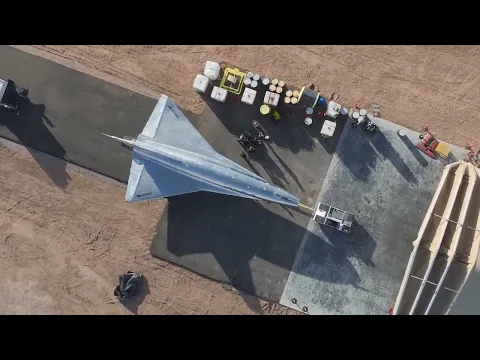

According to newatlas.com, the Mk 2.1 was the latest step by Hermeus in the attempt to transform the Quarterhorse into a platform capable of surpassing historical marks of the SR-71 Blackbird.
The prototype is similar in size to an F-16 Fighting Falcon and was designed as part of a phased development line. The company does not bet on a single final model from the start. The idea is to build successive aircraft, each dedicated to a specific phase, from taxiing to supersonic flights.
This logic allows for testing systems, correcting failures, and advancing more quickly before reaching the larger goal: sustaining hypersonic flights routinely.
What is behind Hermeus technology
The heart of the project is the Chimera propulsion system, a TBCC type engine, an acronym in English for turbine-based combined-cycle. It combines a conventional turbomotor with a ramjet, a solution designed to transition between subsonic and hypersonic speeds.
The company sees the Quarterhorse as a kind of technological heir to the SR-71, albeit unmanned. The goal goes beyond breaking records: the project serves as a testing ground for technologies that need to operate stably at extreme speeds.
This type of advancement, if successful, could pave the way for planes much faster than current ones, with applications still in the proof phase.
From Espionage to Hypersonic Transport
The SR-71 Blackbird remains a difficult benchmark to reach. The Cold War plane still holds official records, such as the speed of Mach 3.32 for a manned jet with a jet engine, as well as altitude and specific route records between major cities.
It is precisely this legacy that Hermeus has set its sights on. The company’s plan includes the development of the Mk 2.2 and Mk 2.3 models, as well as the Darkhorse, an unmanned multi-mission military aircraft, and the Halcyon, a commercial hypersonic jet for 20 passengers.
The recent advancement does not mean the company has arrived yet, but it shows that the path is progressing. And in advanced aviation, every leap in speed counts a lot.
The Company’s Message After the Supersonic Flight
After the test, Hermeus CEO and co-founder AJ Piplica stated that Department of Defense clients are closely monitoring the speed at which the program is advancing. He also said that the flight demonstrates a rare execution in modern aviation and that the U.S.’s ability to deliver new military advantages depends on teams capable of quickly solving technical challenges.
It’s a statement that helps gauge the ambition of the project. Hermeus wants to prove that it can accelerate aircraft development at a pace above the industry standard while attempting to transform an experimental prototype into a base for future defense and transport platforms.
For now, the Quarterhorse Mk 2.1 has already made the loudest part of the message: it broke the sound barrier and brought the company even closer to a competition that seemed reserved for aviation history. If you wish, follow the next steps of this project and see how far this race can go.