Portuguese
  Spanish


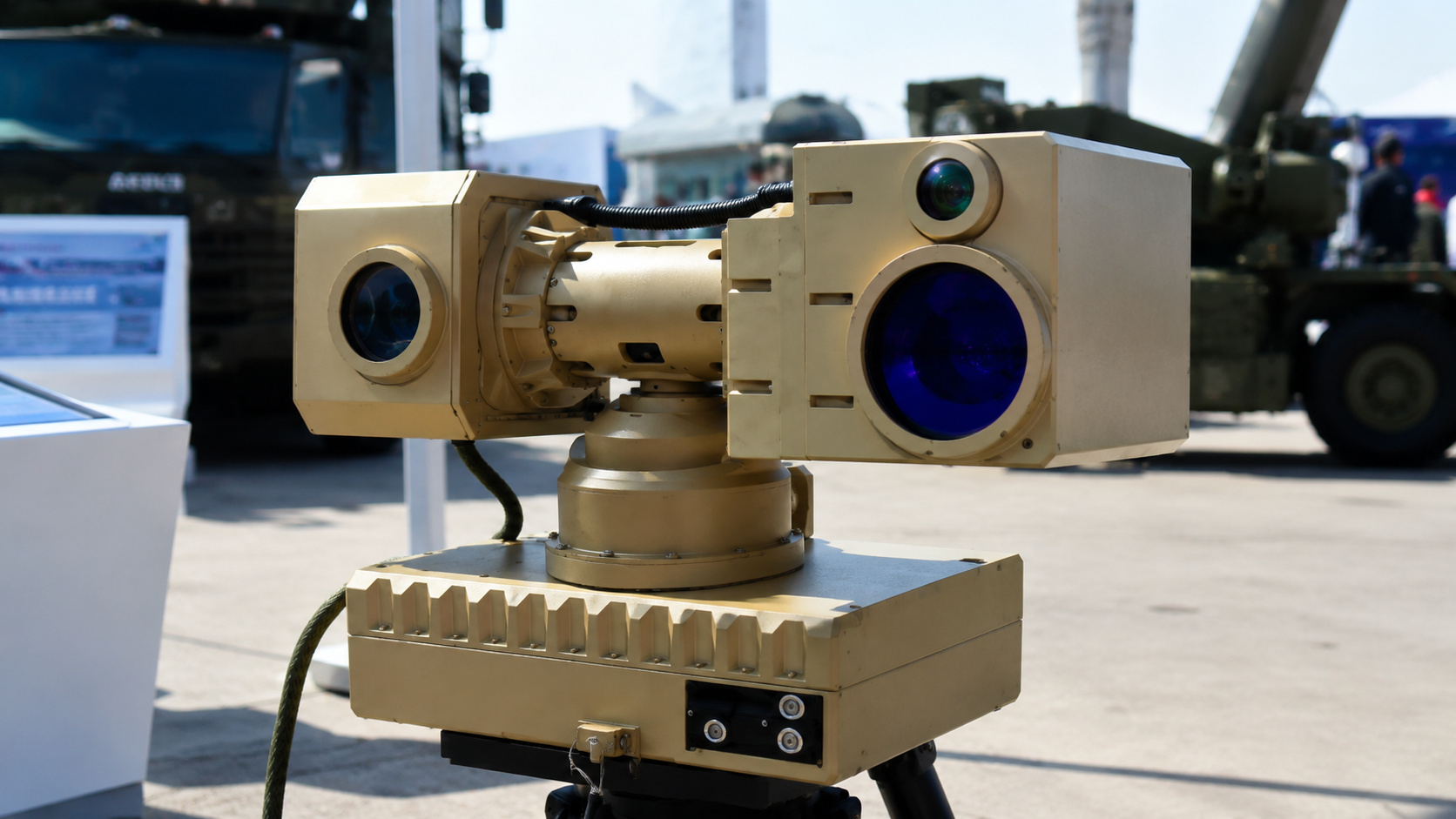

Meet the new Chinese laser weapon created to neutralize war drones, strengthening air defense with high-precision military technology.
China unveiled a new portable laser weapon aimed at combating war drones during the Defense Information Equipment and Technology Exhibition 2026, held in Beijing. According to CNN Brazil on June 23, 2026, the equipment drew attention for combining mobility, low operational cost, and the ability to neutralize aerial threats in seconds.
Developed by Harbin Xinguang Optic-Electronics, the Lijian series — a term that can be translated as “sharp swords” — represents a new step in Chinese military technology. The models were designed to be carried by just one soldier and can act as mobile air defense systems in the field.
Chinese laser weapon bets on mobility to protect troops in combat
The main differentiator of the Chinese laser weapon is its portability. While many anti-drone systems rely on vehicles or fixed platforms, the Lijian II and Lijian III models can be directly carried by military personnel in operation.
-
U.S. Navy’s Ticonderoga-class Cruiser Becomes a 9,800-Ton Missile Fortress with Advanced Aegis System Capable of Tracking Hundreds of Targets

-
France’s Charles de Gaulle: The Sole Nuclear-Powered Aircraft Carrier Outside the US, Weighing 42,500 Tons and Equipped with Two Atomic Reactors

-
The military spaceplane that almost took the Cold War into orbit: Boeing X-20 Dyna-Soar was designed to re-enter above Mach 20, fly for up to 40 hours, land like a plane, and transform Titan rockets into a gateway to a new era of orbital warfare.
-
FAB bets on national drones and increases investments to strengthen the Brazilian aerospace industry





The project was developed with a focus on weight reduction and ease of movement. According to information released during the event, the system consists of only three main elements:
- Laser emitter;
- Air cooler;
- Portable control terminal.
All components can be packed in specific bags for transport.
The Lijian II model weighs about 30 kg, while the Lijian III is approximately 25 kg. This feature enhances the troops’ response capability to emerging aerial threats.


How the anti-drone laser works in practice
The system uses high-energy beams to target sensitive components of war drones. By concentrating energy on a specific point of the target, the equipment can cause structural damage or compromise essential electronic systems for flight.
One of the advantages of this type of solution is the response speed. Unlike conventional methods, the trigger occurs almost instantaneously after the target is identified.
Additionally, the equipment has an inclination angle greater than 90 degrees, allowing interceptions at different altitudes and directions. This increases operational flexibility during air defense missions.
The growth of war drones accelerates the race for new technologies
War drones have become protagonists in various recent conflicts. Equipment that was once mainly used for reconnaissance now performs surveillance, intelligence, and even direct attack functions.
This scenario has led governments and companies in the sector to increasingly invest in military technology aimed at neutralizing unmanned aircraft.
Among the factors driving this trend are:
- Low cost of many modern drones;
- Ease of operation;
- Ability to carry out precision attacks;
- Increasing use in urban and military environments.
The expansion of these threats explains the global interest in anti-drone laser solutions and other directed energy systems.
Shorter range, but greater operational flexibility
Despite the innovation, portable models have a shorter range than some fixed versions developed by the Chinese manufacturer itself.
The Lijian-10G system, installed in a fixed position, has a range of up to 1,200 meters. Meanwhile, the portable models Lijian II and Lijian III can hit targets located about 500 meters away.
Although this difference is significant, experts point out that mobility compensates for the limitation. In real combat situations, the ability to quickly reposition a Chinese laser weapon can represent an important strategic advantage.
The ease of transport also allows smaller units to create temporary air defense points in different regions of the battlefield.
Military technology seeks to reduce interception costs
One of the most discussed aspects of laser systems is the potential for operational savings.
Traditionally, the interception of war drones depends on ammunition, specialized cannons, or short-range missiles. Depending on the threat, the cost of neutralization can far exceed the value of the drone itself.
The anti-drone laser, on the other hand, uses energy as the main resource for engagement. This tends to significantly reduce costs per shot.
Besides financial savings, this approach offers other benefits:
- Less dependence on ammunition stocks;
- Simplified resupply;
- Quick response against multiple threats;
- Less logistical complexity.
For this reason, similar systems have been receiving increasing investments in various countries.
Air defense gets reinforcement for squadrons and platoons
Military analyst Song Zhongping, a former instructor of the People’s Liberation Army of China, highlighted that compact air defense systems can enhance the protection of small units in combat.
According to the expert, the miniaturization of equipment allows individual soldiers to carry systems capable of facing war drones without relying exclusively on larger platforms.
This change can alter how ground forces organize their protection against aerial threats. Instead of concentrating defense in a few points, it would be possible to create multiple mobile protection cores spread across the terrain.
The proposal becomes especially relevant given the increase in attacks carried out by unmanned aircraft in modern conflicts.
Chinese laser weapon reinforces global trend of directed energy
China is not the only country investing in this segment. The United States, United Kingdom, and Israel are also developing solutions based on directed energy to enhance their air defense capabilities.
The common goal is to find more efficient alternatives to face war drones, guided munitions, and other small threats that challenge traditional interception systems.
In this context, the Chinese laser weapon presented in Beijing demonstrates how military technology is advancing towards smaller, lighter, and potentially more economical equipment.
Although challenges related to range, weather conditions, and energy supply still exist, the advances observed in the Lijian series indicate that the use of anti-drone laser systems is expected to gain more space in military strategies in the coming years.
What the Lijian series reveals about future conflicts
The presentation of the Lijian II and Lijian III models shows that the technological competition between major powers is also migrating to the field of defense against drones.
With weights of 30 kg and 25 kg, a range of up to 500 meters, and the ability to be operated by a single soldier, the new Chinese laser weapon aims to offer a quick response to one of the greatest challenges of current conflicts.
As war drones become more accessible and numerous, directed energy-based air defense technologies tend to play an increasingly important role. The emergence of portable equipment like those in the Lijian series suggests that protection against aerial threats could be more distributed, flexible, and efficient on the battlefields of the future.