Portuguese
  Spanish


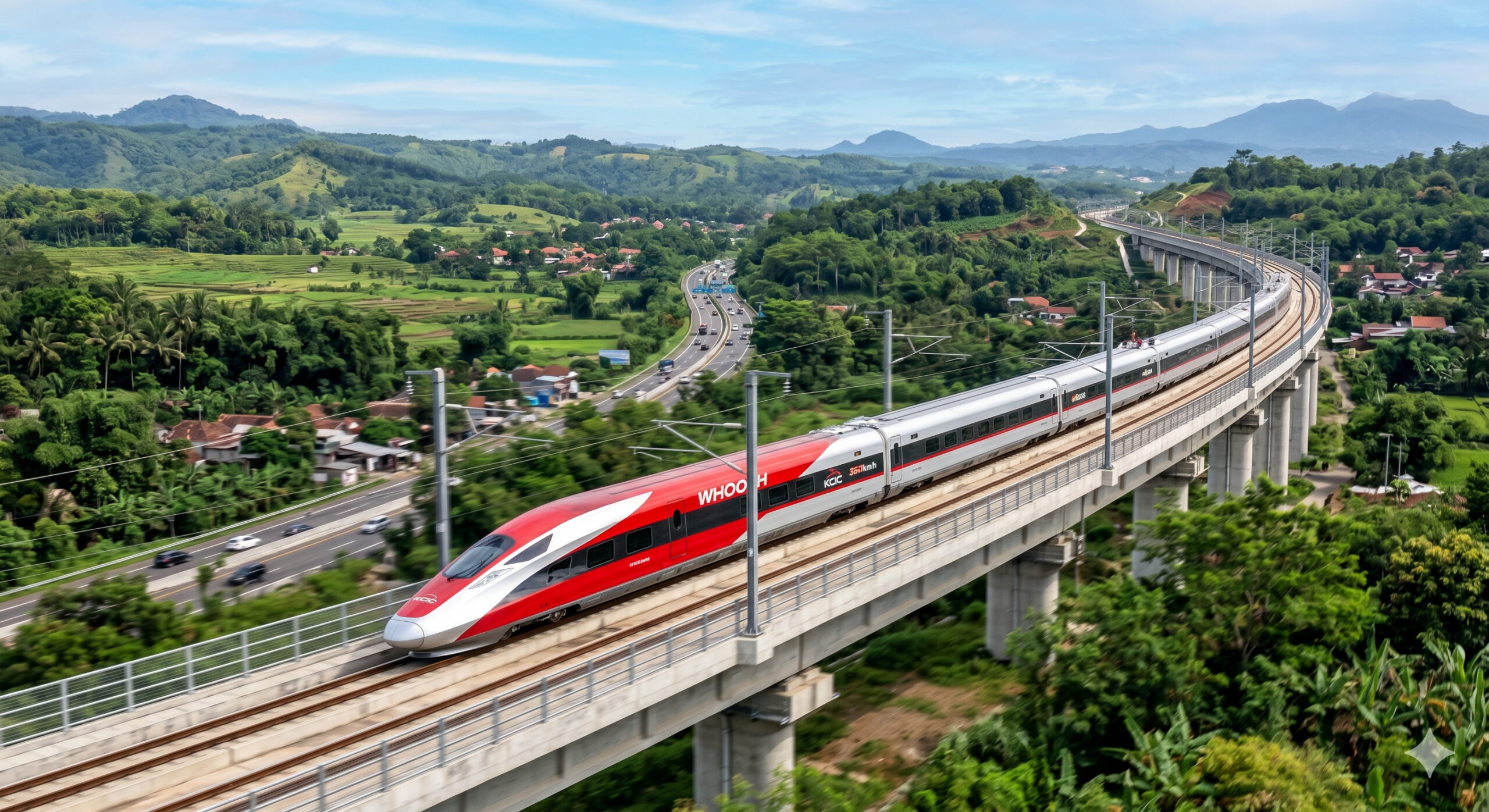

High-speed rail Whoosh, built with Chinese support in Indonesia, reaches 350 km/h, surpasses 6 million passengers and redefines regional mobility.
On October 2, 2023, according to reports published by Reuters and AP, Indonesia officially inaugurated the high-speed rail Jakarta–Bandung, commercially known as Whoosh, operated by Kereta Cepat Indonesia China (KCIC), a joint venture formed by Indonesian and Chinese state-owned enterprises. Connecting Jakarta to Bandung, in western Java, the line was presented as the first high-speed railway in the country and all of Southeast Asia. With an investment of around US$ 7.3 billion, the project marked a turning point in Indonesia’s transportation infrastructure.
According to data released on February 19, 2025 by the Chinese Embassy in Indonesia, the line is 142.3 kilometers long and was designed to operate with trains of up to 350 km/h, reducing the travel time between the two cities from over three hours to about 46 minutes. More than just improving mobility, Whoosh has opened a new railway phase in the region, with effects on urban integration, logistics, and economic development, and is now on the rise in 2026.
Drastic reduction in travel time changes the dynamics between Jakarta and Bandung
Before the inauguration of the high-speed railway, the journey between Jakarta and Bandung was marked by constant traffic jams, especially on highways, with travel times varying between 2.5 and 4 hours, depending on traffic.
-
The Port of Itaqui closes the best first semester in history with over 17 million tons and takes off as the locomotive of the Northern Arc.

-
Brazil’s North-South Railway to Auction Two Grain Terminals in Central Tocantins

-
AI-powered traffic cameras in São Paulo now issue fines for cellphone use and seatbelt violations around the clock

-
Free Upgrade to Professional Driver’s License Categories in Over 130 Locations in Brazil, Including Exams and Courses



With Whoosh, this time has been reduced to about 40 minutes, a significant transformation that completely alters the relationship between the two cities.
This reduction is not just an operational improvement. It redefines daily commuting standards, allowing workers, students, and tourists to move quickly between two of Indonesia’s major urban centers.
The change also has direct implications for the real estate market, urban development, and regional economic integration.
More than 6 million passengers in 2024 consolidate adoption of the system
Data released by KCIC indicates that the railway transported approximately 6.06 million passengers throughout 2024, its first full year of operation.
This number is significant for two main reasons.


First, it demonstrates a rapid adoption of the population to a completely new transportation system, which does not always occur in high-speed projects.
Second, it validates the investment and operation model, indicating that there is sufficient real demand to sustain and expand the system.
The usage scale in the first year reinforces the growth potential of the railway, especially with future planned expansions.
Exported Chinese technology transforms the project into an international showcase
The Whoosh is not just a national railway. It serves as a showcase of Chinese railway technology on a global scale.
The system utilizes technology derived from Chinese high-speed trains, including:
- Advanced control and signaling systems
- Railway structures designed for high speeds
- State-of-the-art rolling stock
- Digital integration for operation and monitoring
China has developed, over the past few decades, one of the largest high-speed networks in the world, and projects like the Whoosh represent the export of this expertise to other countries.
This movement positions China as a global supplier of high-complexity railway infrastructure, expanding its presence in strategic markets.
Project faces challenges of cost, financing, and execution
Despite operational success, the project faced significant challenges during its construction.
The estimated initial cost increased, reaching a final value of around US$ 7.3 billion, which generated internal debates in Indonesia about financing and economic viability.

In addition, there were:
- Construction delays
- Technical challenges in complex terrains
- Issues related to land acquisition
These factors are common in infrastructure projects of this magnitude, especially in countries with complex geography and population density.
Still, the completion of the work and the start of operations demonstrate the capacity for large-scale execution.
Whoosh becomes a key player in the economic integration of Southeast Asia
The Jakarta–Bandung railway was not conceived as an isolated project. It is seen as the first step towards a possible high-speed railway expansion in Indonesia and the region.
There are discussions about future extensions that could connect other major cities on the island of Java and even integrate railway networks with neighboring countries.

This type of expansion can transform Southeast Asia into a new high-speed railway corridor, similar to what has occurred in China in recent decades.
Regional integration has the potential to:
- Reduce logistics costs
- Increase internal trade
- Facilitate tourism
- Improve urban mobility
Economic impact goes beyond passenger transport
Although the initial focus of the railway is passenger transport, the economic effects go far beyond that. The presence of a high-speed line tends to:
- Appreciate areas near the stations
- Stimulate real estate investments
- Attract companies to connected regions
- Create new urban centers
In the case of Whoosh, there is an expectation that areas between Jakarta and Bandung will develop as new economic centers. The railway acts as a growth catalyst, altering the economic geography of the country.
Project reinforces China’s presence in global infrastructure
Whoosh is also a clear example of the Chinese strategy to invest in infrastructure outside its territory. By participating in projects like this, China:
- Expands its economic influence
- Consolidates its technology in new markets “` “`html
- Establishes long-term partnerships with other countries
This strategy has been applied in various regions of the world, including Africa, Latin America, and Southeast Asia.
The Indonesian railway is one of the most visible examples of this expansion, especially as it involves cutting-edge technology.
Sustainability and energy efficiency enter the center of the debate
Another relevant point of the project is the environmental impact. High-speed trains are generally more energy-efficient than road or air transport over medium distances.
The replacement of car or bus trips with rail transport can contribute to:
- Reduction of carbon emissions
- Lower consumption of fossil fuels
- Decrease in urban congestion
However, the construction of infrastructure also generates environmental impacts that need to be considered. The balance between operational efficiency and environmental impact is a central part of the discussion about the future of rail transport.
Future expansion can consolidate a new mobility standard in the region
The initial success of Whoosh opens the door for new railway projects in Indonesia. There are plans and studies to expand the line to other cities, which could significantly broaden the system’s reach.
Moreover, other countries in the region are observing the project as a reference, which could spur similar initiatives.
The Jakarta–Bandung railway could become the first of several high-speed projects in Southeast Asia, consolidating a new mobility standard.