






 Portuguese
  Spanish


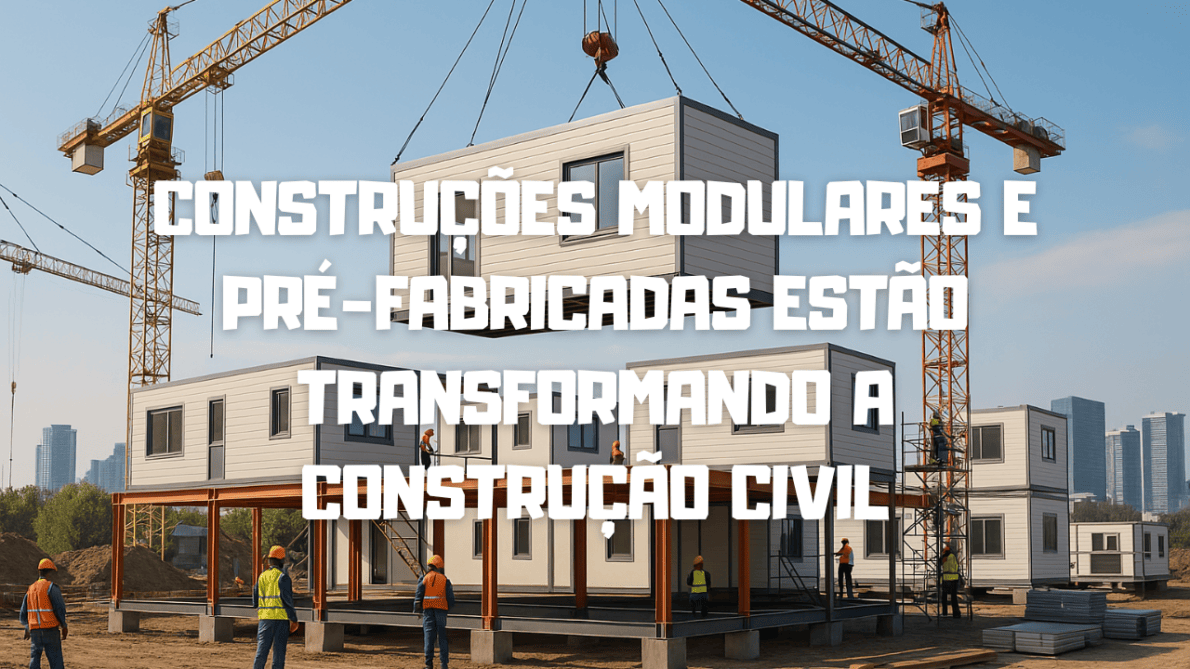

Modular And Prefabricated Constructions Are Transforming The Construction Industry With Faster, Sustainable And Cost-Effective Solutions!
The construction industry is undergoing a silent but highly efficient revolution. Increasingly, companies and professionals in the field have been investing in modular and prefabricated constructions as an alternative to traditional methods.
This trend, which is already strong in countries like China, the United States, and Germany, is beginning to gain traction in Brazil as well — driven by the demand for faster, more economical, and sustainable projects.
But what exactly characterizes a modular or prefabricated construction? Simply put, it is a system in which a large part of the building is produced off-site, in a factory environment.
-
U.S. City Builds Tiny Home Village on Water Company Land to House 136 Homeless People: Inside the Social Housing Units

-
Woman Turns Shipping Container into Home, Embraces Rural Life to Cut Monthly Expenses to Just Over $330
-
France Revamps 530 Social Housing Units with Large Balconies and Glass Facades Without Demolishing Existing Buildings

-
Facing high rent, couple transforms parents’ garage into a fully functional apartment, creating a complete home at a fraction of the market cost.




The components — which can range from panels and slabs to complete modules — are then transported to the site and assembled in record time.
Efficiency And Time Reduction
One of the main attractions of this model is the speed of execution. By allowing foundations and the manufacturing of elements to occur simultaneously, projects can be completed in up to 50% less time than conventional systems.
This schedule optimization translates into financial and operational advantages, especially in large projects such as hospitals, schools, and housing complexes.
In addition to speed, another obvious benefit is the reduction of waste and excess material. Since structures arrive ready or semi-finished at the construction site, there is less rework, cutting, and leftover materials.
This contributes to a cleaner and more sustainable construction site — an increasingly present demand in the sector.
Industrial Standard And Economics
Production in a controlled environment is another distinguishing factor of prefabricated and modular constructions. Temperature, humidity, and quality control are monitored continuously, ensuring more precision and uniformity in the pieces.
This industrial standard not only improves the final quality of the construction but also reduces human error.
Furthermore, the economic gains are significant. Less construction time, lower resource consumption, and reduced labor intensity make the investment more attractive for both construction companies and developers.
Challenges Still Persist
Despite so many advantages, large-scale adoption still faces some challenges. One of them is cultural resistance.
Many professionals and clients still associate the term “prefabricated” with something of low quality or durability — a perception that does not reflect the current reality of these technologies.
Logistics also poses an obstacle. Transporting large modules requires detailed planning, and difficult-to-access sites can complicate assembly.
Additionally, it is necessary to have specialized labor, which is still scarce in the national market.
Another critical point involves municipal regulations. In many Brazilian cities, building codes and technical standards are still not fully adapted to this type of construction, which can delay approvals and generate legal uncertainty.







