Portuguese
  Spanish


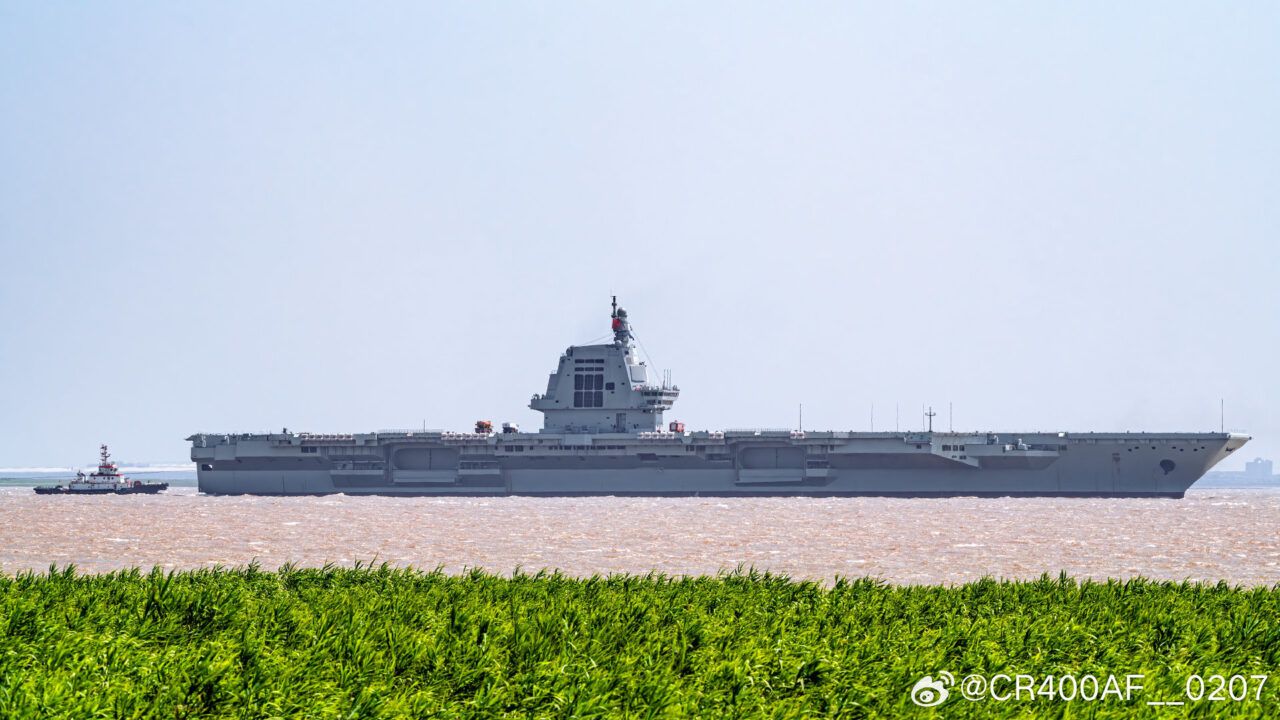


The Chinese Navy Expands Its Fleet In 2025 With New Ships, Submarines, And The Aircraft Carrier Fujian. Naval Expansion Strengthens China’s Military Power In The Indo-Pacific.
The Chinese Navy is about to register a historic milestone in 2025. The Asian country will incorporate around 200,000 tons in new warships, including nuclear submarines and a modern aircraft carrier, consolidating its position as one of the world’s largest naval powers.
This expansion occurs amid growing geopolitical tensions in the Indo-Pacific region and demonstrates China’s ambition to strengthen its military presence at sea.
Aircraft Carrier Fujian Leads Renewal Of The Chinese Navy
The upgrades involve the commissioning of various state-of-the-art naval vessels.
-
The U.S. Navy Conducts Submarine Tests in Idaho Lake to Detect Underwater Noises Hidden by the Ocean

-
Nuclear Submarine USS Alexandria Retired After 35 Years, Having Completed Over 1 Million Miles in Missions

-
MODEC Introduces New Hull Design for FPSO Gato do Mato to Produce Up to 120,000 Barrels of Oil Per Day in Brazil’s Pre-Salt Region
-
This Massive 12-Meter, 21-Ton Underwater Drone Can Operate Autonomously for Up to Five Days


The list includes the anticipated aircraft carrier Fujian (CV-18), commissioning of advanced destroyers, and submarines of the 093B class, significantly reinforcing the Navy of the People’s Liberation Army of China (PLA Navy).
The expectation is that the Fujian will officially enter service on dates of strong political symbolism, such as Victory Day (September 3) or China’s National Day (October 1).
The main star of the Chinese naval expansion in 2025 is the aircraft carrier Fujian (CV-18), which has already completed nine sea tests.
With a displacement of around 80,000 tons, this vessel represents a significant technological leap for the Chinese Navy, comparable to reference models of the United States Navy.
The Fujian is expected to be commissioned later this year and is seen as a central piece to expand China’s global reach via the sea.
Nuclear Submarines Strengthen Strategic Capacity
In addition to surface ships, the Chinese Navy is also investing heavily in submarines.
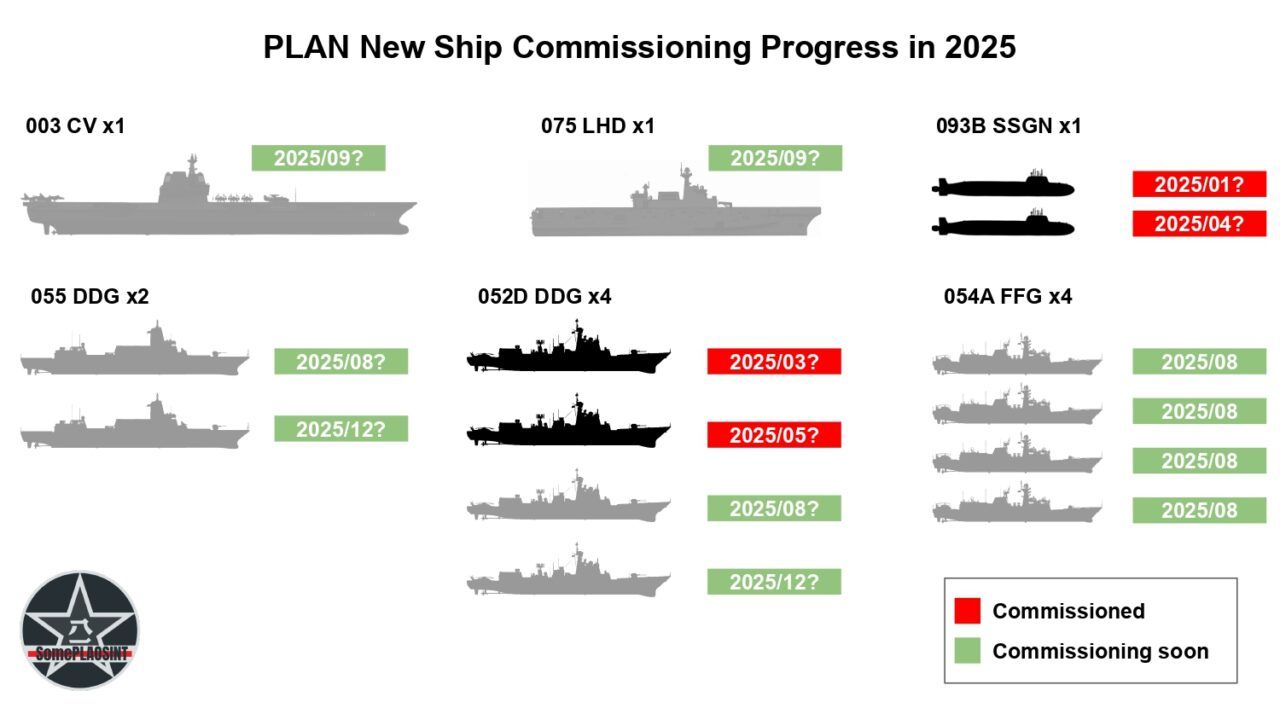
Recent satellite images indicate the likely commissioning of two nuclear-powered submarines of the 093B class — one in the Northern Command and another in the Southern Command.
These units utilize pumpjet technology, which reduces noise and enhances stealth, being essential for deterrence and naval dominance missions.
The goal is to achieve up to eight 093B submarines by 2028, which would consolidate China’s underwater capability in the international arena.
New Destroyers And Frigates Strengthen Presence In The Pacific
The expansion of the Chinese Navy also includes the commissioning of:
- 2 Type 055 Renhai Destroyers (24,000 tons)
- 4 Type 052D Destroyers (30,000 tons)
- 4 Type 054A Frigates (16,400 tons)
Ships like the Suzhou (DDG-158) and the Weinan (DDG-166) are already on mission in the Western Pacific, while the Dazhou (DDG-135) has commenced training at sea.
These vessels have high firepower and are designed for air defense, surface warfare, and escorting strike groups.
Type 075 Assault Ship Strengthens Troop Projection Capacity
Another highlight of the naval expansion is the fourth amphibious assault ship Type 075, with 36,000 tons.
This vessel can carry troops, helicopters, and armored vehicles, significantly increasing the projection capacity of the Chinese Navy in conflict or humanitarian support scenarios.
The presence of this type of ship reinforces China’s preparedness for large-scale amphibious operations.
The Chinese Navy Rivals Global Powers
Adding up all the assets expected to be commissioned just in 2025, the Chinese Navy will incorporate the equivalent of the entire French Navy fleet.
This advancement also represents two-thirds of the navies of the United Kingdom or India, or half of the Japanese fleet (JMSDF).
The rapid expansion places China in a prominent position in the global naval landscape, with direct impact on the security and stability of the Indo-Pacific.
The expansion of the Chinese Navy goes beyond simply increasing the number of ships and submarines.
It reflects Beijing’s desire to ensure secure trade routes, exert greater regional influence, and contain the advance of foreign forces — especially the U.S. and allies.
The naval race is in full swing, and the sea is increasingly a strategic arena of the 21st century.