Portuguese
  Spanish


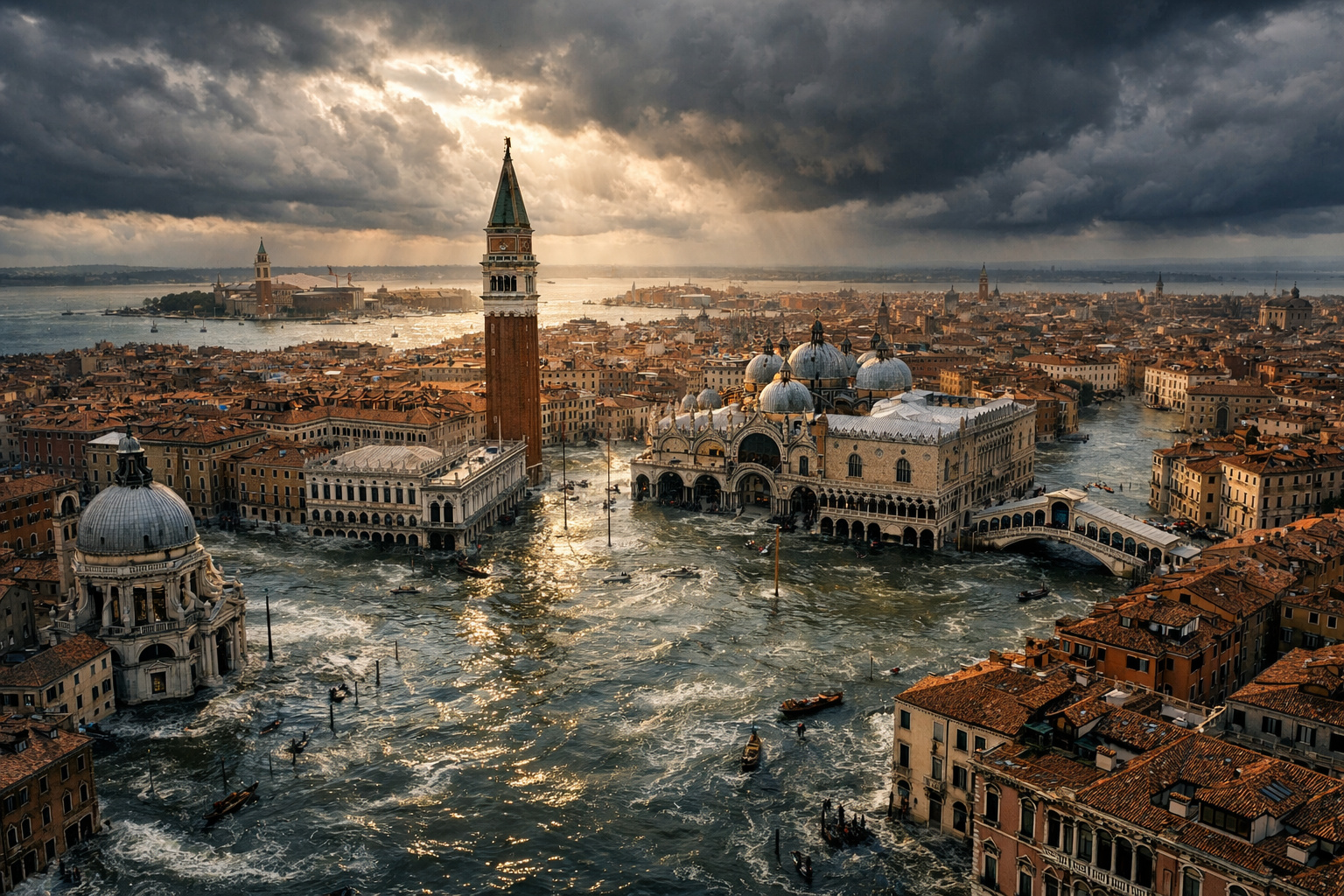

Experts warn of sea level rise, increased flooding, and difficult decisions that could redefine the future of one of humanity’s most iconic heritages
The possibility of Venice disappearing under water has ceased to be a distant scenario and has become a concrete concern for scientists and authorities. This information was released by “ScienceAlert,” based on a study published in the journal Scientific Reports, which analyzes extreme solutions to save the so-called “floating city.” However, the study itself emphasizes that none of the alternatives will be simple — and all involve billion-dollar costs, environmental impacts, and delicate political decisions.
Currently, data indicates that the rise in sea level, driven by climate change, could cause Venice to disappear within the next three centuries. This process, although gradual, already shows alarming signs. In the last 150 years, for example, the city has faced significant growth in flooding, with 18 of the 28 extreme events — when more than 60% of the city was flooded — occurring in just the last 23 years.
Furthermore, it is important to highlight that Venice is not only being threatened by the advance of the sea. Simultaneously, the ground on which the city was built is also slowly sinking. It is worth remembering that, for over 1,600 years, the city has stood on millions of wooden piles — an impressive feat, but one that now faces limits due to environmental changes.
-
Two-Bedroom Home Built in a 40-Foot Shipping Container Delivered and Ready for Same-Day Living in São Paulo Countryside

-
China Constructs Artificial Island 32 km Offshore for Yangshan Port, Connected to Shanghai by 32 km Bridge, Unloading 3,000 Containers in 20 Hours
-
China’s $70 Billion River Diversion Project, the World’s Largest, Moves 44.8 Billion Cubic Meters Annually, Crosses Under the Yellow River, and Displaced 330,000 People
-
Indian Driver Spends 14 Years Digging 10-Meter Tunnel Through Mountain to Connect Isolated Village to the World



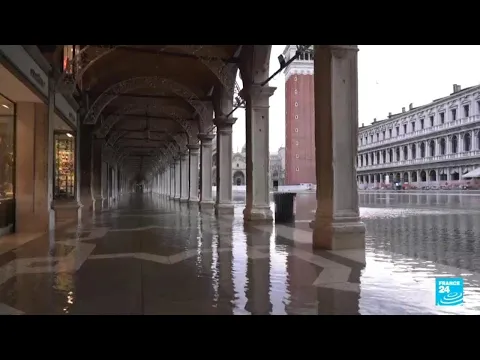

What is behind the rise in sea level and why Venice is at increasing risk
To understand the current scenario, it is essential to grasp the causes of rising ocean levels. This phenomenon results from a complex combination of factors, primarily related to fossil fuel emissions. These emissions increase the concentration of greenhouse gases, which trap heat in the atmosphere.
Consequently, this additional heat is absorbed by the oceans, causing thermal expansion of the water. At the same time, the melting of glaciers further contributes to the increase in sea volume. As a direct result, coastal areas — including regions that were not flooded hundreds or even thousands of years ago — are being progressively invaded by water.
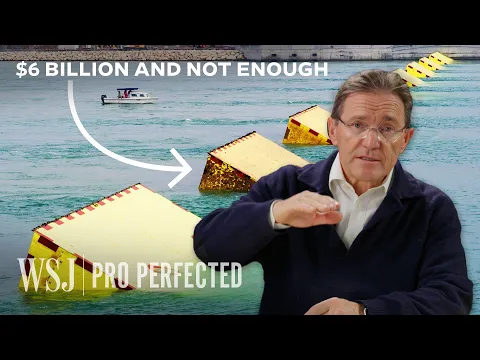
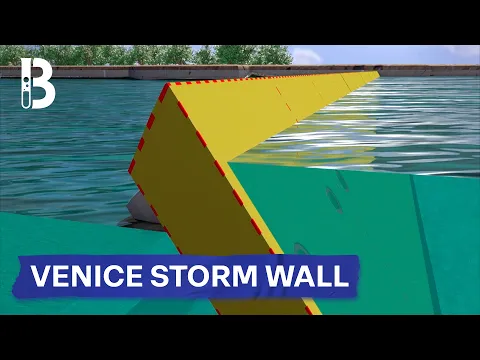
In the case of Venice, the situation is even more delicate. The city currently relies on a narrow barrier island and three movable structures, implemented in 2022, that close the lagoon’s entrances in times of risk. Despite this, experts warn that these measures may not be sufficient in the long term.
According to projections based on the Sixth Assessment Report of the IPCC, these barriers become ineffective when the sea level rises by about 1.25 meters — a scenario that could be reached by the year 2300, even in low-emission scenarios.
The 4 radical solutions to save Venice and the billion-dollar costs involved
In light of this critical scenario, scientists led by oceanographer Piero Lionello from the University of Salento analyzed four main strategies to try to preserve the city. However, each of them presents significant challenges.
The first alternative is to maintain the current model, known as the “open lagoon.” In this case, the lagoon’s entrances would continue to be closed with movable barriers whenever necessary. Although this strategy has already cost about €6 billion (approximately $7 billion), it may become insufficient with rising sea levels. Furthermore, the more frequent the closures, the greater the risk of operational failures and issues such as the deterioration of water quality, which would require pumping systems and sewage treatment.
Next, there is the option of circular dikes. This solution involves constructing barriers about 3 meters high around the main areas of the city. While it offers protection against rises of up to 6 meters in sea level, this alternative could compromise Venice’s connection with its natural ecosystem, as well as negatively impact tourism and the city’s cultural identity. The estimated cost ranges between €0.5 and €4.5 billion.
Another even more radical possibility is the complete closure of the lagoon. In this scenario, the barrier island would be elevated, and the lagoon’s entrances would be permanently blocked with structures approximately 5 meters high. This solution could protect Venice even with rises of up to 10 meters in sea level. However, this would mean the end of the lagoon ecosystem and the city as an active port. Additionally, the necessary investment would exceed €30 billion, not including the need for a permanent pumping system to prevent water stagnation.
Finally, the most extreme alternative is the abandonment of the city. This strategy involves the relocation of residents, historical monuments, and urban structures. It is a massive and emotionally impactful operation, with an estimated cost of €100 billion. Furthermore, this decision would imply leaving the lagoon at the mercy of deeper, warmer, and saltier waters — the effects of which are still unknown.
An uncertain future demands urgent decisions and long-term planning
Given so many variables, experts emphasize that the choice will not be simple. Balancing financial costs, cultural preservation, and environmental impacts is a complex challenge that requires immediate planning. This is because engineering projects of this magnitude can take up to 50 years to be implemented.
Furthermore, the study highlights that global efforts to reduce greenhouse gas emissions are still insufficient. Therefore, even with local actions, the rise in sea levels is likely to continue for decades or centuries.
In this context, scientists warn that radical solutions need to start being considered right away. Otherwise, the current strategy may become obsolete even before the end of this century.
And you, in light of the rising sea levels and increasingly intense climate changes, do you believe it is still possible to save Venice, or is the city’s disappearance already inevitable?