Portuguese
  Spanish




In a Network of 119 Caves in New Mexico, Scientists Found Cyanobacteria That Use Light Outside the Visible Spectrum to Survive. The Discovery Reinforces the Hypothesis of Life in Extreme Environments and Redefines Where to Look for Biosignatures in the Universe.
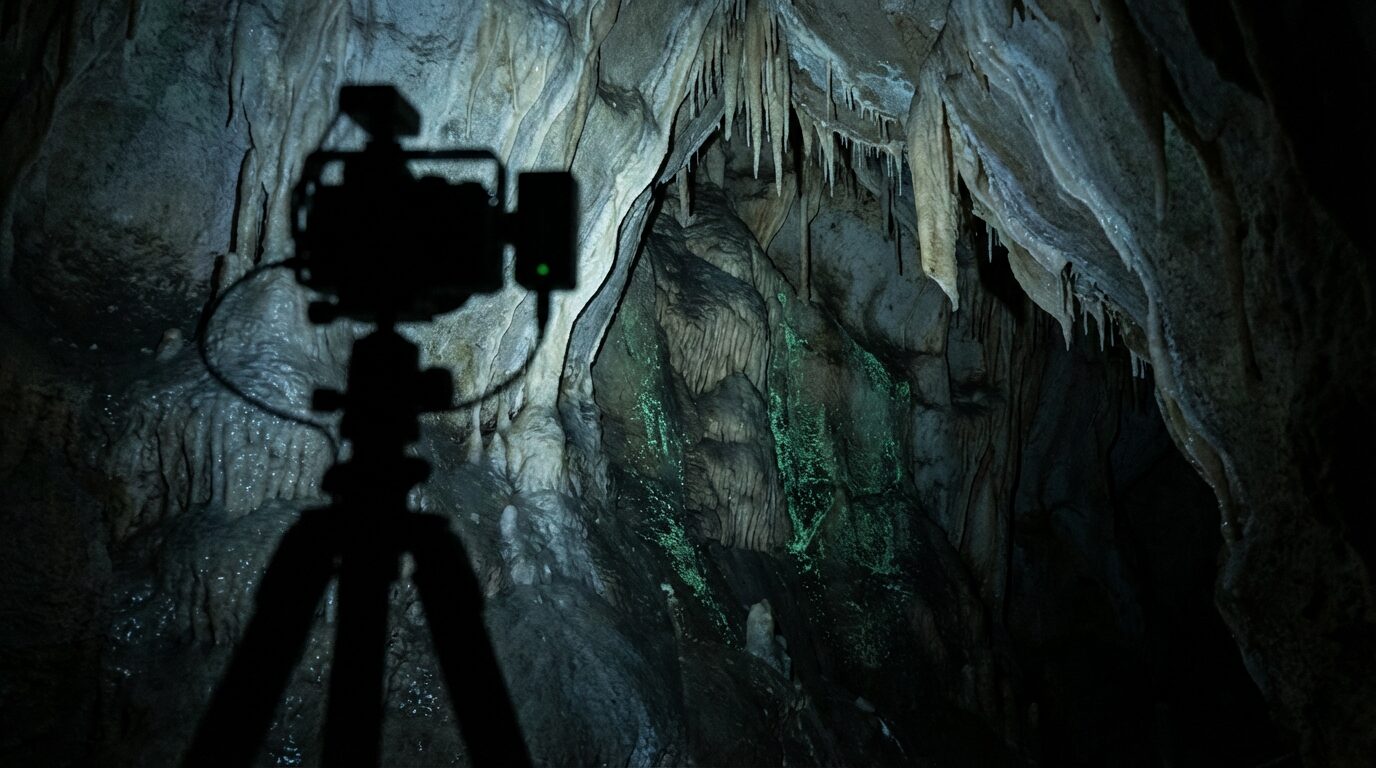
In a completely dark alcove in Carlsbad Caverns National Park, in the Chihuahua desert in southern New Mexico, a wall glowed with iridescent green. What seemed unlikely took shape when cave biologist Hazel Barton, from the University of Alabama, and microbiologist Lars Behrendt, from Uppsala University, observed cyanobacteria attached to the rock. In that sunless environment, the microbes performed photosynthesis in the dark.
According to Barton, the location was “bright green” despite the absolute darkness. The scene is intriguing because photosynthesis generally depends on visible light, but there the energy came from another part of the spectrum. For the researchers, the finding broadens the horizon of astrobiology and indicates that worlds illuminated by red dwarf stars may harbor life.
The park, a UNESCO World Heritage Site, contains caves formed between four and 11 million years ago by sulfuric acid that dissolved limestone. The main attraction is the Carlsbad Cavern, where the Big Room measures nearly 1,220 meters long by 191 meters wide. Although it receives nearly 350,000 visitors per year and has sections with stairs and even wheelchair access, few know about the hidden natural laboratory in the shadows.
-
While playing video games in his room, a 13-year-old teenager was struck by a lightning bolt that entered the house, left a hole in the wall, passed through a metal piece of the desk, and made the boy scream, thinking he was going to die.

-
A metal detector led a prospector to a rock that resisted a saw, acid, drill, and sledgehammer; years later, scientists cut the block with diamond and discovered a 17 kg meteorite from the beginning of the Solar System.

-
Just one message on WhatsApp: Belém launches “Plante Aqui” and plants a tree for free at your doorstep within 15 days, with a goal of 5,000 seedlings by the end of 2026 in the capital of Pará.

-
The most ‘stingy’ millionaire in Canada? Bill Holland saved money to retire at 32, led the management company that now manages $140 billion, and still takes public transportation, in the same club as Warren Buffett and Elon Musk.


Tourist Cave Turns into Natural Laboratory and Reveals Microbes That Use Invisible Light for Us
Behrendt completed his PhD in 2018 and, with an academic award, funded the trip to Carlsbad with Barton. They walked along the tourist trail, turned a corner, and entered a completely dark alcove. When they turned on their flashlights, the green pigments of the microbes clinging to the wall appeared.
Examinations showed that they were cyanobacteria, single-celled organisms that, like plants, perform photosynthesis. The difference is that in the cave, they did not use visible light. Instead of conventional chlorophyll, these lineages relied on special versions, adapted to another type of radiation.
According to Barton, as the team advanced to areas where “you couldn’t see your own hand without a flashlight,” the green pigment remained present. The environment eliminated the hypothesis of direct sunlight and pointed to a more subtle energy source, yet abundant in the underground environment.
For Behrendt, the discovery explains the persistence of photosynthesizing biofilms in deep, isolated spots of the park. During visits to other caves outside the tourist route, the researchers reported the same pattern, reinforcing that it was not an isolated case.
The Role of Near-Infrared and Limestone, How Rock Turns into a Hall of Mirrors
The cyanobacteria of Carlsbad use chlorophyll d, pigments capable of capturing near-infrared, a type of light with a longer wavelength than visible light and imperceptible to the human eye. While visible light penetrates little into caves, near-infrared spreads better through limestone walls, which reflect that radiation.
According to Barton, the limestone “absorbs almost all visible light, but for near-infrared the caves are like a hall of mirrors.” Measurements at the bottom of the cave, where it is darker, detected near-infrared levels 695 times more concentrated than at the entrance. Not surprisingly, communities with chlorophyll d accumulated in the deepest areas.
Evidence Adds Up, From Vinogradskii to Yellowstone and the Sea, and Consolidates Photosynthesis Outside Visible Light
The idea of microbes thriving without common light is not new. In 1890, microbiologist Sergei Nikolaevich Vinogradskii demonstrated that certain microbes live on inorganic matter through chemosynthesis, obtaining energy from chemical reactions with compounds like methane and hydrogen sulfide. These processes explain entire ecosystems far from the Sun.
In the specific field of photosynthesis beyond the visible, researcher Hideaki Miyashita, during a postdoctoral fellowship at Nasa, described in 1996 the marine cyanobacteria Acaryochloris marina, capable of using both visible light and near-infrared. The finding opened a new front of studies on spectral limits of photosynthesis.
Advances also came in 2018, when scientists from Imperial College London identified cyanobacteria that perform photosynthesis in conditions of extreme shade. They were found in bacterial mats in Yellowstone National Park in the United States and inside rocks on Australian beaches, and they grew in the laboratory under near-infrared LEDs.
In these experiments, the microbes alternated between chlorophyll a for the visible range and chlorophyll f for near-infrared. The pattern matches what was observed in Carlsbad, where the presence of chlorophylls d and f in the darkest areas indicates fine adaptation to the available spectrum.
According to Behrendt, photosynthetic communities in protected environments may have remained virtually untouched for about 49 million years. This timescale suggests ecological resilience in stable niches and strengthens the idea that underground environments preserve valuable clues about microbial evolution.
Implications for Exoplanets, Why Red Dwarfs and Dark Worlds Enter the Map of Life
Red dwarf stars, the most common in the galaxy, emit proportionally more light in the near-infrared. If cyanobacteria can exploit it in terrestrial caves, the chances of photosynthetic ecosystems functioning on exoplanets with weak or filtered lighting increases. For astrobiology, this expands the catalog of potentially habitable environments.
Additionally, caves on other worlds may protect microbes from radiation and thermal variations, replicating the stability seen in Carlsbad. The combination of rocks that reflect infrared and pigments like chlorophyll d would create energy pockets sufficient to sustain simple life chains, a concrete target for future missions and telescopes.
According to the evidence gathered by university teams in the United States, Europe, and Australia, photosynthesis does not depend solely on visible light. By crossing field data, spectral measurements, and cultivation under LEDs, the studies paint a coherent picture of how microbes capture energy where human vision sees only darkness.
Practically speaking, this impacts the search for biosignatures in the atmospheres and surfaces of exoplanets. Detection strategies need to consider spectral signatures shifted to infrared and possible biofilms in caves or beneath rocks, where visible light is rare but energy reflected in near-infrared persists.
The Carlsbad caves, with easy access and tourist infrastructure, show how visitable locations can host frontier science. While tourists walk along steps and walkways, just a few meters away, invisible communities have been refining for millions of years the art of turning hidden light into life.
What do you think about this discovery challenging the common sense of where life might exist? Do the microbes of Carlsbad increase the chances of finding biosignatures under red dwarf stars or in caves on other worlds, or is that still excessive optimism? Leave your comment and debate the strength of this evidence, the limits of photosynthesis in the dark, and how it should guide the next generation of searches for life beyond Earth.