Portuguese
  Spanish


A boat created by the Vietnamese craftsman identified as Mr. Ho Thanh Che mimics the classic shape of a flying saucer and combines a fiberglass hull, metallic structure, LED lighting, solar panels, motorized doors, and a jet propulsion system in a recording that shows the real water test.
A flying saucer-shaped boat, handcrafted by the Vietnamese craftsman known as Mr. Ho Thanh Che, gained new attention this Wednesday, June 3, 2026, after images of the project showed the futuristic structure being built from scratch and set to sail on a river.
According to the portal O Antagonista, the aquatic vehicle, created in Vietnam and documented on video by the project’s own creator, features a circular hull similar to a science fiction spacecraft, darkened windows, lights, solar panels, movable doors, and a propulsion system used to make it move over the water.
Flying saucer-shaped boat started with a simple mold and manual construction
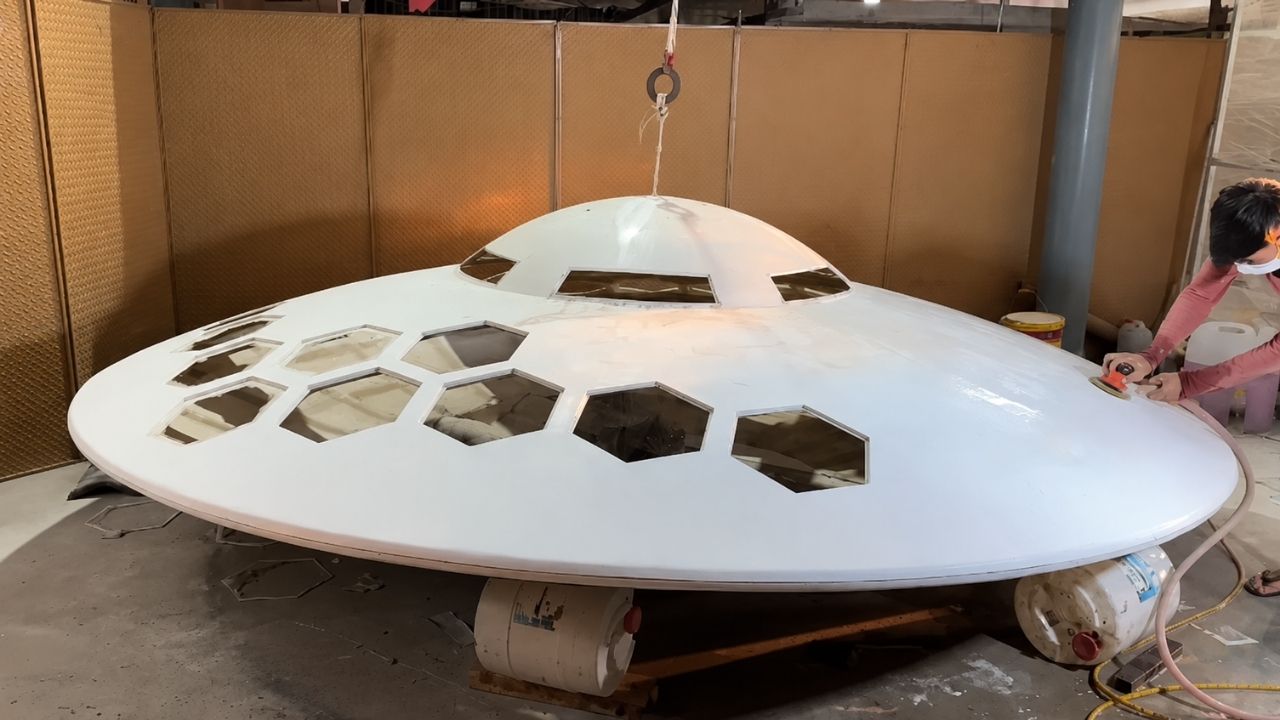
The sophisticated appearance of the project contrasts with the artisanal beginning of the manufacturing. Before receiving metallic finishing and lighting, the boat was born from markings made on the ground and molds prepared to define the upper and lower curves of the circular structure.
-
How Much Does Starlink Satellite Internet Cost for Cars, Trucks, and RVs? Prices for Antenna, Accessories, and Plans

-
Scientists Convert Food Waste into Aviation Fuel, Successfully Test 50% Blend with Conventional Kerosene to Cut Emissions and Promote Sustainable Flights
-
OnePlus N6 Smartphone to Launch in India with 8,000mAh Battery and 45W SuperVOOC Charging, Lasting Up to Three Days
-
Scientists Plan to Release Air Bubbles Underwater to Protect Antarctica’s “Doomsday Glacier” from Melting





The process shown in the video indicates that the creator did not start with ready-made industrial pieces in the final shape. He developed the base gradually, adjusting proportions and contours so that the vessel would have the rounded look of a flying saucer without abandoning the need to float and move on the water.
The point that draws attention is precisely the transformation of common materials into a structure that seems to have come out of a science fiction movie. The shape, however, was not designed just to make a visual impact: the project needed to accommodate internal components, support the pilot, and maintain stability during the test.
By presenting each stage of the assembly, the video turns the construction into an essential part of the audience’s interest. The vessel does not appear ready in front of the camera: the viewer follows the transition from a drawn idea to a functional object capable of being launched into the river.
Metal structure and fiberglass shaped the futuristic hull
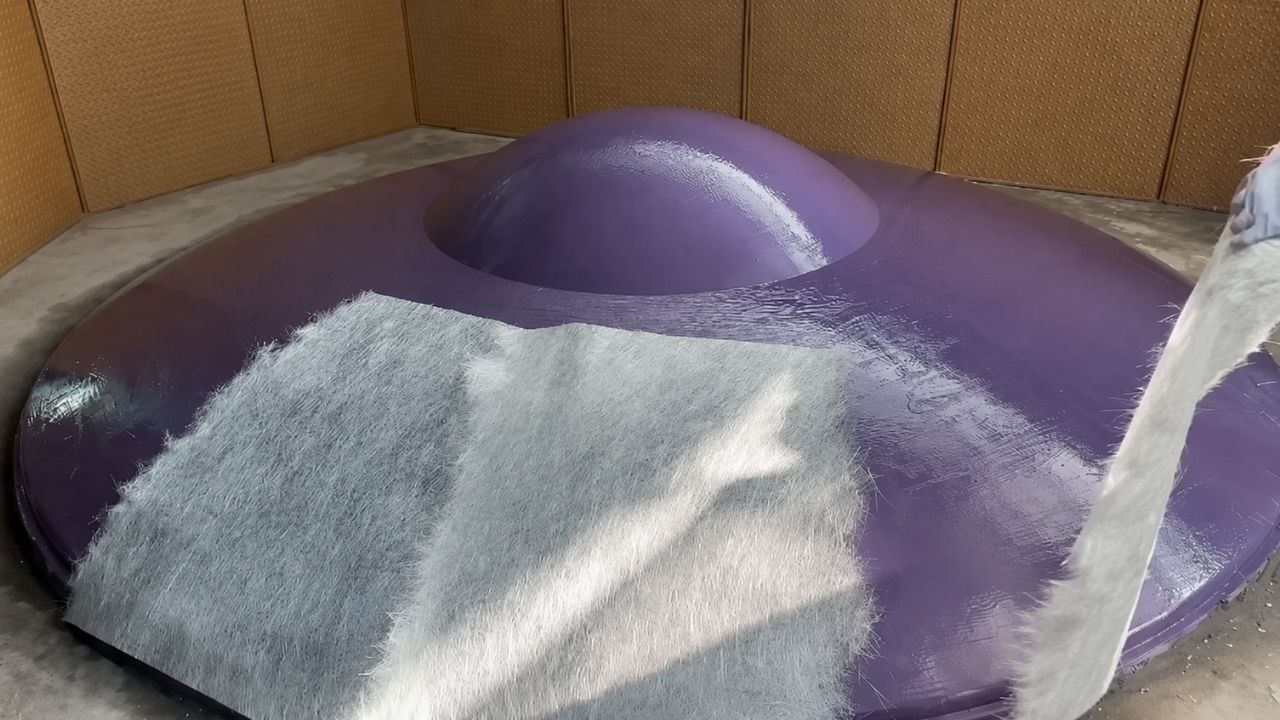
After the initial modeling, the Vietnamese craftsman used metal pieces to reinforce the structure of the vessel. The circular support functions as a kind of skeleton for the boat, helping to sustain the rounded shape and the elements that would later be incorporated into the cabin.
On the molds, layers of fiberglass were applied, a material used to compose the external hull. This step was essential to create a rigid surface compatible with water contact, as well as to allow the smooth finish that brings the vehicle closer to the aesthetics of a spacecraft.
The construction mixes workshop techniques, manual skill, and carefully planned visual decisions. The hull needed to maintain the appearance of a flying saucer, but also accommodate controls, seating, door opening, and the systems necessary to put the structure into operation.
The final result presents two rounded parts joined around a central cabin. Although the look is unusual, the project’s foundation remains that of a motorized vessel built to navigate on water, not to fly.
Windows, lights, and automatic doors reinforce the appearance of a spaceship
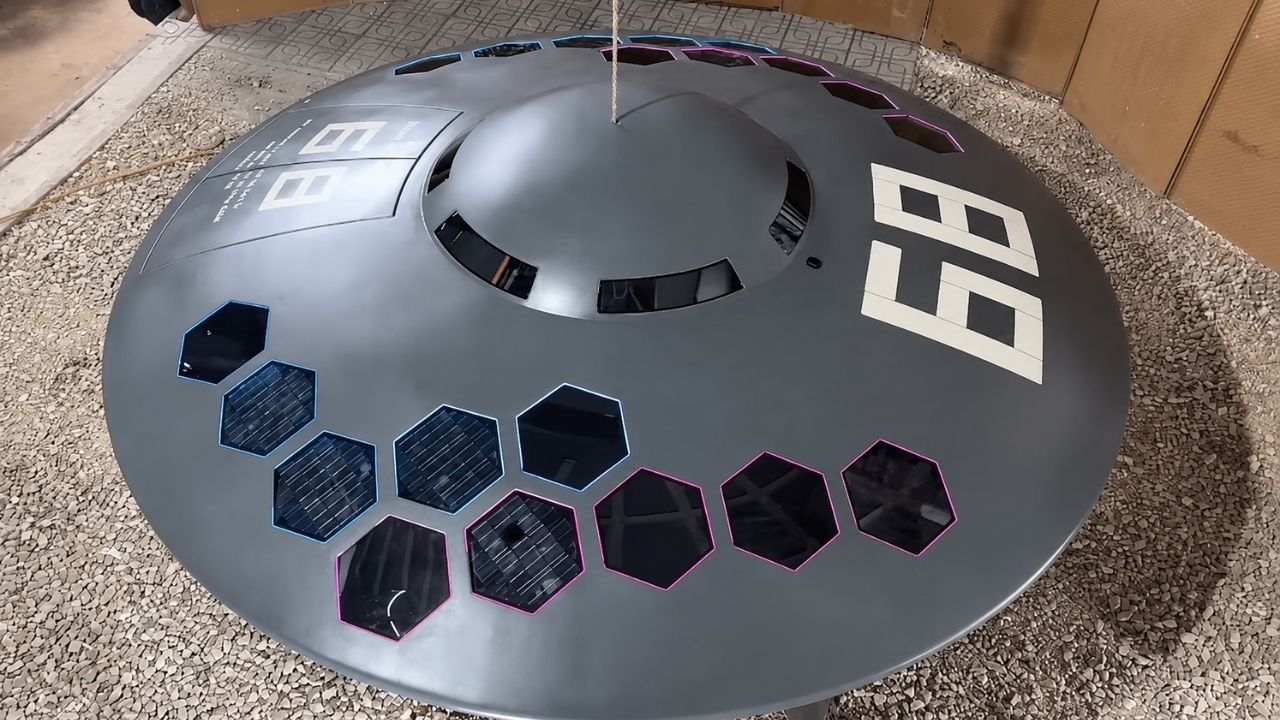
With the main structure completed, the craftsman moved on to the stage that made the boat immediately recognizable as an aquatic version of a flying saucer. The cabin received darkened-looking windows, distributed around the circular body, creating the impression of a closed and futuristic cockpit.
The LED lighting added visual impact to the project, especially when the vessel appears lit. The lights installed inside and outside highlight the geometric shapes of the cabin and help create the sensation that the structure could be in a movie scene.
The motorized doors are one of the most surprising details of the set. Instead of a common opening, the vehicle features panels that move to allow the pilot’s entry, reinforcing the idea of a handcrafted ship built with real functions, and not just as a decorative piece.
On top of the vessel, solar panels integrated into the exterior design also appear. The available material shows their installation in the project, associating the boat with a modern visual proposal and energy components that match the technological appearance of the creation.
Jet propulsion allows handcrafted flying saucer to navigate the river
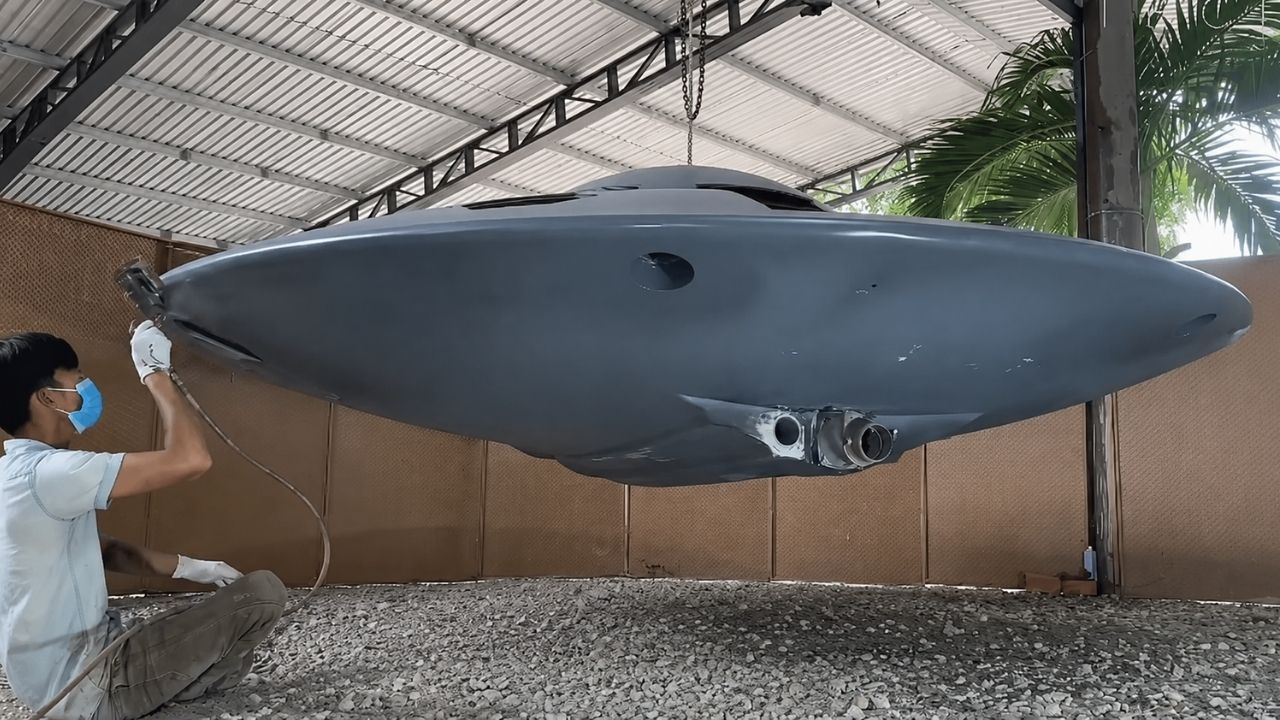
To take the structure off the drawing board and make it move, the project received a jet propulsion system. In vessels of this type, the mechanism uses water displacement to generate thrust, eliminating the need for a visible external propeller at the rear.
The choice contributes to the vehicle’s clean aesthetics. Since the boat was designed to resemble a flying saucer, a less apparent external system helps preserve the rounded lines and the visual effect intended by the creator.
It is in the operation on the water that the construction ceases to be just a futuristic sculpture. The vessel needs to respond to commands, maintain balance, move forward in the river, and accommodate the pilot inside a compact cabin surrounded by electrical and structural components.
The video shows the Vietnamese craftsman conducting the creation during the test, while the circular hull moves over the water’s surface. The material proves that the vessel floats and navigates, although it does not present, in the highlighted excerpt, complete technical data on autonomy, power, or system range.
Water test transforms unlikely idea into functional vessel
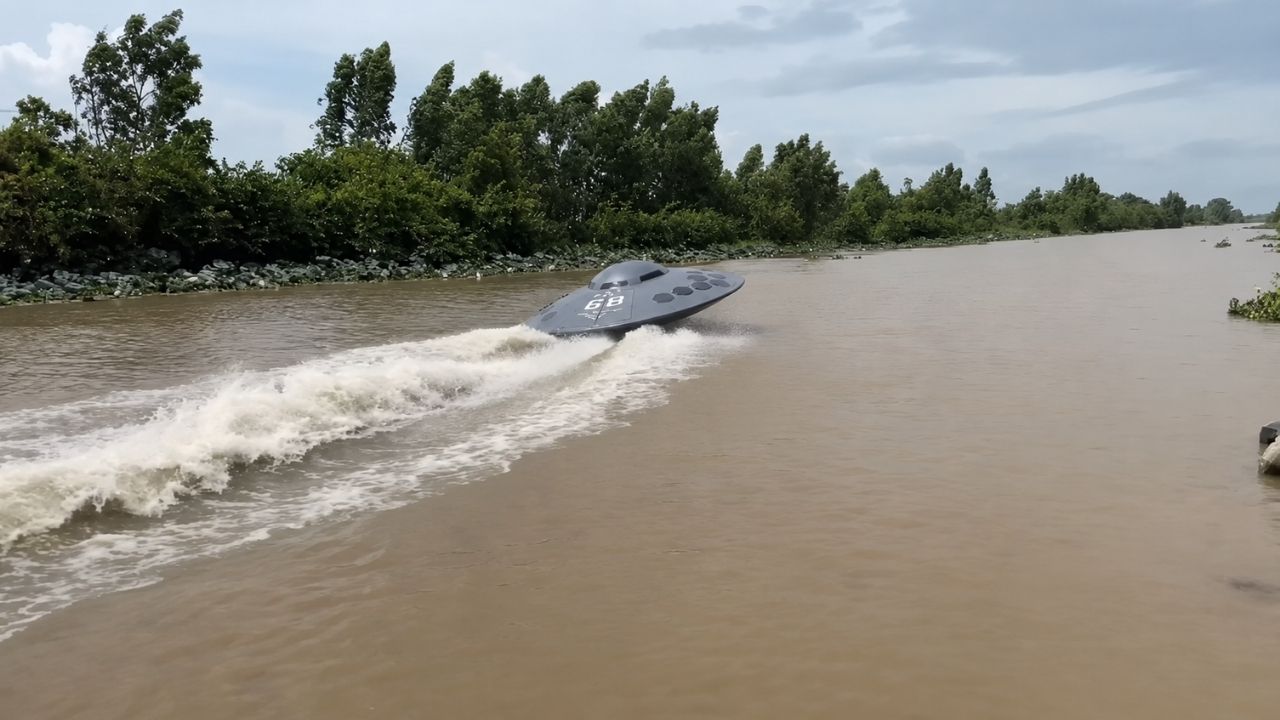
The decisive moment occurs when the boat is taken to the river. Until then, the project could be seen as a visual exercise in creativity and artisanal construction; upon entering the water, the structure demonstrates that it was designed to function as an aquatic vehicle.
During the test, the cabin remains occupied by the pilot, while the lights and solar panels help highlight the UFO look and the vessel moves forward on the river. The scene creates a contrast between the natural landscape and the unusual appearance of the metallic structure, which moves like a futuristic ship over the surface.
The impact of the project comes from the combination of unlikely appearance and practical result. The craftsman not only reproduced the shape popularly associated with flying objects in movies and cartoons but also adapted this image to a construction capable of floating and navigating.
Even without details disclosed about the total cost, exact assembly time, or full technical performance, the test presented in the video is enough to show that the project surpassed the aesthetic phase. The artisanal vessel managed to fulfill its basic function in the water.
Vietnamese creator transforms workshop into a scene of inventive engineering


The project gained attention for presenting a construction different from conventional vessels. Instead of prioritizing only speed or transport, Mr Ho Thanh Che developed a boat that attracts attention for the visual experience, manual complexity, and the surprise effect it provokes when seen sailing.
The work also highlights how manufacturing videos can spark interest by showing each stage of an unusual object. The audience follows the definition of shapes, the hull coating, the installation of components, and finally, the moment when the idea needs to work outside the workshop.
The creation does not rely on extraordinary promises: what impresses is seeing a fanciful structure fulfill a concrete function. By placing the artisanal UFO on the river, the creator showed that an entertainment project can also bring together planning, finishing, and applied mechanical solutions.
The recent repercussion revives a work that had already circulated internationally in videos and publications about design and artisanal inventions. Now, the vehicle draws attention again by combining a well-known image from science fiction with a real navigation experience.
Futuristic boat proves that creativity can also leave the workshop and hit the water
The boat shaped like a flying saucer built by the Vietnamese craftsman brings together traditional materials, motorized solutions, and an unusual aesthetic in a single project. Fiberglass, metal reinforcement, lights, movable doors, solar panels, and jet propulsion were combined to transform a bold idea into a functional vessel.
More than just looking like a spaceship, the creation sparks interest because it was actually set in motion. The river test shows that, at least for the purpose presented in the video, the structure can float and navigate while maintaining the futuristic shape that made it recognizable.
The invention draws attention precisely for crossing the boundary between imagination and execution. Instead of remaining as a drawing, model, or decoration, the artisanal flying saucer gained a hull, controls, pilot, and water under its structure.
Would you have the courage to enter a boat with the appearance of a flying saucer and navigate a river, or do you think the project impresses more with its visuals than its utility? Leave your opinion in the comments and share which detail of this construction surprised you the most.