






 Portuguese
  Spanish


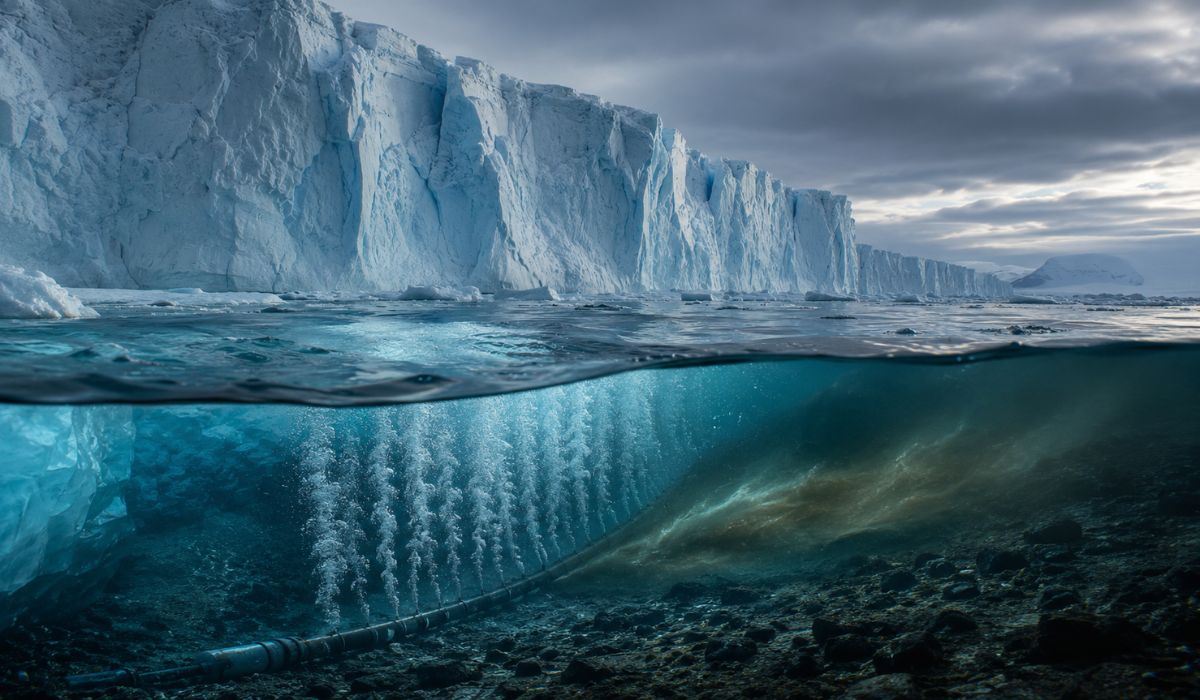

Researchers evaluate techniques to reduce the contact of warm water with the Thwaites Glacier in Antarctica, while studies test limits, environmental risks, and possible interventions against sea level rise.
Scientists studying the Thwaites Glacier in West Antarctica are evaluating a new line of research to try to reduce the arrival of relatively warm ocean water at the base of the ice.
The proposal involves releasing air bubbles on the seabed to cause mixing between water layers and decrease the direct contact of heat with the glacier, according to projects and studies on glacial climate intervention.
The alternative appears alongside the idea of installing submarine curtains anchored to the ocean floor, also under scientific and engineering evaluation.
-
Chinese R6000 Drone Combines Airplane and Helicopter Features, Carries Up to 12 People for Multiple Missions

-
In the World’s Most Densely Populated Desert, Families Dig Funnel-Shaped Underground Cisterns to Capture Rare Rainfall and Store Drinking Water for Up to Eight Months

-
Smart Glass Revolutionizes Privacy: Touch-Activated Opacity Transforms Windows into Connected Home Features with App and Voice Control
-
Young Innovators from Brazil Turn Discarded Plastic into Eco-Friendly Bricks Using Coconut Fiber, Offering a Sustainable Alternative for Construction


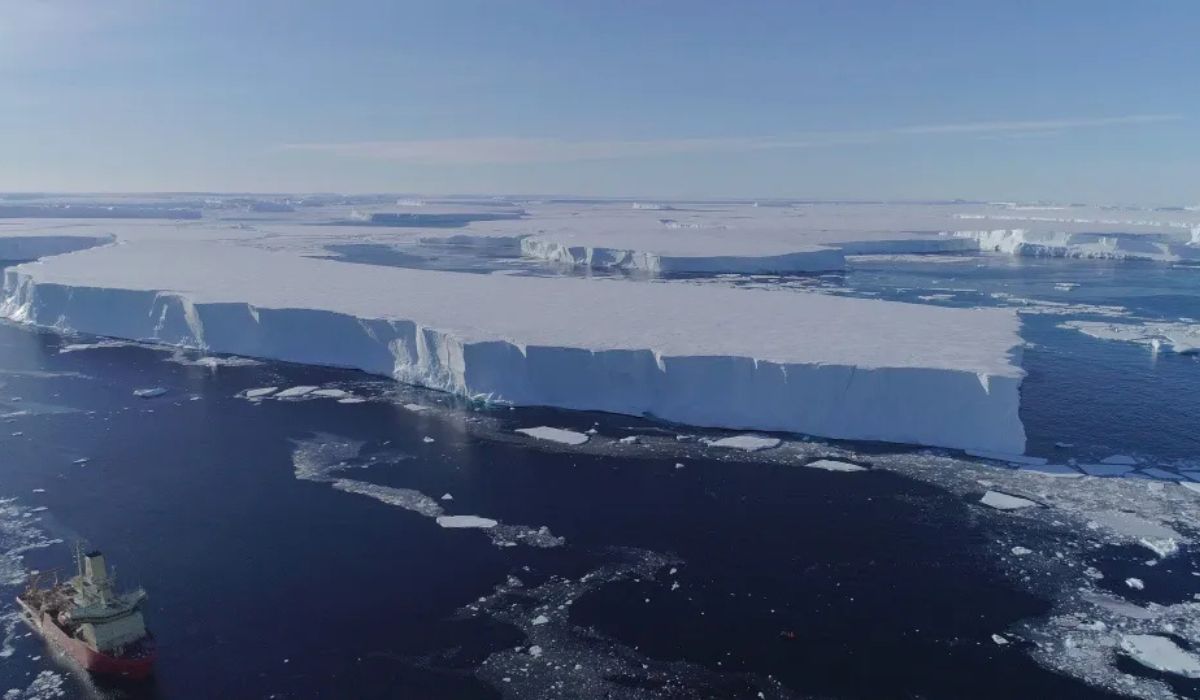
Known as the “Doomsday Glacier,” Thwaites is monitored by researchers because it is among the fastest-retreating glaciers in Antarctica.
The ice block is located in West Antarctica, has an area approximately the size of Florida or Great Britain, and loses more than 50 billion tons of ice per year, according to the International Thwaites Glacier Collaboration and the National Snow and Ice Data Center in the United States.
The complete collapse of Thwaites could raise global sea levels by about 65 centimeters over the coming centuries.
The scientists’ attention is also due to the glacier’s role in containing other ice masses in West Antarctica.
If this system loses stability, the ice loss could add to other ocean rise processes.
The air bubble proposal was discussed by researchers involved in glacial climate intervention studies.
Instead of building a continuous physical barrier, a pipeline installed on the seabed would release air or cold water in a constant flow.
The goal would be to modify local circulation and make it difficult for warmer water to directly reach the underside of the glacier.
How warm water threatens the Thwaites Glacier
Thwaites does not lose ice solely due to atmospheric influence.
In the case of this glacier, ocean water plays a significant role in melting beneath the structure.
Studies with satellite radar data identified the entry of relatively warm saltwater several kilometers under the grounded ice, in a process associated with tides and water pressure at the contact between ocean, rock, and ice.
The team led by Eric Rignot from the University of California, Irvine, published evidence in 2024 of seawater intrusions under the Thwaites.
According to the international collaboration monitoring the glacier, data obtained between March and June 2023 by ICEYE mission satellites showed movements of rising, falling, and flexing of the ice related to the tidal cycle.
This contact contributes to the basal melting, a process that occurs at the bottom of the glacier.
The circumpolar deep water is salty and can remain liquid at temperatures below the freezing point of freshwater.
This condition favors the erosion of the ice base and reduces the support that helps contain the glacier’s advance towards the ocean, according to researchers involved in the study.
Data gathered by the International Thwaites Glacier Collaboration indicate that the Thwaites already shows a surface speed greater than 2 kilometers per year near the grounding line.
Since the 1990s, the amount of ice flowing out of the region has nearly doubled, information used by scientists to assess the possibility of faster retreat in the future.
From the underwater curtain to air bubbles
The most well-known proposal involves flexible curtains attached to the seabed to redirect warm currents before they reach vulnerable glaciers.
In the case of Thwaites and the neighboring Pine Island, the project is discussed for areas of the Amundsen Sea, where ocean circulation influences ice melting.
The Seabed Curtain Project, an initiative linked to the University of the Arctic, describes a gradual research route.
The plan includes tank tests, ecosystem studies in Svalbard, field trials in a Norwegian fjord, and only in a future stage, evaluation of potential application near the Thwaites.
The project states that any deployment in Antarctica would depend on scientific evidence, environmental safeguards, and international agreement.
The alternative with air bubbles seeks to reduce reliance on a large-scale physical structure.
The logic is similar to that used in bubble barriers applied in maritime works to contain sediments or reduce acoustic impacts.
In the Antarctic environment, however, the scale would be larger and would require continuous energy supply in a polar region that is difficult to access.
Researchers treat the idea as experimental.
So far, there is no public demonstration that a bubble curtain can protect a glacier the size of Thwaites.
The possible effects on ocean circulation, nutrients, marine life, and sea ice formation in an environmentally sensitive area also remain open.
Glacial geoengineering divides researchers
The advancement of these proposals occurs within a broader debate on climate geoengineering.
A scientific vision document published in 2024, “Glacial Climate Intervention: A Research Vision”, advocates for expanding studies on glacial interventions.
The text states, however, that this type of research does not reduce the need to cut the use of fossil fuels.
The report points out that the planet’s two major ice sheets, in Antarctica and Greenland, continue to deteriorate even under optimistic emission scenarios.
According to the document, humanity may not be able to prevent sea level rise, but can study ways to slow the process while reducing carbon emissions.
This is one of the points in debate among researchers in the field.
Some scientists believe that such interventions could buy time for coastal cities and vulnerable countries.
Other experts assess that geoengineering projects may create the mistaken perception that emission reductions can be delayed.
The discussion gained new elements after recent studies presented different scenarios for the evolution of Thwaites.
A study published in Nature Climate Change in 2023 concluded that the opportunity to preserve the West Antarctic ice sheet in its current state has likely passed, and that governments should prepare for several meters of sea level rise over the centuries.
On another front, research led by Mathieu Morlighem and published in 2024 indicated that one of the most extreme scenarios of rapid collapse due to ice cliff instability may be less likely this century than some previous models suggested.
The International Thwaites Glacier Collaboration summarized the finding as a less severe outlook for this specific mechanism, but emphasized that polar ice loss remains a significant threat.


What is still unknown about intervention in polar ice
Among the points still under evaluation are the technical feasibility, environmental safety, and international governance of such an intervention.
Installing curtains on the seabed, maintaining pipelines under polar conditions, and operating energy systems near glaciers would require complex logistics, high costs, and supervision rules among countries.
It also remains to be defined how these interventions could alter oceanic circulation.
Some researchers assess that redirecting warm water from one region could shift heat to other vulnerable areas.
Furthermore, sea level rise does not depend solely on Thwaites: thermal expansion of the oceans, melting of other glaciers, ice loss in Greenland, and land subsidence in coastal areas also contribute to the equation.
The Centre for Climate Repair at the University of Cambridge claims to research “climate repair” approaches based on different methods.
The institution describes this field as something beyond emission reduction, involving greenhouse gas removal, ice preservation, and, in some hypotheses, planetary cooling techniques.

Meanwhile, the Seabed Curtain Project anticipates studies of natural analogs in Svalbard, engineering tests, and eventual pilots in more accessible environments before any concrete discussion about a project in Antarctica.
A report on ecological comparisons in Svalbard fjords is expected by September 2026.
The current scenario indicates that there is no intervention ready to be applied to the “Doomsday Glacier.”
What exists, according to available projects and studies, is a research agenda to verify if any technology could reduce risks without producing undesirable environmental or climatic effects.


