Portuguese
  Spanish


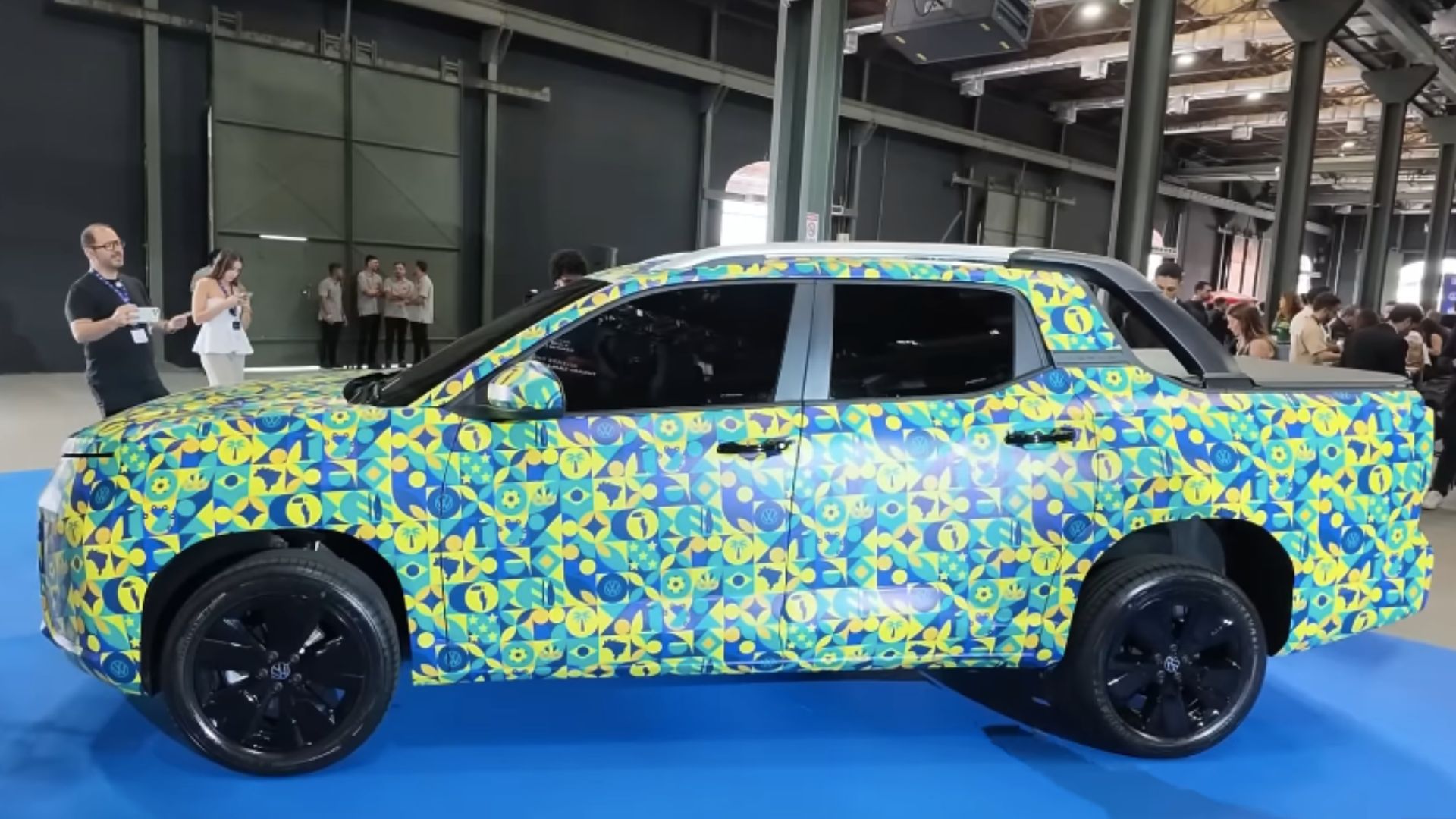

New Volkswagen pickup will be produced in Paraná with high nationalization rate, MQB architecture adapted for heavy work and light hybrid proposal to compete with Strada, Toro, and Montana in the Brazilian market starting in 2027
Volkswagen has decided to change its stance in the Brazilian pickup market and is already preparing a direct offensive against the Fiat Strada, the Fiat Toro, and even the new electrified models that are gaining ground in the country. As recently announced by the German automaker itself, the future Volkswagen Tukan will be produced in São José dos Pinhais, Paraná, and will arrive in the Brazilian market starting in 2027 with a strategic mission: to reposition the brand in one of the most competitive segments of the national automotive industry.
The project represents an important transformation for Volkswagen in Brazil. This is because the new Tukan will not just be the natural replacement for the Saveiro. The pickup was designed to operate in a higher market segment, targeting consumers who currently choose models like the Fiat Strada, Chevrolet Montana, and more affordable versions of the Fiat Toro.
Moreover, the automaker intends to use the Tukan as a kind of national technological showcase amid the rapid growth of Chinese manufacturers, especially BYD, which has been expanding its presence with electrified vehicles and competitive prices.
-
Tesla Begins Testing Two-Seater Autonomous Robotaxi Without Steering Wheel or Pedals, Featuring Onboard Safety Monitor

-
Renault Sandero: Affordable Used Models Feature 1.6 Engine, 106 HP, 14.7 km/l Fuel Efficiency, and Cruise Control Options.

-
Volkswagen Jetta Highline Remains Popular Years After Discontinuation: Features 2.0 TSI Engine, DSG Transmission, and Spacious Trunk, All for Less Than a New Fiat Argo

-
Brazilian Company from Caxias do Sul Among World’s Leading Brake Friction Material Manufacturers, Present in Over 125 Countries


Volkswagen bets on MQB platform and more robust structure to face Fiat’s dominance

According to information released by ‘Garagem360‘, the new pickup will use the well-known MQB platform, a global architecture already applied in various models of the brand. However, the structure will undergo specific adaptations to support a more robust proposal aimed at both urban use and heavy work.
The German manufacturer’s strategy makes it clear that the goal goes beyond replacing the Saveiro. Volkswagen wants to directly compete in the territory dominated by Fiat in recent years, especially with the Strada, the absolute leader among compact pickups in Brazil.
Another important detail involves the national production process. The Tukan will be developed and manufactured entirely in Brazil, with approximately 76% nationalization of parts. This move reinforces the automaker’s attempt to value the local industry precisely at a time when Chinese brands are increasing investments and market share in Brazil.
In this sense, production in São José dos Pinhais, Paraná, also emerges as a strategic step to maintain competitive costs and expand the ability to respond to the new global competition.
Preliminary Technical Sheet of the Volkswagen Tukan 2027
| Item | Expected Information |
|---|---|
| Platform | MQB with structural adaptation for pickup |
| Production Location | São José dos Pinhais (PR) |
| Nationalization Index | 76% of national components |
| Top-of-the-line Engine | 1.5 turbo flex |
| Hybrid System | 48V mild MHEV |
| Entry Versions | 1.0 170 TSI Engine |
| Estimated Power of 1.0 | Up to 116 hp |
| Estimated Torque of 1.0 | 16.8 kgfm |
| Transmission | 6-speed automatic |
| Rear Suspension | Rigid axle with leaf springs |
| Rear Brake System | Drum |
Reinforced Suspension Brings New Tukan Closer to Fiat Strada’s Proposal
Among the most relevant technical details of the future Tukan is the adoption of a rear suspension with a rigid axle and leaf springs. This setup is commonly used in pickups aimed at greater structural resistance, cargo transport, and heavy-duty use.
In practice, this brings Volkswagen closer to the same logic adopted by the Fiat Strada. Unlike the old Saveiro, which used a torsion axle with coil springs, the new Tukan is born with a broader focus and characteristics clearly aimed at robustness and durability.
Furthermore, the planned mechanical setup also shows an attempt to balance performance, energy efficiency, and maintenance costs. The entry versions are expected to use the well-known 1.0 170 TSI engine, while the higher variants will receive the new 1.5 turbo flex engine associated with the 48V mild hybrid system.
Volkswagen Uses Mild Electrification to Respond to BYD’s Advancement in Brazil

The arrival of the Tukan also marks an important change in Volkswagen’s strategy in response to the advancement of BYD and other Chinese manufacturers in Brazil. In recent years, electrified vehicles have ceased to be exclusive to premium segments and have started to directly pressure traditional brands.
Therefore, Volkswagen decided to bet on the 48V mild hybrid MHEV technology in a high-volume model. The proposal is similar to the path that Fiat has already started to follow in part of its national lineup.
Even so, there is an important difference. While many Chinese brands focus exclusively on more sophisticated hybrid or electric models, Volkswagen and Fiat try to preserve a formula more adapted to the Brazilian reality: local production, flex engines, partial electrification, and potentially more affordable prices.
This combination could become decisive in the coming years, especially in an increasingly competitive market pressured by the arrival of new automotive technologies.
With a launch scheduled for 2027, the Volkswagen Tukan emerges as one of the most important bets of the German brand to regain ground in the pickup truck segment and face a competition that promises to become even more intense in Brazil.