






 Portuguese
  Spanish


Volcano That Froze The Planet In 1831 Was Finally Discovered By Scientists. Understand How The Volcano Froze The Planet And Left Humanity On Alert!
In 1831, a shocking event altered the course of the climate in the Northern Hemisphere: an unknown volcano erupted, releasing immense amounts of ash and smoke into the sky, darkening the atmosphere and cooling much of the Northern Hemisphere. The Volcano froze the planet and crops were ruined, entire communities faced famine, and the world trembled in the aftermath of this cataclysm. Discover the volcano that froze the planet in 1831.
Volcano That Froze The Planet In 1831 Is Discovered By Scientists
The volcano froze the planet; however, despite all the devastation, its location has always been a mystery. Nevertheless, a team of scientists led by volcanologist William Hutchison from the University of St Andrews in the United Kingdom managed to find the culprit by analyzing the eruption ash preserved in the ice of Greenland.
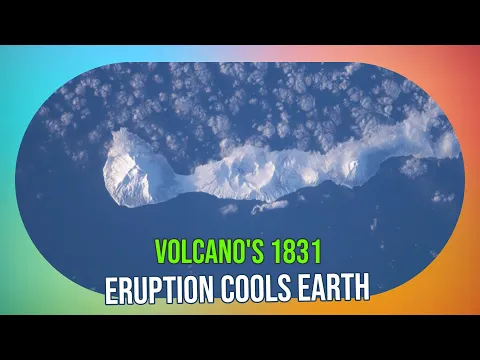
After an exhaustive comparison effort, they linked this historical event to a volcano in the Zavaritskii caldera, located on the remote island of Simushir in the Central Kurils of Russia. This small strip of land, located between Russia and Japan, extends only 59 kilometers but hides a volcanic past as fierce as it is revealing.
-
Ancient 4,000-Year-Old City in Brazil Grew Wealthier and Reduced Inequality, Study Finds

-
Lost Page from Archimedes Palimpsest Resurfaces in French Museum After Decades, May Reveal Hidden Mathematical Calculations with X-ray and Multispectral Imaging
-
Brazilian Education Ministry Announces Tech Benefits for Teachers, Providing Smartphones, Notebooks, and Tablets to Enhance Digital Learning and Professional Development
-
Woman Stranded for Six Months in Brazilian Airport After Losing Passport and Ticket, Faces Agonizing Wait to Reunite with 15-Year-Old Son at Age 56.



The scientists’ study to discover the volcano that froze the planet in 1831 required international collaboration to collect and analyze volcanic samples from this remote region. Hutchison described how they established the definitive link.
According to the researcher, the moment in the lab when they analyzed the two ash samples together, one from the volcano and the other from the ice, was a true eureka moment. He couldn’t believe the numbers were identical. From this discovery, the team of scientists also confirmed the age and magnitude of the eruption, cementing the link between the ice ash and the Zavaritskii volcano.
How The Volcano Froze The Planet?
In the 19th century, humanity lacked modern tools, such as seismic monitoring stations or low-orbit satellites. Thus, a volcanic eruption on an uninhabited island could go completely unnoticed. Today, thanks to advancements made by scientists, it is possible to track events like this, reconstruct how the volcano froze the planet, and changed the climate.
For decades, scientists speculated about the origin of the eruption of the volcano that froze the planet in 1831 and 1833. One of the main theories pointed to the Babuyan Claro volcano in the Philippines, but later investigations showed this never happened. Another hypothesis placed the event on Graham Island, an intermittent volcano in the Strait of Sicily. However, the chemical analysis of the ash trapped in Greenland’s ice ruled out these possibilities.

They then discovered that, in 1831, sulfur precipitation, a known sign of volcanic activity, was about 6.5 times higher in Greenland than in Antarctica. This fact gave scientists a clue that the large eruption must have originated in mid-latitudes of the Northern Hemisphere and not in tropical zones, as previously thought, the researchers reported.
What Is The Volcano That Froze The Planet In 1831?
The Zavaritskii is characterized by its caldera, the hollow basin, a formation that often occurs when a volcano explodes. This caldera likely formed during the 1831 eruption, according to scientists.
Hutchison and his team identified the characteristics of a Plinian eruption, similar to that of Vesuvius, and made an exact match between microscopic fragments of volcanic glass in the ice and the samples from Simushir. The crater left by this eruption, known as the Zavaritskii caldera, still dominates the island’s landscape and was likely formed during the 1831 event.


-

-

-

-

-

-

14 people reacted to this.