






 Portuguese
  Spanish


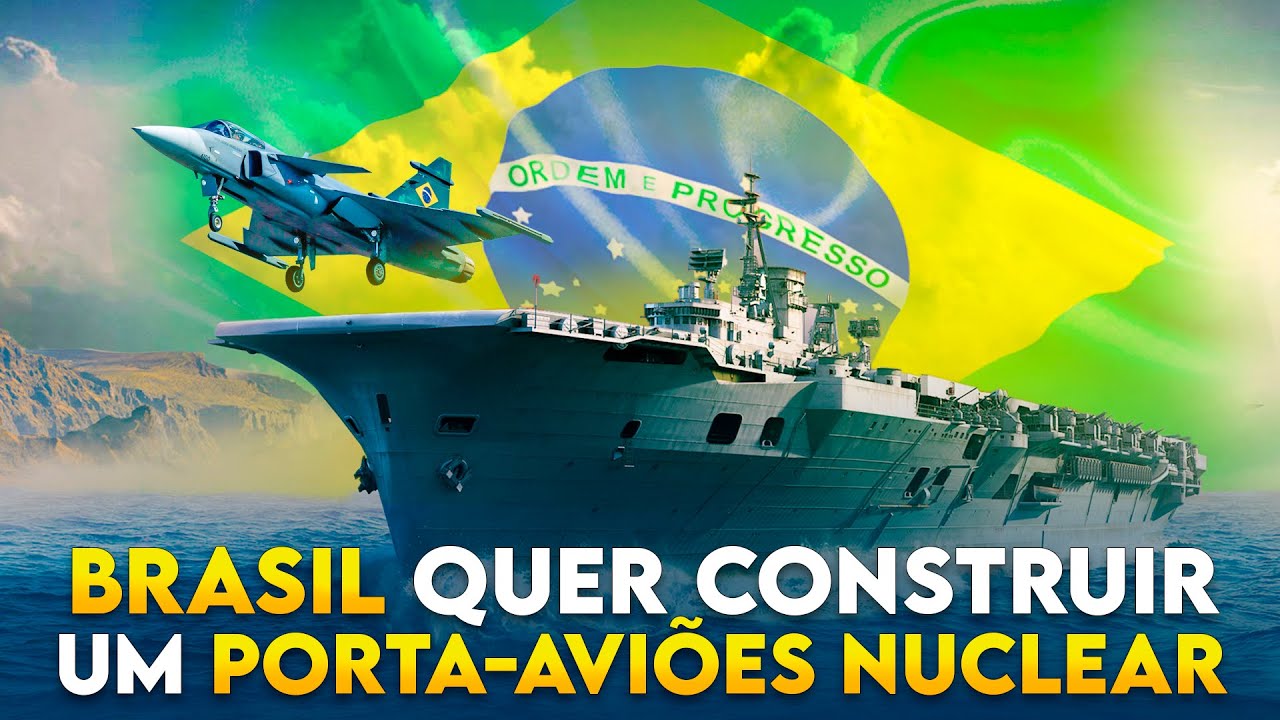


Washington On Alert! Brazilian Navy Wants to Build an Aircraft Carrier and Promises to Make the Country the First in Latin America to Operate This Powerful Machine, Revolutionizing Its Geopolitical Position in the World
The Brazilian Navy is determined to elevate its position in the global geopolitical landscape with an ambitious project: the construction of an aircraft carrier. If realized, this plan would make Brazil the first country in Latin America to operate a vessel of this size, consolidating its naval strength and reinforcing its maritime defense capabilities.
The advancement of this initiative has put Washington on alert, highlighting the strategic impact of this move.


Brazil Aims for the World Naval Elite with Plans for an Aircraft Carrier
The project for a Brazilian aircraft carrier represents a shift in the country’s defense strategy. The Brazilian Navy sees this vessel as a crucial factor for expanding its presence in the oceans and strengthening its power projection. In addition to reinforcing the security of the so-called Blue Amazon, the initiative could redefine Brazil’s position in the international military landscape.
-
Unable to secure a mortgage as a self-employed single mother, she designed her own floating home from a 20-meter boat and now lives “off-grid” with her two children and solar panels on an English canal.

-
Man Transforms Rusty Shipping Container into Luxury Home with Insulated Walls, Large Windows, and Drywall Finish, Surprising Onlookers

-
“Super Grass” Miscanthus Grows Rapidly Without Pesticides, Replacing Heating Oil in Europe and Now Used in Carbon-Capturing Concrete and Walls in World’s First “Bale House”
-
Abandoned House Renovation Fixes Decades-Long Leak in Two Days with Red Steel Roof Installation



The proposal has generated reactions in the geopolitical sphere, especially in Washington, which is closely monitoring any move that alters the naval balance in the region. Should Brazil proceed with this project, it could join a select group of nations that operate aircraft carriers, enhancing its influence and response capability in conflict and defense scenarios.
Now It’s Serious! Brazil Wants to Build Nuclear Aircraft Carriers by 2040
Among the plans being evaluated is the possibility of a nuclear aircraft carrier, a technology mastered by only a few naval powers. The Brazilian Navy considers this option as a way to ensure greater autonomy and power projection in the long term. The goal is for the vessel to be operational by 2040, an ambitious objective that, if realized, will revolutionize the country’s naval defense.
With an extensive coastline and the need to protect its maritime resources, Brazil sees a nuclear aircraft carrier as a strategic investment to consolidate its sovereignty in the oceans. However, experts warn that the challenge goes beyond building the vessel: it will require the development of advanced support infrastructure, training highly specialized crews, and ensuring a robust budget for fleet maintenance.
Challenges for the Construction of a Nuclear Aircraft Carrier
The implementation of a nuclear aircraft carrier by the Brazilian Navy faces considerable challenges. Admiral Marcos Sampaio Olsen emphasizes that, despite the strategic interest, the country will need solid financial planning and significant investments in technology to make the project viable.
In addition to the high costs, construction requires advanced technical knowledge, a specialized industrial sector, and adequate support infrastructure. Currently, few nations possess the expertise necessary to operate a vessel of this type. Therefore, analysts question whether Brazil will be able to overcome these barriers and turn its vision into reality.
An Ambitious Plan from the Brazilian Navy That Could Redefine Naval Geopolitics
If it manages to develop a nuclear aircraft carrier, Brazil will have a much stronger presence on the global stage. This decision would influence the geopolitical balance in the region and provoke reactions from countries that historically dominate the seas, such as the United States and the United Kingdom.
The comparison with Russia is inevitable. Despite being a military superpower, Moscow chose not to prioritize aircraft carriers in its naval strategy, raising debates about the real necessity of such vessels for the Brazilian Navy. However, proponents of the initiative argue that, unlike Russia, Brazil has an extensive coastline and needs means to protect its maritime interests.
The realization of this project will require well-founded strategic decisions. Brazil will have to determine whether it intends to develop its own vessel from scratch or seek alternatives in the international market.
Brazilian Navy Also Evaluates Acquisition of HMS Prince of Wales Aircraft Carrier
In addition to the idea of having its own aircraft carrier, the Brazilian Navy is interested in acquiring the HMS Prince of Wales, a carrier from the Royal Navy. This possibility has generated intense discussions among experts, as purchasing this vessel could accelerate the process of strengthening Brazil’s naval capabilities.
The acquisition of the British aircraft carrier would provide Brazil with an immediate power projection capability in the Atlantic. However, the logistical and financial challenges are significant. The cost of operating and maintaining a vessel of this size is extremely high, raising doubts about the feasibility of this investment.
Another factor complicating the negotiations is competition. Australia is also interested in purchasing the HMS Prince of Wales, which could influence the Brazilian Navy’s decision-making process. Additionally, the need to adapt the Brazilian fleet to operate with this aircraft carrier would require time and additional resources.
The Naval Power of Brazil and Its Defense Capability
With an active personnel of approximately 81,040 military personnel, the Brazilian Navy is the largest naval force in Latin America. Its mission includes protecting Brazil’s vast coastline, conducting maritime security operations, and defending the country’s natural resources. Additionally, the Navy plays a crucial role in humanitarian missions, scientific research, and international cooperation.
Currently, the main vessel in the Brazilian fleet is the NAM Atlântico (A140), an amphibious assault helicopter carrier acquired from the United Kingdom. Originally operated as HMS Ocean, the Atlântico has become the largest vessel in the Brazilian Navy, performing strategic force projection and amphibious operations.
Despite this advancement, Brazil still does not have an operational aircraft carrier. In the past, the country operated the NAe São Paulo, acquired from France, but the vessel was decommissioned due to technical issues and high maintenance costs. Now, with new plans being discussed, the Navy seeks to recover this capability and take a significant step in its defense strategy.
Brazil Seeks to Recover Its Naval Relevance
Historically, Brazil has had prominence on the naval scene. In the early 20th century, the country surprised the world by acquiring the battleships Minas Gerais and São Paulo, which were considered the most advanced of their time. These ships reinforced Brazil’s influence in South America and demonstrated its interest in having a modern and well-equipped navy.
Now, with the possibility of developing its own aircraft carrier or acquiring a foreign model, Brazil seeks again to consolidate its position among the world’s most relevant naval forces. The challenges are enormous, but the potential for change in the geopolitical landscape is equally significant.
Whether with a nuclear aircraft carrier or by purchasing the HMS Prince of Wales, one thing is certain: the Brazilian Navy is determined to redefine its future and strengthen its presence at sea. And, in light of this movement, Washington continues to monitor each step of this evolution closely.
What do you think? Does Brazil really need a nuclear aircraft carrier to strengthen its naval defense, or would it be a risky investment? Could this decision change the geopolitical balance in Latin America? Share your opinion in the comments!





A visão da END (A *Estratégia Nacional de Defesa) do Brasil* (https://www.gov.br/capes/pt-br/centrais-de-conteudo/estrategia-nacional-de-defesa-pdf) é garantir que a Marinha do Brasil tenha uma frota moderna, versátil e capaz de atuar em múltiplos cenários, desde a defesa do litoral até operações em águas internacionais, alinhada aos interesses estratégicos do país.
Em relação aos *meios de grande porte* da Marinha do Brasil, orienta a modernização e ampliação das capacidades navais para garantir a defesa do território nacional, a proteção da *Amazônia Azul* (área marítima sob jurisdição brasileira) e a projeção de poder em águas distantes. As diretrizes da END para os meios de grande porte incluem:
—
*1. Submarinos:*
– *Submarinos Convencionais:* A END prevê a construção de submarinos convencionais (classe Riachuelo) no âmbito do *Programa de Desenvolvimento de Submarinos (PROSUB)*, em parceria com a França. Esses submarinos são essenciais para patrulhamento, dissuasão e defesa de águas territoriais.
– *Submarino Nuclear (SN-BR):* Um dos projetos mais estratégicos da Marinha, o submarino nuclear brasileiro, está em desenvolvimento. A END destaca a importância dessa capacidade para garantir uma presença dissuasória de longo alcance e operações em águas profundas, sem a necessidade de reabastecimento frequente.
—
*2. Navios de Superfície:*
– *Fragatas:* A END orienta a modernização da frota de superfície, com destaque para o *Programa Tamandaré*, que prevê a construção de novas fragatas (classe Tamandaré) para substituir navios mais antigos. Essas fragatas serão equipadas com sistemas modernos de armas, sensores e defesa antiaérea.
– *Navios de Patrulha e Corvetas:* A Marinha deve continuar investindo em navios de patrulha oceânica (classe Amazonas) e corvetas para monitoramento e proteção da Zona Econômica Exclusiva (ZEE) e áreas estratégicas.
– *Navios de Apoio e Logística:* A END prevê a ampliação da capacidade logística com a construção de navios de apoio, como navios-tanque e navios de transporte, essenciais para operações de longo alcance e sustentação de forças em missões prolongadas.
—
*3. Porta-Helicópteros e Projeção de Poder:*
– A END reconhece a importância de navios de grande porte com capacidade de projeção de poder, como o *NAe São Paulo* (antigo porta-aviões, cuja substituição está em discussão) e futuros navios de assalto anfíbio. Esses meios são fundamentais para operações de projeção de força, apoio a operações terrestres e resposta a crises.
—
*4. Navios de Pesquisa e Monitoramento:*
– A END também orienta a ampliação da capacidade de pesquisa oceanográfica e monitoramento marítimo, com navios de grande porte equipados para mapeamento do leito marinho, exploração de recursos naturais e vigilância da Amazônia Azul.
—
*5. Autossuficiência e Indústria Nacional:*
– A END enfatiza a necessidade de desenvolver a *indústria nacional de defesa*, reduzindo a dependência de fornecedores estrangeiros. Isso inclui a construção de meios de grande porte em estaleiros brasileiros, como o Estaleiro e Base Naval de Itaguaí (EBN), que é central para o PROSUB.
– A Marinha deve continuar investindo em pesquisa e desenvolvimento (P&D) para tecnologias críticas, como sistemas de propulsão, armamentos e sensores.
—
*6. Proteção da Amazônia Azul:*
– A END destaca a importância de meios de grande porte para a proteção da *Amazônia Azul*, que abrange uma área de aproximadamente 4,5 milhões de km² de mar territorial e ZEE. Navios de grande porte são essenciais para patrulhamento, dissuasão e resposta a ameaças como pirataria, pesca ilegal e exploração não autorizada de recursos.
—
*7. Cooperação Internacional e Operações Conjuntas:*
– A END prevê a participação da Marinha em operações conjuntas e coalizões internacionais, o que exige meios de grande porte com capacidade de interoperabilidade com outras marinhas. Isso inclui navios de apoio logístico, fragatas e submarinos.
—
*Resumo das Previsões para Meios de Grande Porte:
– *Submarinos convencionais e nucleares* para dissuasão e patrulhamento.
– *Fragatas e corvetas modernas* para defesa de superfície.
– *Navios de apoio logístico* para sustentação de operações de longo alcance.
– *Navios de projeção de poder* (como porta-helicópteros ou futuros porta-aviões).
– *Navios de pesquisa e monitoramento* para proteção da Amazônia Azul.
– *Fortalecimento da indústria nacional* para construção e manutenção desses meios.
Fonte e pesquisa fornecida pela IA Deepseek em resposta a pergunta a seguir:
QUANTO AS PREVISÕES DOS MEIOS DE GRANDE PORTE, O QUE A END ORIENTA DE FATO A PND (POLITICA NACIONAL DE DEFESA)?
Impressionante os comentários rasos e imediatistas de quem desconhece a END (Estratégia Nacional de Defesa); “Em setembro de 2007, o então presidente Luiz Inácio Lula da Silva criou um grupo de trabalho, coordenado pelos ministros Nelson Jobim e Roberto Mangabeira Unger, para confeccionar uma Estratégia Nacional de Defesa.[1] Durante mais de um ano, militares do Ministério da Defesa e da Secretaria de Assuntos Estratégicos, juntamente com as forças armadas, se dedicaram ao projeto. Foi aprovada em 18 de dezembro de 2008, pelo Decreto nº 6.703.” Wikipédia.
Os maiores projetos de investimentos e desenvolvimentos das nossas FFAA, provavelmente, aconteceu nas gestões do então governo Lula com foco na END, e por incrível que pareça, justamente, na gestão do Bolsonaro, por exemplo, a FAB cometeu um dos maiores “tiro no pé” reduzindo sua participação e desprestigiando o projeto do KC-390, do qual ela é beneficiária dos royalties
Tem que dar risada mesmo. Quem teve essa ideia de diarreia não sabe quanto custa manter um elefante branco desses flutuando por um ano. Sugiro falar com a Marinha dos Estados Unidos. E vai colocar o que em cima, Skyhawks da guerra da Coreia ? Certos artigos deveriam passar por uma crivo para saber se vai agregar algum valor ou aspecto de fake news. Perdi alguns minutos do meu dia lendo essa papagaiada