Portuguese
  Spanish


Prevented from obtaining a mortgage due to being self-employed, a single mother in England decided to create her own floating home. She designed and fitted out a nearly 20-meter canal boat, where she now lives off-grid with her two children, using solar energy, a composting toilet, and a thousand-liter water tank.
When the bank said no, she found her own way to have a home. In England, a single mother known only as Jen designed and built her own floating house after failing to secure a mortgage, as shown in the video “She Lives Full-Time on Her Self-Built Boat,” on YouTube. The idea turned into a home for her and her children.
The decision arose from a practical obstacle. Being self-employed, Jen couldn’t get approved for a home loan, and upon seeing the boats moored in the canal, she thought that was the life she wanted, according to the report from My Positive Outlooks. It was the push she needed to take on the project.
The result is a home on the water. The boat, named Adi Shakti, is about 20 meters long and functions as a complete floating house, with three bedrooms, a kitchen, and a bathroom, where the family lives full-time, free from rent and mortgage.
-
Man Transforms Rusty Shipping Container into Luxury Home with Insulated Walls, Large Windows, and Drywall Finish, Surprising Onlookers

-
“Super Grass” Miscanthus Grows Rapidly Without Pesticides, Replacing Heating Oil in Europe and Now Used in Carbon-Capturing Concrete and Walls in World’s First “Bale House”

-
Abandoned House Renovation Fixes Decades-Long Leak in Two Days with Red Steel Roof Installation
-
Man Builds Entire House by Hand from Abandoned Pallets Found in Brazilian Forest, Complete with Round Door and Matching Doghouse

Next, see who Jen is, why she swapped financing for a boat, how the floating house was built, how much this lifestyle on the canal costs, and what this story from England has to do with Brazil.
Who is Jen, the mother who designed her own floating house
The protagonist of the story prefers to remain anonymous. Publicly known only as Jen, she is a single mother living with her two children in a floating house on the canals of England, in the Tring area, near London.
She is self-employed and works on board. Besides living on the boat, Jen uses the space to serve clients for holistic therapies and massage, an activity she has maintained for years, which helps support the family’s life within the floating house.
The routine is that of someone living on the move. Like many residents of the British canals, Jen needs to move the boat from time to time, following local navigation rules, giving the floating house an itinerant character through the waters of England.
This style has a name in the United Kingdom. Those who live on a boat without a fixed location are called continuous cruisers and need to change spots every few weeks, covering a minimum distance per year to maintain the license, which makes the floating house change scenery all the time.
Living like this requires organization, but it gives freedom. Instead of being tied to an address, Jen can take the floating house to different parts of the canal, waking up sometimes near a village, sometimes surrounded by trees, a flexibility that a fixed house in England would never offer.
The feat gained worldwide attention through the internet. The video showcasing Jen’s floating house amassed millions of views, attracting curious people to see how a single mother managed, on her own, to create a complete home inside a canal boat.
Why she traded a mortgage for a boat
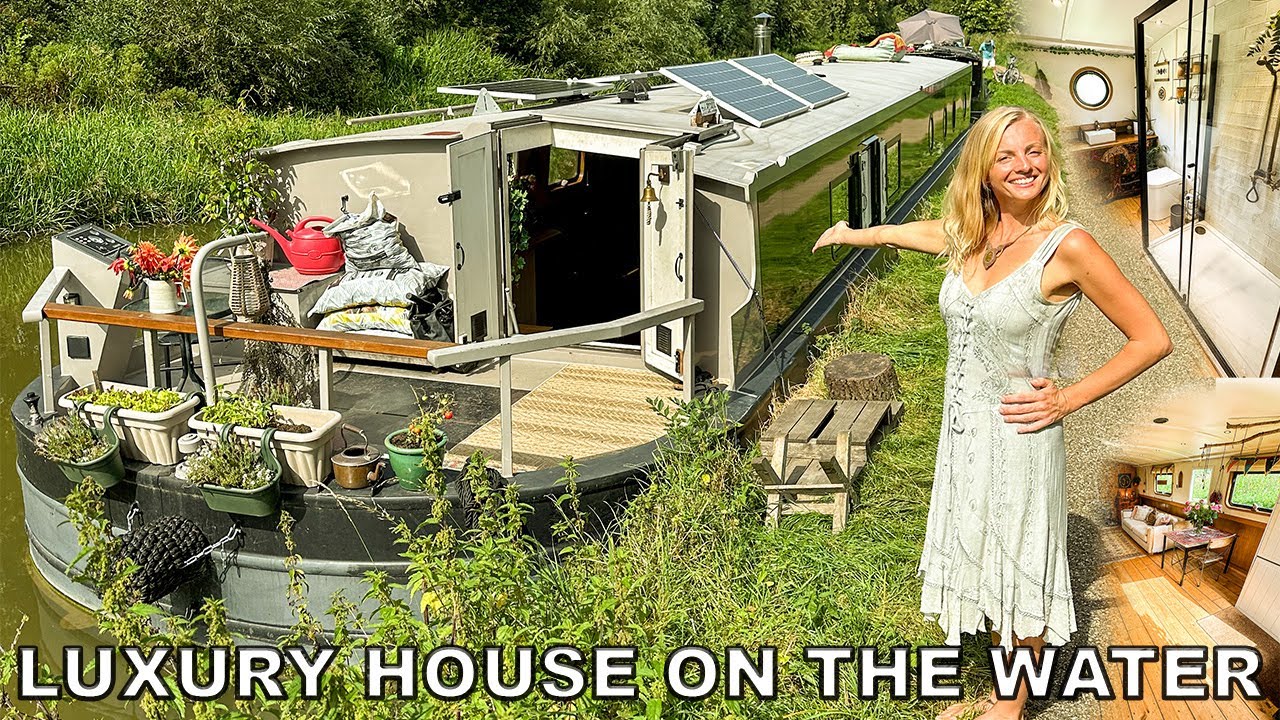
It all started with a closed door. Being self-employed, Jen faced difficulty in securing a mortgage, a common situation for those without proven fixed income, leaving her without access to buying a traditional house in England.
Instead of giving up, she changed her strategy. Observing the boats living in the canals, Jen realized there was a different and cheaper way to have a roof over her head, without relying on banks or a mortgage, and decided to bet on the floating house.
The financial logic weighed in the choice. Building and living on a boat was more affordable than paying rent or financing for decades, and it also gave Jen the freedom to live her own way, without the pressure of a long-term mortgage debt.
There was also a desire for a different life. For Jen, the canal represented more autonomy and contact with nature, and the floating house combined the solution to the housing problem with a lifestyle she truly wanted to pursue with her children.
How the boat was built: ready-made hull, her finishing
It’s important to recount the construction accurately. Jen did not make the steel hull herself: this part, the metal structure of the boat, was built by professionals in about seven weeks, and then transported and placed in the water by crane.
Her work came later. With the empty hull in hand, Jen herself assembled the entire interior of the houseboat, installing the kitchen, walls, bedrooms, and finishes over about ten weeks, which added up to approximately seventeen weeks in the total process.
The arrival of the hull was a spectacle in itself. The steel structure of the boat came from another city and had to be placed in the water by a crane, a remarkable moment that transformed a pile of metal into the base of Jen’s future houseboat on the canal.
Doing the finishing touches herself had its advantages. By assembling the interior alone, Jen saved a lot of money and adapted every detail of the boat to the taste and needs of the family, something difficult to achieve when buying a ready-made house in England.
The cost was much lower than a house. According to the report, the boat and the engine, already with lining and electrical part, cost about 87 thousand pounds, plus 10 thousand pounds for the internal finishing, a much lower value than that of a property in England.
It was a project of courage and planning. Facing the assembly of a houseboat requires study, hands-on work, and organization, and the fact that Jen did the finishing herself is what gives the story the merit of a true do-it-yourself.
A 20-meter boat with three bedrooms
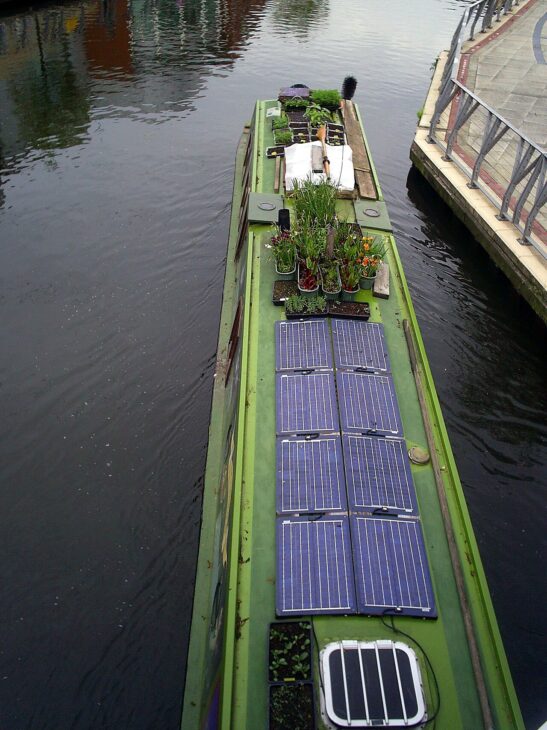
The size surprises those who imagine a cramped boat. Jen’s houseboat is about 20 meters long by almost 4 meters wide, a wide canal model that offers much more internal space than the traditional narrow boats of England.
Inside, it looks like a real house. The boat has three bedrooms, which ensures a space for Jen and one for each child, in addition to a kitchen, living room, and bathroom, all organized to fit comfortably in the elongated structure of the houseboat.
Every corner was designed to make the most of the space. Beds with built-in wardrobes, compact living areas, and smart solutions make the houseboat function as a complete home, proving that living on a boat doesn’t mean giving up quality of life.
There is even space for cultivation. On the roof and bow of the boat, Jen keeps pots with herbs and vegetables, transforming part of the houseboat into a small garden, a touch that brings life on the canal closer to the routine of a house on solid ground.
Solar energy, water, and composting toilet: life “off the grid”
Living on the canal requires self-sufficiency. Jen’s houseboat operates largely off the grid, meaning it is not connected to public utilities, which requires her to generate her own energy and carefully manage water and sewage.
The energy mainly comes from the sun. The boat has four solar panels that power the refrigerator and lights for most of the year, and in the summer, electricity is practically free, significantly reducing the cost of living on the houseboat.
In winter, there is a backup. When the sun disappears, Jen runs the boat’s engine for about two hours a day to charge the batteries, spending around 50 pounds a month on diesel, a low amount compared to the bills of a regular house.
Water and the bathroom follow the same logic. The houseboat has a thousand-liter water tank, which lasts about two weeks, and a composting toilet instead of a traditional one, solutions that make life on the canal possible without relying on fixed plumbing.
Gas is also used sparingly. On the boat, gas cylinders handle the stove and part of the heating and can last weeks, another example of how the houseboat operates with little and forces the family to manage each resource carefully.
Living off the grid changes the relationship with consumption. Since everything on the houseboat is measured, from water to energy, Jen and her children have learned to use only what is necessary, a habit that the average resident of a house in England, connected to public utilities, almost never develops.
How much it costs to live on a houseboat
The main attraction is the low day-to-day cost. Once completed, Jen’s boat has much lower monthly expenses than a rented or financed house, which helps explain why so many people trade a mortgage for life on the canal.
Fixed expenses are minimal. Besides the approximately 50 pounds per month on diesel in winter, the houseboat consumes little gas, with cylinders lasting weeks, and relies much less on paid energy and water than a typical property in England.
The initial investment also pays off. Adding up the hull and the finish, Jen spent close to 97,000 pounds to have the houseboat, an amount that, in many places, wouldn’t even be enough for the down payment on a house financed by mortgage.
Of course, there are hidden costs. Navigation license, boat maintenance, and occasional repairs are part of the equation, but overall, living on the houseboat is still cheaper than the routine of renting or financing for many people.
The license is an important part of the budget. To navigate the channels of England, the owner of a boat needs to pay an annual authorization, in addition to taking care of the hull and the engine, expenses that exist but are usually less than the sum of rent, condominium fees, and bills of a regular house.
It’s worth remembering that the savings started long ago. By spending around 97,000 pounds to have the floating house, Jen avoided decades of mortgage, and it’s this long-term calculation that makes many people in England look at life on the canal as a viable way out of the high cost of housing.
Is living on a boat worth it?
For Jen, the answer seems to be yes. The floating house solved the housing problem without a mortgage, reduced the cost of living, and still gave the family freedom and contact with nature, a set of advantages that compensated for the effort of construction.
But the lifestyle requires adaptation. Living on a boat means dealing with reduced space, moving through the canal frequently, managing your own energy and water, and facing the cold of England’s winter, challenges that not everyone is willing to face.
The upside goes beyond money. Living in the floating house brings the family closer to outdoor life, reduces consumption, and brings a sense of independence, values that, for many people, are worth as much as the savings on the mortgage.
In the end, it’s a matter of choice. Jen’s story shows that living on a boat is not for everyone, but it can be a real housing alternative for those looking to escape high costs and embrace a simpler routine on the canal.
What does this have to do with Brazil
The problem of expensive housing is not just in England. In Brazil, the price of properties and rent also weighs on the budget, and many people face difficulty in obtaining a mortgage, which makes stories like Jen’s floating house sound quite familiar here.
The country has a tradition of life on the water. In riverine regions of the Amazon and the coast, living on a boat or in a stilt house is already a reality for many families, showing that the idea of a floating house resonates with the culture of various parts of Brazil.
There is also the lesson of do-it-yourself. Just as Jen built her own floating house, creative Brazilians build and adapt low-cost housing, proving that it’s possible to solve the housing problem with ingenuity, even without easy access to a mortgage.
Finally, there’s the reflection on consumption. Seeing a family live well on a boat, spending little and generating their own energy, is an invitation to rethink how much we really need to live, a question that is relevant both in England and in Brazil.
And you, would you live in a floating house?


Jen’s story shows that there is life beyond the mortgage. By designing her own floating house and fitting out a 20-meter boat, she achieved a home for her children spending much less than a regular house would cost in England, and also gained freedom on the canal.
More than an escape from financing, it’s an example of creativity. With solar power, a water tank, and a composting toilet, the floating house proves that it is possible to live comfortably and cheaply even off the grid, as long as you accept a different routine.
And you, would you live in a floating house like Jen’s, swapping the mortgage for a boat on the canal, or do you think life on the water is too complicated? Share your opinion in the comments and share with those who dream of escaping rent.