Portuguese
  Spanish


New communication technology from the European Space Agency changes the sending of alerts about asteroids with impact risk and shows why minutes can make a difference in planetary defense
The European Space Agency has adopted a new instant voice call system to speed up alerts about potential impacts of near-Earth asteroids. The change replaces the reliance on emails in critical situations and aims to ensure that specialists are alerted at any time of the day.
The update does not mean that an asteroid is currently on a collision course with Earth. The main point is different: improving response time when a space object presents a significant probability of impact and needs to be quickly observed by telescopes and technical teams.
According to information published by CNN Brazil on June 15, 2026, the change involves the integration of a voice API into the alert system used by ESA’s planetary defense. With this, those responsible for monitoring can receive automatic calls, instead of relying solely on email messages that may be seen too late.
-
From Advertising Student to Havaianas Partner: João Boto Turns Açaí, Jambu, and Amazon River Dolphins into Sportswear with $200 Startup

-
São Paulo to Host Brazil’s Largest Military Aviation Museum, Aiming for Global Top Five by 2027 with 100 Aircraft Displayed
-
Entrepreneur Leaves Job After 20 Years, Invests Under $200 to Launch Sustainable Craft Store Inspired by Beeswax Wraps, Now Earning $7,000 Monthly

-
Long Island Home Found with Over 155 Animals, Including Sick Cats and Dogs Without Clean Water, Amid Strong Ammonia Odor Leading to Police Investigation


The measure reinforces a known challenge of modern astronomy. Small asteroids can be detected a few hours or days before an approach, and this short interval requires quick communication to confirm orbits, estimate risks, and gather scientific data.
ESA replaces emails with voice calls for asteroid alerts
The new technology has been incorporated into ESA’s monitoring work to improve communication in cases of potential imminent impacts. Previously, alerts were sent mainly by email, a useful channel but less efficient when the person responsible is off-duty, sleeping, or away from the computer.
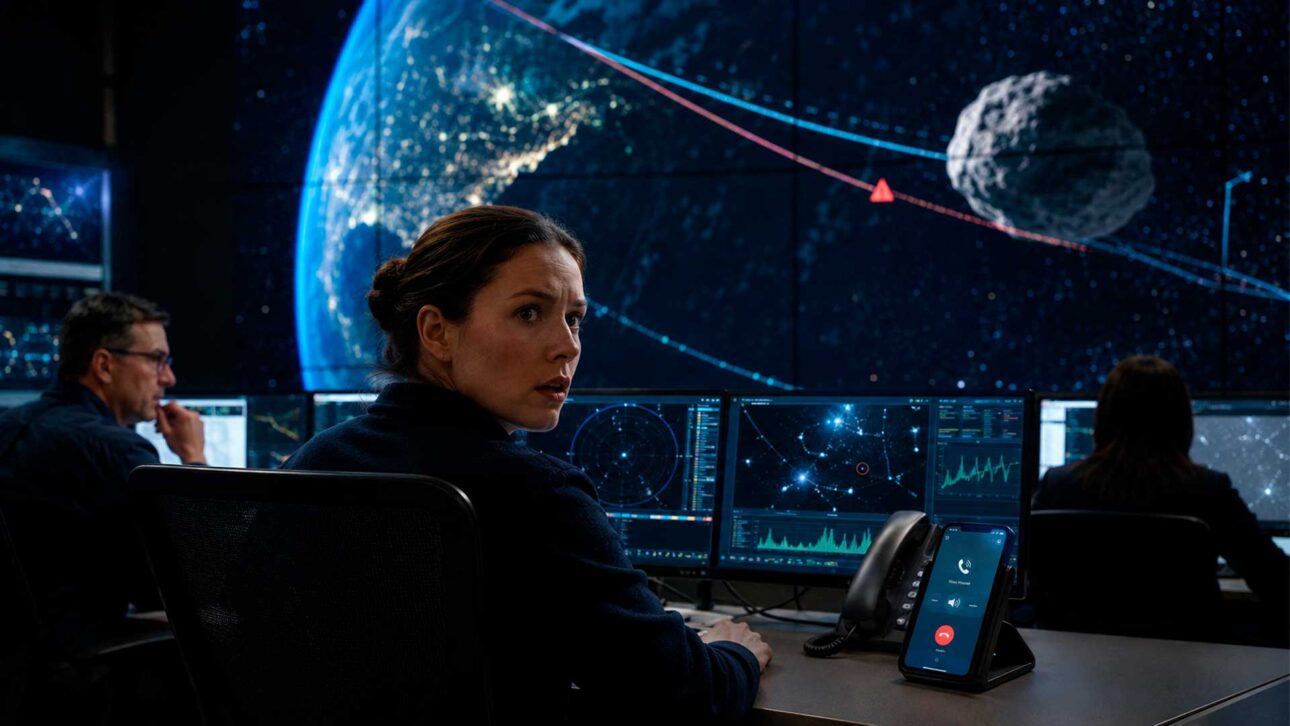
According to Infobip, a global cloud communications company involved in the partnership, the solution allows ESA members to receive instant voice calls, operating 24 hours a day. The company reported on February 24, 2026, that system tests recorded alerts sent within up to five minutes after detecting high-probability events.
This time gain is important because confirming a possible impact depends on new observations. When an object is newly discovered, its orbit may still have uncertainties, and each additional observation helps reduce doubts about size, trajectory, and eventual entry region into the atmosphere.
In practice, the voice call functions as a direct alarm for specialists. Instead of waiting for someone to check an inbox, the system tries to reach the responsible person immediately, regardless of time or location.
How the alert for near-Earth asteroids works
The asteroids monitored in this type of system are part of the group of near-Earth objects, known by the acronym NEO. They are asteroids or comets whose orbits bring them close to our planet’s orbital neighborhood.
The ESA’s Near-Earth Object Coordination Center reports that dozens of near-Earth asteroids pass every month up to 0.05 astronomical units from Earth. This distance is equivalent to about 7.5 million kilometers, which is very far in human terms, but relevant for astronomical calculations and space surveillance.
The monitoring is not limited to saying if an object “will pass close.” The technical tables gather date, distance, speed, estimated maximum brightness, and indices that help assess the frequency of similar approaches. This data guides astronomers on which objects deserve additional monitoring.
In many cases, the size of the asteroid is not measured directly. It is estimated from the observed brightness and models of its reflectivity, which explains why small uncertainties can change the initial risk assessment.
Why smaller objects also concern planetary defense
Large asteroids capable of causing global effects are rare, but small and medium-sized objects appear more frequently in the Solar System. They do not usually pose an extinction risk, but they can cause local or regional damage, especially if they explode in the atmosphere.
The case of Chelyabinsk, Russia, on February 15, 2013, became a reference for this type of threat. The United Nations Office for Disaster Risk Reduction records that the meteor exploded in the sky, generated a shock wave, injured about 1,500 people, and damaged approximately 7,200 buildings in the region.
The episode showed that not all risks come from a direct impact on the ground. An airburst can break windows, affect structures, and cause injuries in urban areas, even when the object disintegrates before reaching the surface.
For this reason, minutes or hours of warning can have scientific and operational value. Even when there is no time to divert an object, the alert can help point telescopes, record atmospheric entry, and improve models used in future risk assessments.
This is also why internal communication needs to be quick. An email ignored for a few hours could mean missing the chance to observe an asteroid before it enters the atmosphere or passes too close for new measurements.
Monitoring unites ESA, NASA, and international networks
Planetary defense is an international area because no country controls the sky alone. Observatories in different regions of the world, orbital calculation centers, and space agencies exchange data to refine predictions and reduce uncertainties.
NASA explains that its NEO observation program funds efforts to discover still unknown objects, calculate and refine orbits, determine physical properties, and study mitigation technologies. This work complements European initiatives and international alert networks.
Besides monitoring, planetary defense also involves deflection tests. In 2022, NASA’s DART mission hit the asteroid Dimorphos to demonstrate the kinetic impactor technique, which consists of slightly altering the trajectory of a space body through controlled collision.
This type of technology depends on an essential condition: lead time. The earlier a dangerous object is discovered, the greater the chance to study its orbit, evaluate alternatives, and, if necessary, plan a coordinated response.
Technology does not deflect asteroids alone but improves the reaction
The adoption of automated calls by ESA should not be understood as a magic solution against asteroids. It does not change the orbit of any celestial body, does not replace telescopes, and does not eliminate the limitations of detecting small objects.
The advancement is in the communication layer, which is decisive in scientific emergencies. If a system identifies a probability of impact, the information needs to quickly reach the right specialists so that new observations can be made while there is still time.
This difference may seem small, but it is relevant for newly discovered objects. In some cases, the observation window is short, and delays can prevent astronomers from confirming whether the risk has increased, decreased, or disappeared after new calculations.
Technology also helps organize data collection when the impact is inevitable but low-risk. Small asteroids entering the atmosphere can provide information about composition, resistance, fragmentation, and behavior of natural objects at high speed.
What changes for the population and why this should not cause panic
For the general population, the change does not indicate an immediate threat. What it shows is that space agencies are improving systems to better deal with rare but possible events involving near-Earth asteroids.
The work of planetary defense is usually quiet because most approaches pose no danger. Even so, each close passage helps scientists test models, calibrate instruments, and improve forecasting ability.
It is also important to separate technical alert from public alarm. An internal system can be triggered to investigate an object without it meaning a real risk to cities or countries. Many initial possibilities are dismissed after new observations reduce orbital uncertainties.
The novelty of the ESA comes precisely at this point: shortening the path between detection and qualified human analysis. In planetary defense, the response begins long before any space mission, with data, communication, and coordination.