






 Portuguese
  Spanish


Electric trucks appear in Beichuan, China, with 216 plugs, 1.44 MW chargers, and a daily peak of 300,000 kWh. The charging yard has 100 MW planned, 51 MW installed, solar support, batteries, and operation focused on heavy regional logistics 150 km from Chengdu for road transport.
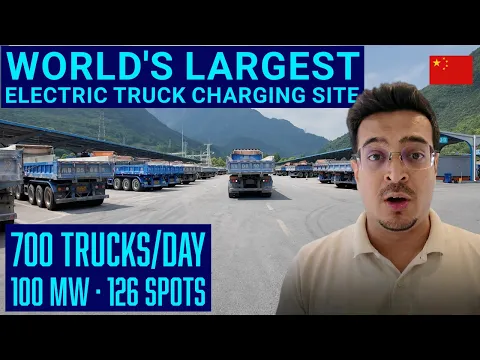
The electric trucks already occupy a giant charging yard in Beichuan, a region located about 150 km north of Chengdu, China. The site was visited and presented in a video by Haseeb, an electromobility consultant, during a visit organized by Huawei, according to the report.
According to a video published by the eTechvolution channel, the footage was taken on May 5, during the Labor Day holiday period in China, when some vehicles were parked or already charged to return to operation. The structure appears as a charging center focused on regional logistics, with hundreds of trucks, 216 plugs, 1.44 MW chargers, and a daily peak of 300,000 kWh.
A charging yard that looks more like an industry than a parking lot
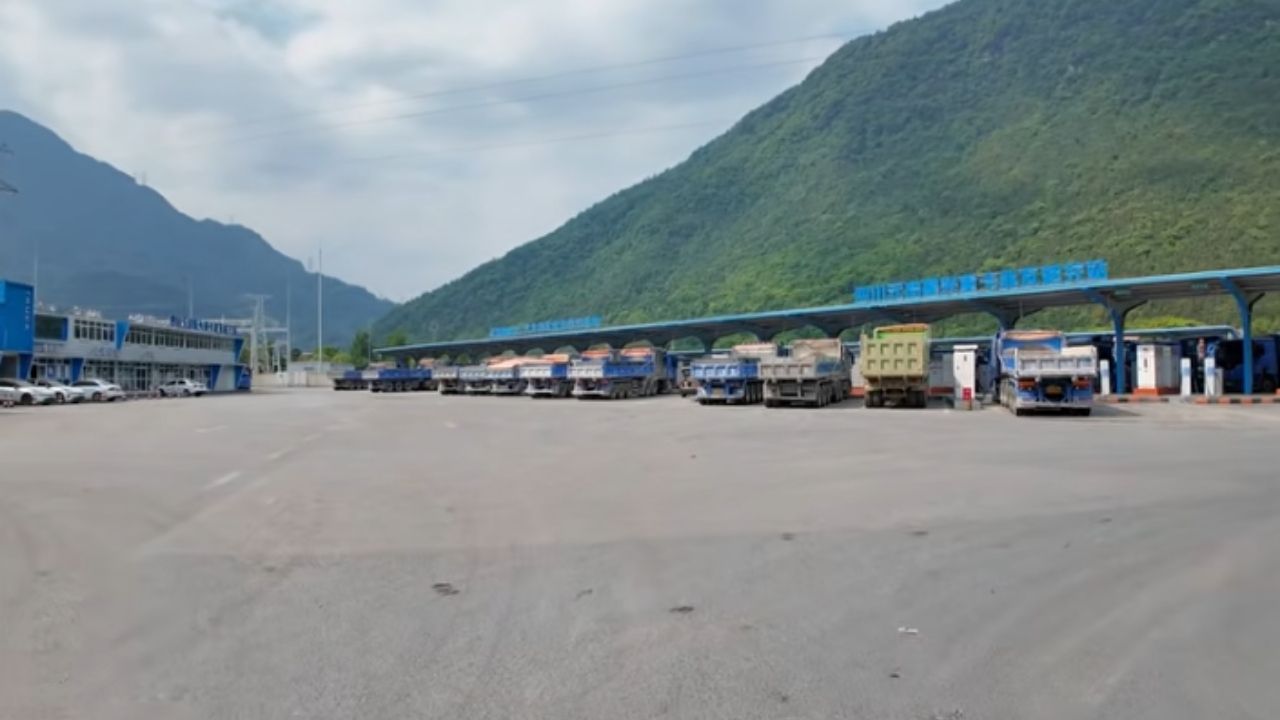
What stands out in the video is not just the presence of the electric trucks, but the scale of the space. The site was described as the largest charging yard for electric trucks ever seen by the presenter, with a planned capacity of 100 MW.
-
Ancient Ritual Circle, Hidden for 5,000 Years, Discovered in Scotland’s Machrie Moor Using Sensors, Revealing a “Phantom Stonehenge”

-
Engineers Develop Fridge-Sized Machine to Produce 95-Octane Synthetic Fuel from Air and Water, Aiming to Sustain Combustion Engines Without Oil
-
Two-Armed Robot Uses AI to Reassemble Destroyed Pompeii Frescoes, Solving an “Impossible” Puzzle
-
New Law in Brazil Requires Breaks for Type 1 Diabetes Management at Work, School, and Public Exams


In the first stage, according to the report, 51 MW are already installed. This number comes from 72 Huawei power units of 720 kW each. It is an infrastructure designed for heavy flow, not for occasional charging of light vehicles.
The scale becomes clearer when the presenter walks through the space and shows rows of trucks, power modules, dispensers, chargers, transformers, batteries, and areas still planned for expansion. The yard functions as a logistical hub, where energy and heavy transport meet.
Beichuan is about 150 km from Chengdu
The yard shown is in Beichuan, a region described as a city or county about 150 km north of Chengdu. The location appears as a strategic part of the operation, as the area serves trucks used on regional routes.
According to the source, the site is at an altitude of about 650 meters and has high-power electrical infrastructure nearby. The video also shows a large power grid in the background, reinforcing that the yard was installed where there was capacity to sustain heavy demand.
The choice of location does not seem random. For electric trucks to operate continuously, the charging point needs to be near the route, close to the power grid, and within a predictable round-trip logic.
216 plugs were verified on site
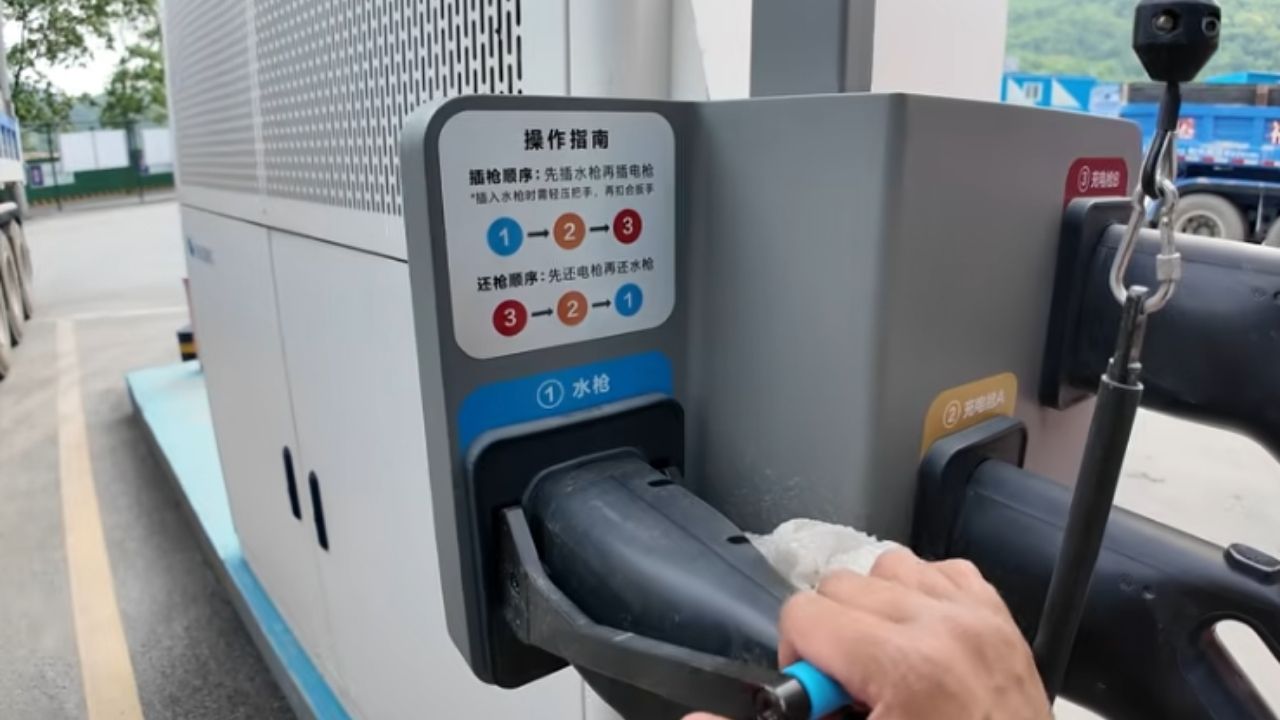
One of the strongest numbers in the video is the number of plugs. The presenter claims to have counted 108 charging points with dual dispensers, resulting in 216 plugs available in the yard.
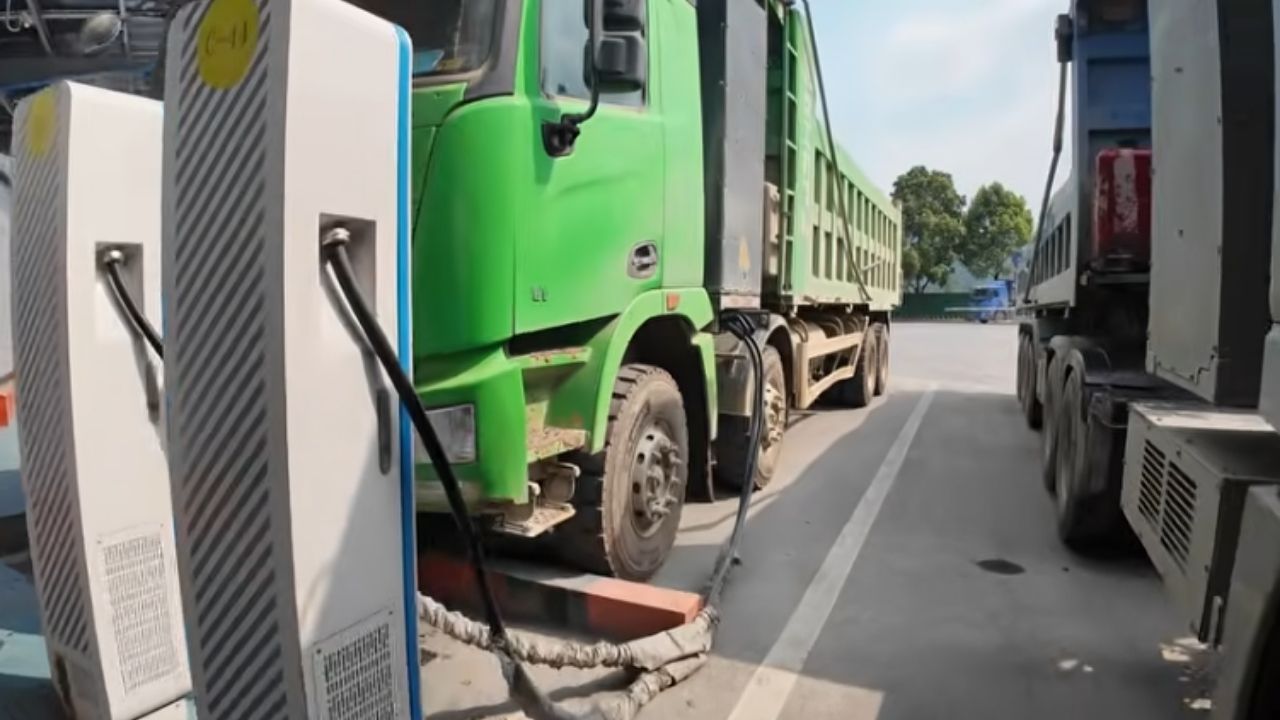
This count was made during a tour of the site, according to the report itself. He explains that he did not consider each cable as a separate point, but each charging spot with two connectors. In practice, each truck can use two cables at the same time to speed up recharging.
This logic is common in the system shown. Instead of relying on a single connector, some trucks receive energy through two simultaneous plugs. This allows for higher power and reduces downtime, something essential in logistics operations.
1.44 MW chargers became the highlight of the visit
The technical highlight of the visit was a 1.44 MW charging system, presented as something rare even for those who follow heavy charging infrastructure. The equipment shown has three connections: two for charging and a third for liquid cooling.
Cooling is necessary because power of this magnitude generates intense heat in cables and connectors. The higher the power, the greater the thermal and electrical demand on the system. Therefore, the 1.44 MW charger appears connected to a support and cooling unit.
In addition to megawatt chargers, the yard also uses dispensers of up to 600 kW. According to the video, each point can have two cables, and trucks can receive high charges during short stops, depending on the model and battery condition.
300 thousand kWh delivered in a single day
Another impressive number is the daily peak of energy delivered. According to the source, the maximum recorded in a single day was 300 thousand kWh. The presenter emphasizes the data more than once, precisely because of the size of the operation.
This volume shows that the recharging of electric trucks in the yard is not just a technological demonstration. It is a real operation, with daily demand, queues, defined routes, and vehicles returning to work after charging.
The video also mentions an average traffic of about 700 trucks per day. The presenter notes that, on a peak day, the volume of energy could correspond to hundreds or even a thousand trucks recharging different amounts of battery, although he does not provide a precise calculation for this point.
Trucks operate in medium-range logistics
The presented operation does not seem to be for long national trips, where the truck crosses several provinces for consecutive days. The described use is closer to what is called medium-range logistics, with routes between 200 and 300 km.
In this logic, the trucks leave, complete a regional route, and return to the same yard to recharge. This model favors electrification because it reduces road uncertainty. The operator knows where the vehicle starts, where it ends, and where it will recharge.
Therefore, electric trucks appear as a more viable solution on predictable routes. The challenge is not just having a large battery, but organizing a recharging network that combines power, location, and operational flow.
Truck batteries vary according to the type of vehicle
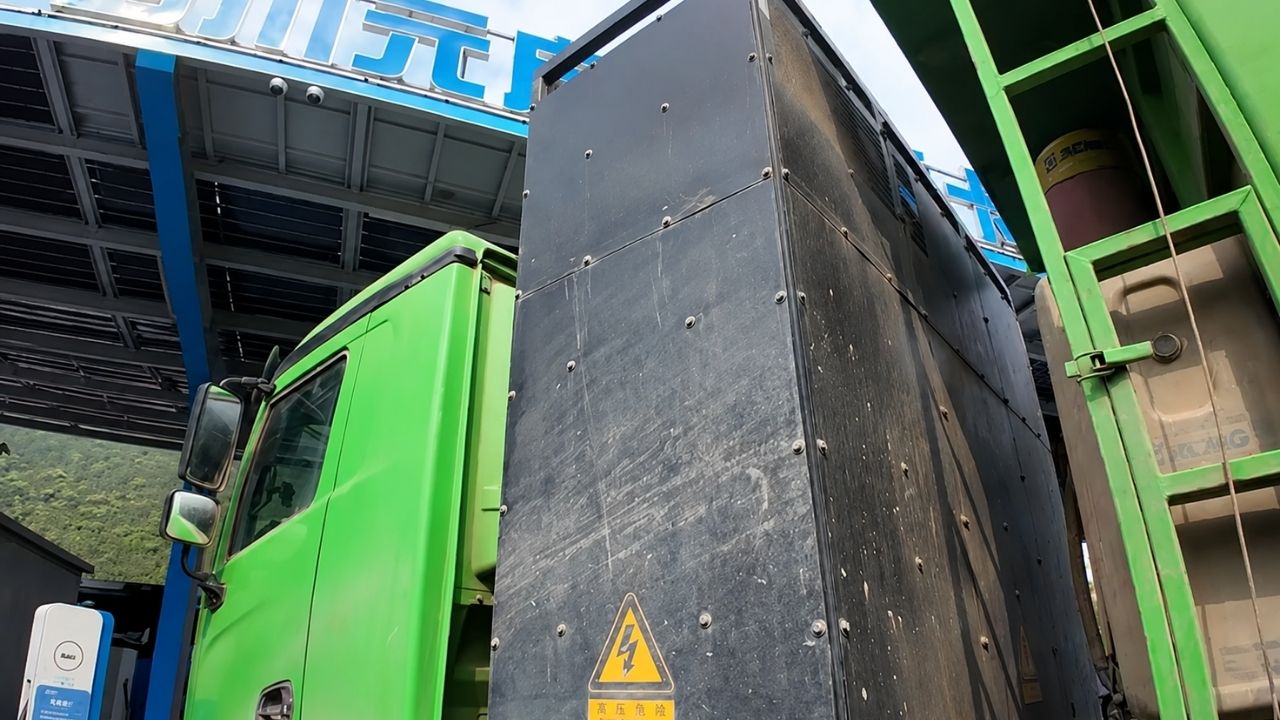
The video shows blue and green trucks with different configurations. In the blue trucks, batteries of 401 kWh and 601 kWh were mentioned, apparently in vehicles without removable batteries.
The green trucks, on the other hand, would have batteries of about 281 kWh, with signs that they could be removable or swappable. The presenter notes hooks and structures that would indicate the possibility of swapping, but treats the information with caution.
The diversity of batteries shows that there is no single standard for electric trucks in the area. There are rigid vehicles, semi-trailers, fixed batteries, possible swappable batteries, and different capacities according to the logistical application.
Solar and batteries help, but the electrical grid sustains the scale
The yard also features solar energy. According to the video, there is an installed solar capacity of 1 MW, distributed over more than one coverage. The presenter mentions the possibility of producing about 5,000 kWh on a good day, but does not confirm if this value is average or occasional.
In addition to solar energy, the site has battery storage systems. The transcript mentions support battery units and then shows a Huawei module with a nominal capacity of 250 kWh and a nominal power of 108 kW.
Even so, the scale of the yard depends mainly on the connection to the high-power electrical grid. Solar energy and batteries help the system, but an operation with 51 MW installed requires robust electrical infrastructure around it.
Huawei appears as the central supplier of the infrastructure
The visit was organized by Huawei, and the brand appears in various components of the yard. According to the video, the 720 kW power units are from Huawei, as well as the inverters and part of the battery systems.
The presenter also highlights the 1.44 MW charger from Huawei, which uses liquid cooling. This point reinforces the entry of technology companies into heavy charging infrastructure, a segment that mixes energy, transportation, and software.
In the case of electric trucks, the charger becomes as strategic as the vehicle itself. Without available power, the truck stands still. Without thermal control, the power does not sustain. Without a network, the scale does not close.
The second stage should bring the yard close to 100 MW
The first stage of the site already totals 51 MW installed, according to the report. The second stage is expected to expand the structure with more megawatt systems, but the presenter states that he could not confirm the timeline accurately.
What was informed by the site operators is that the next phase should not install new 600 kW dispensers. The expansion would be based on 33 systems of 1.44 MW, bringing the total capacity close to 100 MW.
If this expansion is completed, the yard will no longer be just large and will start operating on an even larger industrial scale. Heavy recharging, in this case, ceases to be a promise for the future and becomes infrastructure planned in stages.
Hundreds of trucks show that the transition has already moved beyond discourse

During the tour, the presenter visually estimates that there were more than 250 trucks on site, many of them outside the charging points. This occurred on a holiday, which helps explain why several vehicles were parked.
Even so, the image is striking. Hundreds of electric trucks in a single yard change the perception of heavy electrification. It is not an isolated prototype, but an operation with flow, drivers, infrastructure, and routine.
The video also mentions a conversation with a driver, according to which between 50% and 60% of the logistics trucks in the Beichuan region are already electrified. The presenter himself treats this data as anecdotal, based on local conversation, and not as official statistics.
The contrast with Brazil appears in the infrastructure

The topic draws attention to Brazil because the charging infrastructure for heavy vehicles is still discussed as a challenge. Meanwhile, the yard shown in Beichuan features high-power chargers, parking corridors, solar energy, batteries, and expansion plans.
The comparison should not be made as if the two countries had the same fleet, logistics matrix, or energy planning. But the visual contrast is inevitable: in one place, heavy recharging appears as a debate; in the other, as an operational routine.
For electric trucks to gain scale in any country, it’s not enough to sell the vehicle. It is necessary to ensure energy, charging points, predictable routes, maintenance, temperature control, trained operators, and an economic model that works for carriers.
Heavy charging no longer seems like a distant experience
The yard at Beichuan shows how the electrification of electric trucks can advance when infrastructure and logistics are planned together. The site has 216 plugs, 1.44 MW chargers, 51 MW already installed, and a daily peak of 300,000 kWh delivered.
The scene is impressive because it shows scale. There are lined-up trucks, dual connectors, megawatt systems, backup batteries, solar energy, and a second phase planned to bring the yard closer to 100 MW. Charging no longer seems like a test and has started to feel like routine.
Do you think Brazil could set up a similar structure for electric trucks in the coming years? Would the biggest challenge be energy, cost, roads, technology, or political will? Share your opinion.






