






 Portuguese
  Spanish


In 1989, a resident of Blaubeuren, Germany, found a strange rock while digging in the garden and set it aside for three decades. Only in 2020 did he discover it was a 30.26 kg meteorite, the largest stony meteorite ever recorded in the country, 4.5 billion years old.
Sometimes, the greatest treasure is right under our feet and we don’t even notice. This is what happened to a resident of the small town of Blaubeuren, in southern Germany, who spent 31 years ignoring a meteorite in his own backyard. According to the German Aerospace Center (DLR) and the University of Münster, the rock turned out to be the largest stony meteorite ever found in the country.
The discovery began in a mundane way in 1989, when the man was digging a trench to lay cables and his shovel hit an unusually heavy stone. He set it aside for decades, until in 2020, he decided to investigate and was told by scientists that he had a piece of the early Solar System, 4.5 billion years old, at home.
A “heavy and magnetic stone” in the garden trench
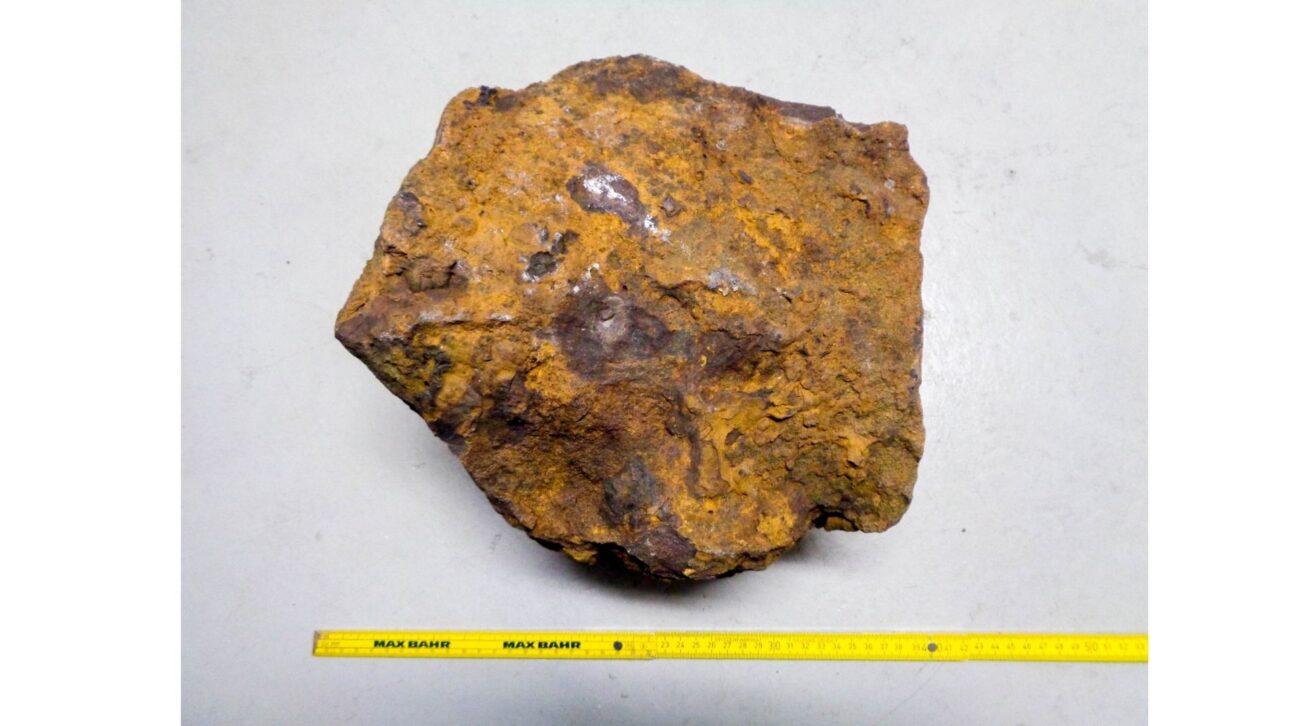
Image: 1/8, Credit: Gabriele Heinlein
It all started with a simple construction. In 1989, the resident was digging a trench for cables on his property in the Swabian region when the shovel hit a rock measuring 28 by 25 by 20 centimeters.
-
A man was renovating the basement of his house on the outskirts of Paris when he unearthed a human skeleton in the dirt floor and called archaeologists, who found 38 medieval bodies underneath, 10 of them in plaster sarcophagi, buried between the 3rd and 10th centuries in an area of 52 m².

-
British couple lifts the floorboards of the hallway in the “dream house” just looking for a pipe and finds an entire hidden floor beneath the flooring, removes more than 70 tons of earth, and gains almost 40 m² and two new rooms that should greatly increase the property’s value.
-
Designed to navigate without a fixed crew, the new Zeelander 8 Solea combines 24 meters of luxury, 4,000 hp of power, a speed of 40 knots, and a range of up to 2,700 nautical miles in a yacht created to transform the owner’s experience at sea.
-
Scientists will live at the bottom of the sea in an “underwater house” at a depth of 17 meters, where up to 4 divers will be able to investigate the ocean for longer and study fragile samples before decompression destroys their secrets.


When he lifted it half a meter to the surface, he noticed it was surprisingly heavy, the first sign that it was not just any stone, but one of those meteorites that cross space to fall on Earth.
Curious, he brought a magnet close to the angular block and confirmed there was iron inside. Still, without imagining what he had in his hands, he left the rock in a corner of the garden, where it would be forgotten for a long time.
It’s even understandable that no one suspected. Meteorites usually have a characteristic dark crust, formed by heating during their high-speed descent through the atmosphere. The Blaubeuren boulder, however, was so worn that not even a specialist would imagine its cosmic origin just by looking at it.
31 years ignored and almost thrown away
What impresses is the patience of chance. The rock remained in the garden until 2015, deteriorating over time, treated as a mere nuisance that hindered the construction.
The meteorite came close to ending up in the trash. “The block was on the trailer, ready to be taken away”, the discoverer recounted.
Luckily, he reconsidered the idea at the last minute and moved the stone to the basement, where he kept it dry inside a cabinet, a decision that saved the find.
The hunch that changed everything: a phone call to the DLR
It was only many years later that the penny dropped. In January 2020, the resident decided to finally discover the composition and history of the strange rock and contacted the DLR’s Institute of Planetary Research.
At the institution, director Heike Rauer and researcher Jürgen Oberst put him in touch with Dieter Heinlein, a meteorite specialist at the DLR in Augsburg. After phone conversations and sending images, the discoverer sent the scientist a small fragment of 23.4 grams for analysis.
The diamond saw and the 4.5 billion-year-old chondrules
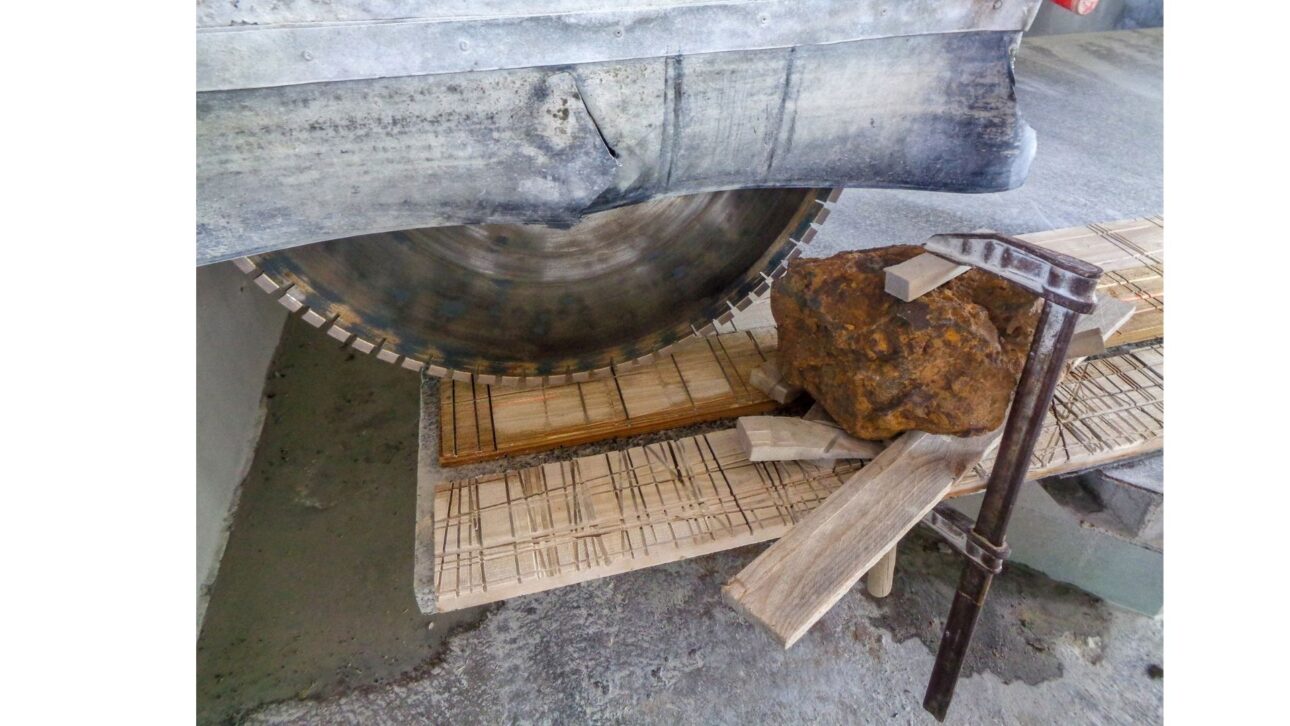
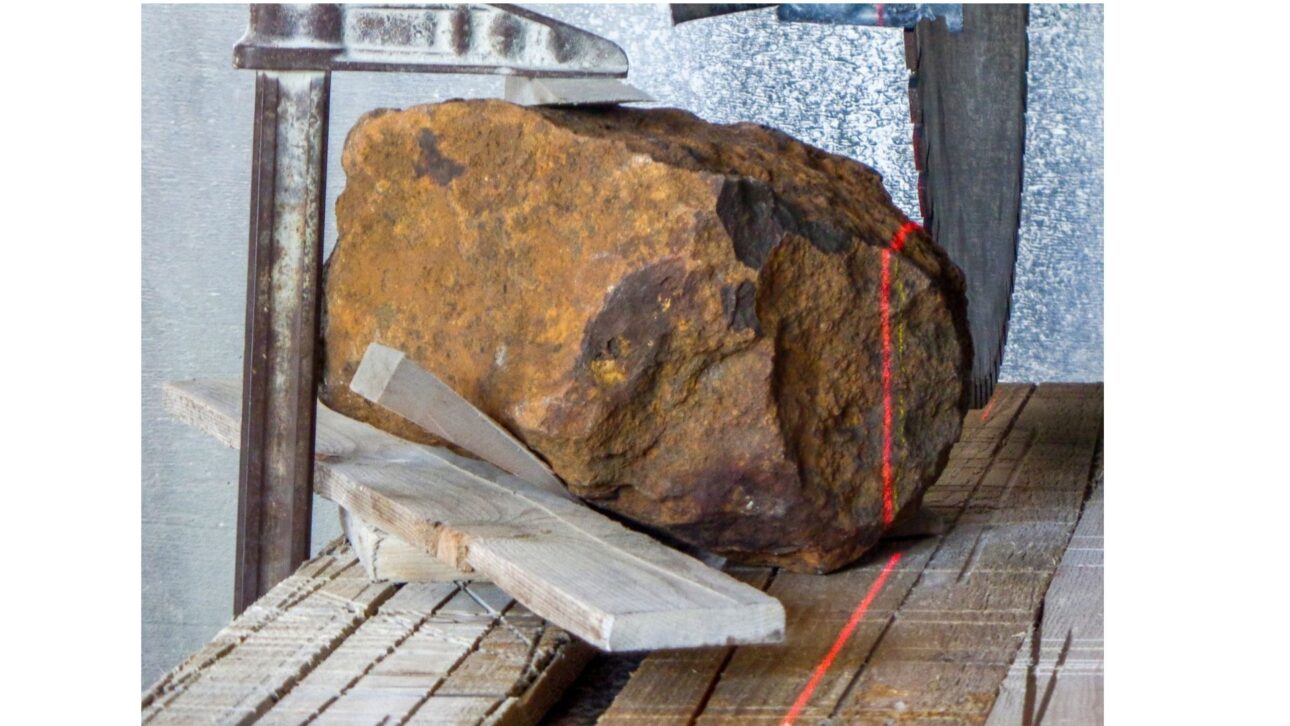
It only took one look for the specialist to suspect. Heinlein soon recognized the presence of iron ore, but it was when cutting the piece with a diamond saw that he had confirmation: before him was a matrix of millimetric chondrules, small spheres typical of rocky meteorites.
And these spheres tell a very ancient story. They formed during the birth of the Solar System, 4.5 billion years ago, and are the original building blocks of all planets.
Seeing also the characteristic metallic inclusions, Heinlein had no doubts: “I was almost immediately certain that it was a meteorite fragment”, he stated.
The largest rocky meteorite in Germany: 30.26 kg
The following analyses turned curiosity into a record. With a mass of 30.26 kilos, the find was confirmed as the largest rocky meteorite ever found in Germany, easily surpassing the former record holder, the “Benthullen” meteorite, weighing 17.25 kilos, discovered near Oldenburg.
From a technical point of view, it is a “standard H4-5 chondrite”, according to Heinlein. Its density was measured at 3.34 grams per cubic centimeter, a high value, explained precisely by the significant iron and nickel content of the rock.
Named “Blaubeuren” and officially recognized
Every meteorite needs a name and an official seal. This one was named “Blaubeuren”, in honor of the small medieval town where it was found, 17 kilometers west of Ulm, in the south of the country.
The recognition followed the rite of science. The finding was submitted to the Nomenclature Committee of the Meteoritical Society on June 16, 2020, and about three weeks later, on July 7, 2020, the entity confirmed in its bulletin that the rock was officially a meteorite.
What science discovered: a cosmic collision
To uncover the origin of the stone, the material went through three different laboratories. At the Natural History Museum of Bern, isotope measurements revealed that the rock suffered erosion after falling in the Swabian Jura mountain range, proving that “Blaubeuren” is indeed Swabian.
Radioisotope measurements indicated that the meteorite may have fallen to Earth several centuries ago, although studies are still ongoing.
The most revealing analysis came from the University of Münster. According to researcher Addi Bischoff, “Blaubeuren” is a breccia, a rock formed by the joining of several fragments that underwent at least one violent collision in the past, something common in this type of chondrite.
Beneath the surface, olivine predominates, an iron and magnesium silicate that accounts for almost three-quarters of its mineral composition.
Why meteorites like this are treasures of science
Far beyond curiosity, such finds are extremely valuable. Meteorites are key pieces to study the early development of the Solar System and they arrive on Earth, as scientists joke, for free. Most come from the asteroid belt between Mars and Jupiter until a change in orbit puts them on a collision course with our planet.
Not everything, however, survives the journey: as they enter the atmosphere at very high speed, often only a small fragment reaches the ground.
For now, “Blaubeuren” remains with its finder, but the owner’s wish is noble: to see the largest rocky meteorite in Germany displayed in a museum, so that everyone can admire the “Swabian that fell from the sky”.
And you, have you ever passed over a treasure without knowing?
From an obstacle in a ditch to a national record holder, the Blaubeuren meteorite proves that great discoveries sometimes wait decades abandoned in a corner of the backyard.
And you, have you ever passed over a treasure without knowing? What would you do if you found a suspicious rock in your garden? Tell us in the comments and tag that friend passionate about space and astronomy.


