Portuguese
  Spanish


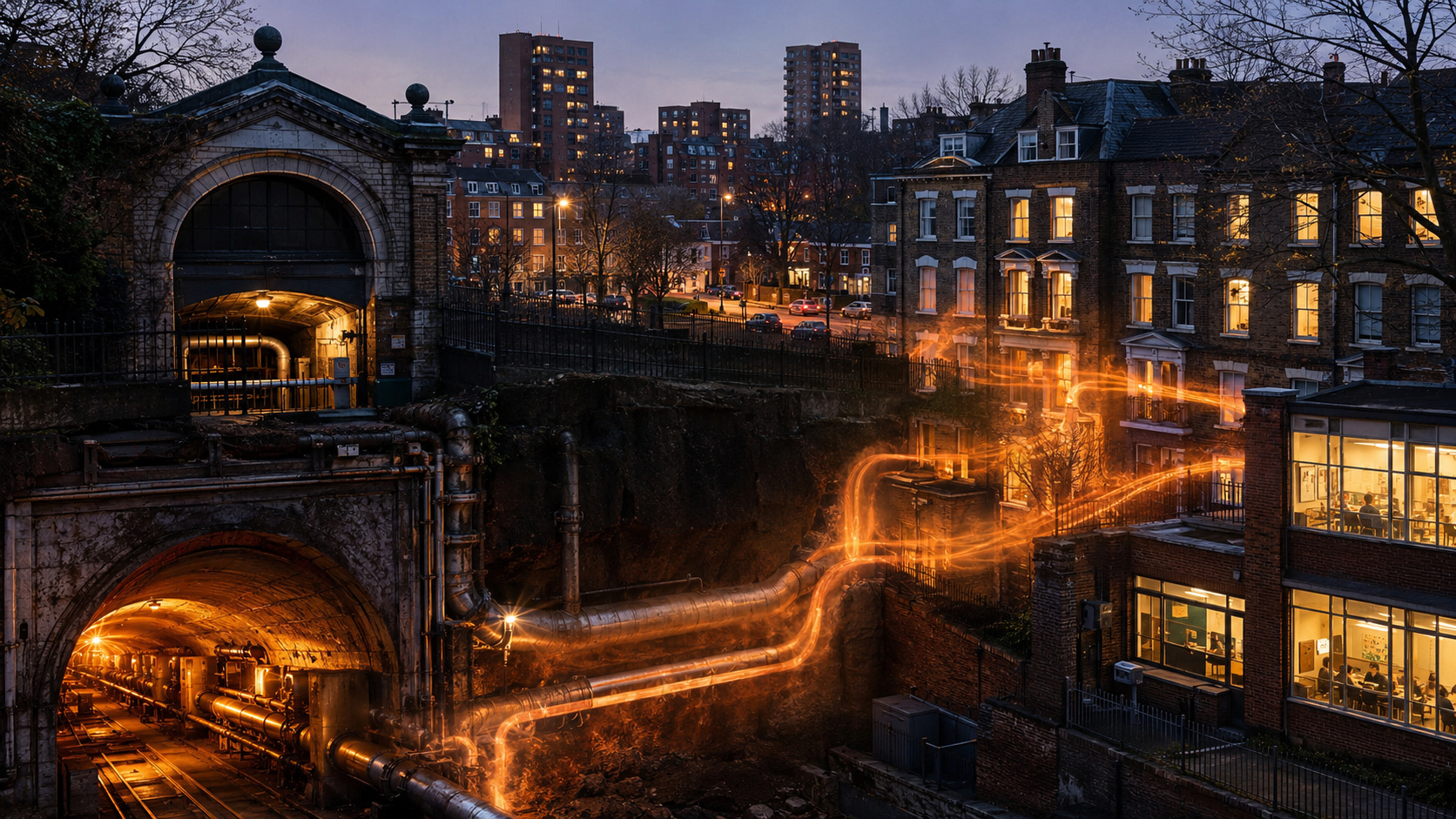

In Islington, the wasted heat from the London Underground is no longer just discomfort in the tunnels and now powers a district heating network that uses the old City Road station to bring thermal energy to homes, schools, and community buildings, showing how an old city can repurpose what was once lost underground
The suffocating heat of the London Underground has become a heating source in Islington. The old City Road station, closed since 1922, now functions as a hidden energy center within the Bunhill Heat and Power project.
The information was released by Islington Council, the local council for the London borough. The project reuses hot air from the Northern Line tunnels to heat homes, schools, and community buildings through a district heating network.
In practice, the heat that was once seen as a problem now has a useful function. The initiative connects old infrastructure, emissions reduction, and the fight against energy poverty in an urban solution difficult to imagine at first glance.
-
At 17, she hand-painted her first watercolor design for school uniforms; her brand grew without investors, sold 135,000 pieces, and aims for $3 million in revenue by 2026.

-
Shell Discovers Intact Early 19th-Century Wooden Shipwreck in the Gulf of Mexico at Over 1,300 Meters Deep
-
Brazilian Entrepreneur Turns Door-to-Door Jewelry Sales into a Family Business Empire with Over 70 Stores

-
$75 Million Bridge in Brazil Opens to Connect Cities, Create Jobs, and Cut Travel Time from 30 to 2 Minutes; Spanning 1.24 km, It’s Among the Country’s Largest and Ends Decades of Ferry Queues.




Ghost station closed since 1922 became an invisible boiler in London’s underground
The old City Road station is no longer just a ghost station of the London Underground. Closed since 1922, it now houses part of the Bunhill 2 expansion, connected to Islington’s district heating system.
The space functions as an underground energy center. It harnesses the heat accumulated in the tunnels of the Northern Line, one of London’s Underground lines.
This heat is captured and sent to heat pumps. These pieces of equipment increase the temperature of the water circulating through the heating network and reaching buildings connected to the system.
The heat that bothered passengers now heats homes, schools, and community buildings
The case draws attention because the London Underground is usually associated with intense heat in the tunnels. What was merely discomfort for passengers has become a usable energy source.


The logic is simple. The Underground generates heat underground, this heat is extracted from the tunnels and then helps to heat water for use in buildings.
The Bunhill Heat and Power project shows that useful energy can be hidden in common places in the city. The station, closed for decades, has become part of a practical solution for district heating.
Heat pumps transform hot air from tunnels into heated water for the urban network
Heat pumps are the heart of the system. They don’t create heat from nothing. They harness the existing heat in the air coming from the tunnels and increase its capacity to heat water.
This heated water enters the district heating network. Afterwards, it reaches homes, schools, and community buildings served by the project in Islington.
The idea can be understood like this: the surplus heat from the Underground is captured, boosted by equipment, and used to heat environments. Waste becomes a public service.
Islington Council presented the project as a pioneer in the use of residual heat from the Underground
Islington Council, the local council for the London borough, presented the project as the first of its kind in the world to use residual heat from an underground train network to heat buildings.
Residual heat is the heat left over from an activity. In the case of the Underground, it accumulates in the tunnels and would normally be lost to the underground environment.
The importance of the project lies in this repurposing. Instead of treating the heat as a useless problem, Islington began to use it as part of an urban energy network.
Urban repurposing helps combat energy poverty and reduce emissions
The project also has a social impact. The network was linked to combating energy poverty, a situation where residents struggle to keep their homes adequately heated.
In cold regions, heating is not a luxury. It is part of the well-being of families, schools, and community spaces.
The initiative was also linked to emission reduction. This makes the case relevant for cities seeking climate solutions without relying solely on new surface constructions.
London shows that old cities can find energy in unlikely places
The example of Islington shows that an old city can still reveal new ways to use its own infrastructure. Tunnels, closed stations, and old systems can gain modern functions.

City Road station, closed since 1922, has returned to the center of history as a hidden piece of urban heating. The subway continues to transport people, but its heat has also started to help buildings.
This type of solution draws attention because it doesn’t depend on a futuristic landscape. It arises from a simple question: what does the city already waste every day that it could use better?
The wasted heat from the London Underground is no longer just an inconvenience for passengers and has become part of a network that heats homes, schools, and community buildings in Islington.
The old ghost station shows how forgotten infrastructure can gain a new function. Do you think other cities should map their energy waste before building new power plants? Leave a comment.