






 Portuguese
  Spanish
  3 min of reading
  0 comments


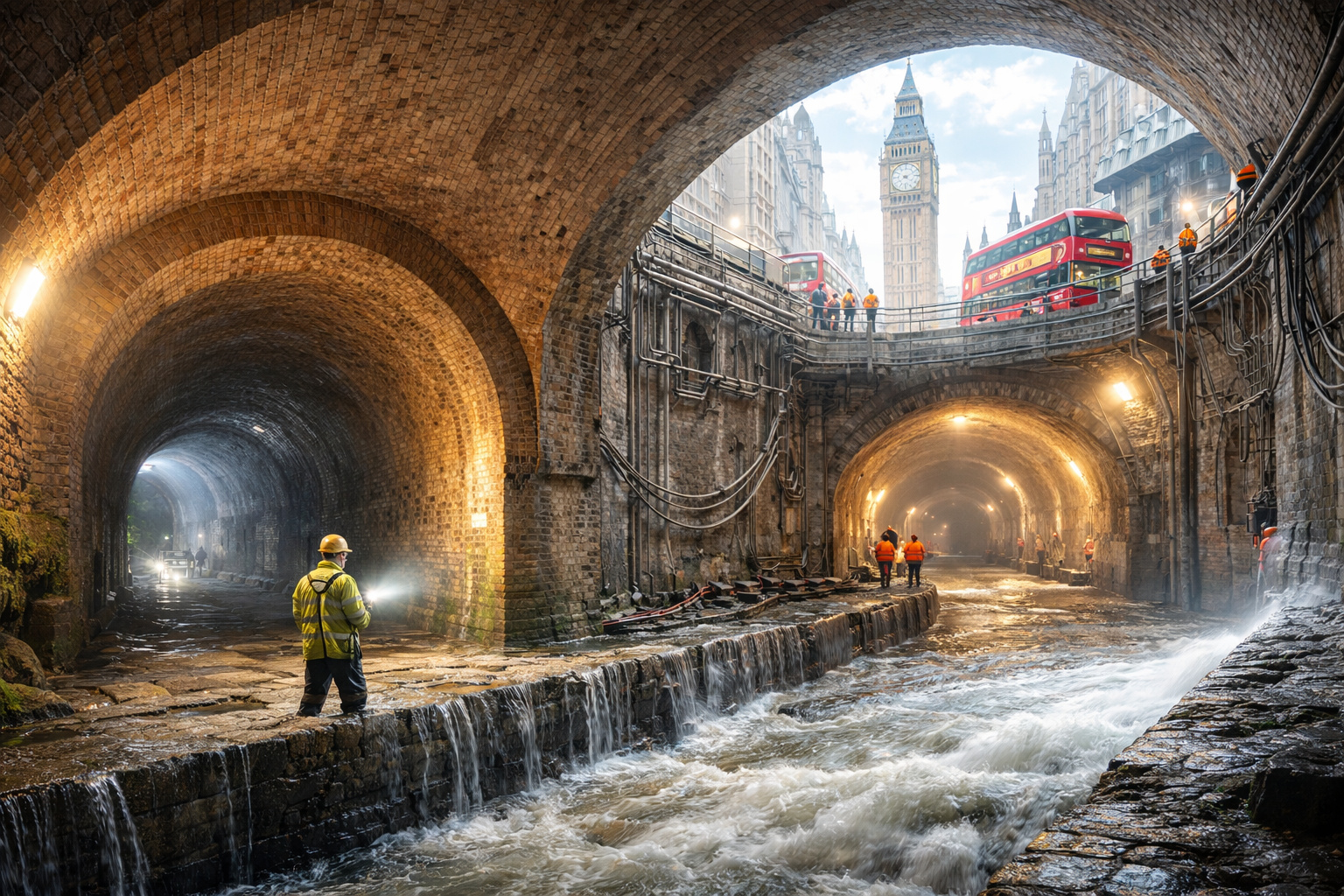
Ancient Watercourses Buried by Urban Construction Expansion Continue Flowing Beneath One of the Most Expensive Cities in the World and Still Influence Engineering, Drainage, and Heavy Infrastructure Decisions
Underneath the asphalt of London, the water never stopped. While skyscrapers, subway tunnels, and busy avenues dominate the landscape, ancient underground rivers continue to flow silently, hidden beneath concrete and pipes.
This is not an urban legend. These are natural watercourses that were buried as the city grew, but they remain active and integrated into the drainage and sewer system.
And this changes everything when it comes to heavy engineering.
-
Without a mansion, without high investment, and without a traditional classroom, a teacher living in a 22 m² house taught students to build a 9 m² studio apartment with the equivalent of R$10,000.

-
Largest bridge in São Paulo reaches 75% completion and is expected to strengthen strategic connection in the interior of São Paulo.

-
Without her own home and pressured by rent, a 25-year-old bought a small 15-meter boat, gradually renovated the interior by herself, transformed the interior with paint, new flooring, a larger bathroom, and started living on the canals, paying much less per month.
-
Tired of seeing families sleeping on the street, São Paulo delivered 18 m² furnished microhouses and took 888 people off the streets: Vila Reencontro became the model social housing for the homeless population.



The Billion-Dollar Metropolis Built Over Rivers That Disappeared from the Map, But Not from the Subsoil
London has expanded over centuries upon a natural water network formed by various tributaries of the River Thames.
Among the best known are Fleet, Tyburn, Walbrook, Westbourne, Effra, and Neckinger. Many of them have been channeled, covered, or incorporated into the underground infrastructure.
What is impressive is that these rivers were not eliminated. They were redirected.
Today, they continue to flow beneath famous streets like Fleet Street. The current urban layout still reflects the original path of these waters.
For a city with millions of inhabitants and constant construction, this represents a permanent technical challenge.
The Invisible Construction Challenge Engineers Face Whenever London Digs into the Subsoil
Building subway tunnels, deep foundations, or modern drainage systems in London requires meticulous mapping of what lies below the ground.
The ancient rivers influence foundation depth, risk of infiltration, ground stability, and urban drainage capacity.
According to experts, ignoring these watercourses can lead to structural problems and overloading of the sewer systems.
There is no official number released regarding the total volume of water that still circulates in these channels, but estimates suggest that a significant portion of the city’s stormwater drainage passes through these historical routes.
In other words, modern engineering directly depends on decisions made centuries ago.
The Technical Secret Behind the Transformation of Underground Rivers into Sanitation Infrastructure
During the 18th and 19th centuries, London faced severe sanitary crises.
The solution found was to incorporate many of these underground rivers into the city’s sewer system. Instead of eliminating natural watercourses, the engineering of the time transformed them into underground conduits.
This adaptation was crucial in containing diseases and allowing urban expansion.
What stands out is that this makeshift solution became a permanent part of the infrastructure.
Even today, these channels act as structural components of the urban water system.
It is a forced integration between nature and engineering that few cities in the world have had to face on this scale.
The Direct Impact on Modern Projects and the Domino Effect for Urban Future
London continues to invest heavily in underground infrastructure, including subway expansions and drainage improvements.
Each new project must consider this historic water network.
In a city where the square meter is among the most expensive in the world, any miscalculation can represent millions in losses.
Additionally, climate change is increasing the volume of heavy rains, further pressuring the systems that depend on these hidden rivers.
The ancient natural geography continues to influence billion-dollar decisions.
The city of the future is being built on a past that has never gone away.
London has not eliminated its rivers. It has only hidden them. And this choice continues to shape urban engineering to this day, transforming the subsoil into one of the most complex structures in Europe.
What do you think of this historical adaptation that still impacts modern projects? Did you imagine that a global metropolis operates over active rivers?


-

-

-

-

-

32 people reacted to this.